Have you ever wondered what electric cars will look like in five years? Ten years? Or questioned whether the EV you buy today will feel outdated by 2030? You’re not alone. The electric vehicle landscape is evolving faster than ever, and understanding the technology roadmap isn’t just interesting—it’s essential for making smart purchasing decisions.
Here’s the straight answer: The EV technology roadmap from 2025 to 2035 focuses on three game-changing developments: solid-state batteries that could double driving range by 2030, ultra-fast charging reaching full charges in under 10 minutes by 2028, and vehicle-to-grid technology that turns your car into a mobile power station. But that’s just scratching the surface of what’s coming.
In this article, I’ll walk you through the major technological milestones on the horizon, explain what they mean for you as a potential EV owner, and help you understand when it might make sense to jump in versus wait for the next breakthrough. Whether you’re shopping for an EV today or just curious about the future of transportation, understanding this roadmap will give you the knowledge to navigate the electric revolution with confidence.
Battery Technology: The Heart of the EV Revolution
Let’s be honest—everything in the electric vehicle world ultimately comes down to the battery. It determines how far you can drive, how quickly you can recharge, how much the car costs, and even how long the vehicle remains useful. The good news? Battery technology is advancing faster than most people realize.
Lithium-Ion Evolution: Not Done Yet
While everyone’s talking about the batteries of tomorrow, today’s lithium-ion technology is still getting better. Current generation EVs typically use NMC (nickel-manganese-cobalt) or LFP (lithium iron phosphate) chemistry, but manufacturers are squeezing impressive improvements from these established technologies.
What’s happening now (2025-2027):
- Energy density increases: Expect 15-20% more capacity in the same physical space by late 2026
- Faster charging capability: Current-gen batteries are being optimized for 350kW charging (think 20-80% in 15 minutes)
- Extended lifespan: New battery management systems are pushing cycle life beyond 300,000 miles
- Cost reductions: Industry analysts predict lithium-ion pack costs dropping below $80/kWh by 2026, making EVs price-competitive with gas cars
Tesla’s 4680 cells and CATL’s Qilin batteries represent this evolutionary step—they’re not revolutionary chemistry changes, but they’re packing more energy into smarter, more efficient packages.
Solid-State Batteries: The Game Changer
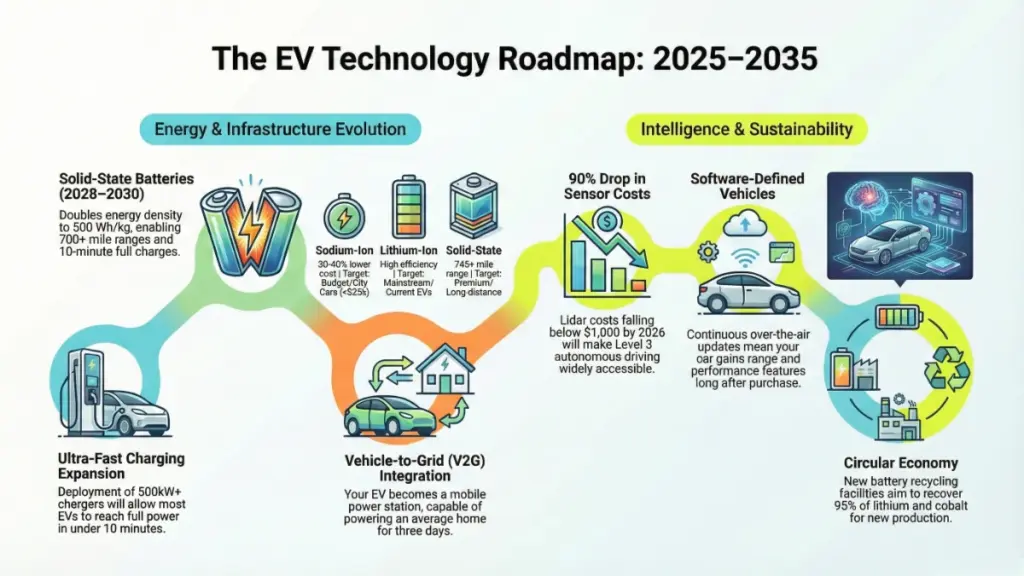
This is where things get exciting. Solid-state batteries replace the liquid electrolyte in current batteries with a solid material, solving several problems simultaneously. Toyota, QuantumScape, and Solid Power are leading the charge here, and their roadmaps suggest we’re closer than you might think.
Expected timeline and benefits:
- 2026-2027: First limited production vehicles with solid-state batteries (likely luxury models)
- 2028-2030: Broader market availability in premium EVs
- 2030-2035: Mainstream adoption across multiple price points
What makes solid-state batteries revolutionary?
- Double the energy density: 400-500 Wh/kg compared to today’s 250-300 Wh/kg
- 10-minute full charges: Solid electrolytes can handle much higher charge rates
- Improved safety: Solid electrolytes are non-flammable, reducing fire risk
- Longer lifespan: Potentially 1 million+ miles before significant degradation
- Better cold weather performance: Less capacity loss in freezing temperatures
Toyota has publicly committed to solid-state EVs by 2027-2028, with a claimed range of 745 miles and a 10-minute charge time. That’s not science fiction—that’s on the official roadmap.
Sodium-Ion and Alternative Chemistries
Not every advancement needs to be a moonshot. Sodium-ion batteries are emerging as a practical, cost-effective alternative for specific use cases, particularly in affordable EVs and stationary storage.
Why sodium-ion matters:
- Abundant materials: Sodium is everywhere; no supply chain concerns like cobalt
- Lower cost: Projected 30-40% cheaper than lithium-ion
- Better safety profile: Less prone to thermal runaway
- Perfect for city cars: Adequate for 150-200 mile range vehicles at lower price points
CATL has already begun mass production of sodium-ion batteries in 2024, and BYD is incorporating them into budget-friendly models. Expect to see these in entry-level EVs by 2026, potentially enabling truly affordable electric cars under $25,000.
Charging Infrastructure: Speed, Convenience, and Ubiquity
A better battery is only half the equation. Charging infrastructure is evolving just as dramatically, and the roadmap here might surprise you with how quickly things are progressing.
Ultra-Fast Charging: Breaking the 10-Minute Barrier
Remember when a 50kW charger seemed fast? The industry has blown past those numbers, and the acceleration isn’t slowing down.
Current state (2025):
- 350kW chargers are becoming common along highways
- Most modern EVs can charge 20-80% in 18-25 minutes
- Networks like Electrify America and Tesla Superchargers continue expanding
Near-term roadmap (2026-2028):
- 500kW+ chargers: Already being deployed in pilot programs
- 800V+ vehicle architectures: Enabling even faster charging (Hyundai Ioniq 6, Kia EV6, Porsche Taycan lead here)
- 10-minute full charges: Achievable with next-gen battery chemistry and cooling systems
- Plug-and-charge authentication: No more apps or cards—just plug in and go
Long-term vision (2029-2035):
- Megawatt charging for commercial vehicles: Semi-trucks charging in under 30 minutes
- Wireless charging lanes: Inductive charging while driving on equipped highways (several pilot programs already underway)
- Automated charging for autonomous vehicles: Your robotaxi charges itself
The International Energy Agency reports that public charging points worldwide exceeded 2.7 million in 2024, with that number expected to quintuple by 2030. That’s not gradual growth—that’s explosive infrastructure build-out.
Bidirectional Charging and Vehicle-to-Grid (V2G)
Here’s a capability that could fundamentally change how you think about your EV: what if your car wasn’t just a vehicle, but a mobile power station?
What V2G technology enables:
- Home backup power: Use your EV’s 75-100 kWh battery to power your house during outages
- Grid stabilization: Utilities pay you to draw power during peak demand
- Energy arbitrage: Charge when electricity is cheap, sell back when it’s expensive
- Renewable integration: Store excess solar/wind power in your car
Roadmap timeline:
- 2025-2026: More EVs ship with bidirectional charging hardware (Ford F-150 Lightning and VW ID.4 already offer this)
- 2027-2028: Utility programs become widely available in most states
- 2028-2030: Vehicle-to-home (V2H) becomes standard on most EVs
- Post-2030: Fully integrated V2G with automated energy trading
Ford estimates that the F-150 Lightning’s battery can power an average home for three days during an outage. Now imagine millions of EVs creating a distributed energy storage network—that’s the vision driving this technology.
Autonomous Driving Integration: EVs and Self-Driving Technology
Electric vehicles and autonomous driving technology are converging faster than most people realize. The two technologies are natural partners, and the roadmap shows them becoming increasingly intertwined.
Why EVs Are Perfect for Autonomy
Think about it: electric powertrains offer precise, computer-controlled acceleration and regenerative braking—exactly what self-driving systems need for smooth operation. Plus, EVs generate abundant electrical power for the sensors, cameras, and computing hardware that autonomous systems require.
Current autonomous capabilities in EVs (2025):
- Level 2+ systems: Tesla Autopilot, GM Super Cruise, Ford BlueCruise offer hands-free highway driving
- Advanced parking: Automated parking in tight spaces, remote summoning
- Traffic jam assist: Stop-and-go automation in congested traffic
Near-term roadmap (2026-2028):
- Level 3 autonomy: Hands-off, eyes-off driving in specific conditions (already legal in some states)
- Expanded operational domains: More roads, weather conditions, and scenarios where automation works
- Over-the-air improvements: Your car gets smarter with software updates
- Robotaxi services expand: Waymo, Cruise, and Tesla robotaxis in major cities
Long-term vision (2029-2035):
- Level 4 autonomy widespread: Full self-driving in defined geographic areas
- Shared autonomous EV fleets: Reduce vehicle ownership needs in urban areas
- Purpose-built autonomous EVs: Vehicles designed without traditional controls
Mercedes-Benz already offers Level 3 autonomy in the EQS sedan in certain conditions, and their roadmap suggests Level 4 capabilities in production vehicles by 2028. Tesla continues pushing toward “Full Self-Driving,” though regulatory approval remains the wildcard.
The Sensor and Computing Roadmap
Autonomous driving requires massive computing power and sophisticated sensors. Here’s how that technology is evolving:
Sensor evolution:
- Lidar costs dropping 90%: From $75,000 in 2017 to under $1,000 by 2026
- 4D imaging radar: Sees through weather conditions that challenge cameras
- AI-powered camera systems: Tesla’s vision-only approach getting smarter
- Sensor fusion: Combining multiple sensor types for redundancy and accuracy
Computing power increases:
- Current systems: 100-250 TOPS (trillion operations per second)
- 2026-2027: 500-1,000 TOPS with next-gen chips
- 2028-2030: 2,000+ TOPS enabling Level 4/5 autonomy
NVIDIA’s Drive Thor platform, launching in vehicles by 2025-2026, will deliver 2,000 TOPS while using less power than previous generations. That’s the kind of computational leap that makes truly autonomous EVs possible.
Manufacturing and Materials Innovation
The way we build electric vehicles is changing just as dramatically as the vehicles themselves. Manufacturing innovations are crucial for making EVs affordable, sustainable, and available at scale.
Gigafactories and Production Scaling
The battery factory building boom is unprecedented in automotive history. Understanding this roadmap helps explain why EV prices are dropping and availability is increasing.
Current production capacity (2025):
- Global battery production: Approximately 1,500 GWh annually
- Enough for roughly 20-25 million EVs per year
Projected capacity growth:
- 2028: 4,000+ GWh capacity (supporting 50+ million EVs annually)
- 2030: 6,000+ GWh capacity (meeting projected demand)
- Post-2030: Capacity continues expanding toward 100% EV sales
Major investments include:
- Tesla’s multiple Gigafactories (Texas, Berlin, Shanghai, plus planned facilities)
- CATL’s massive expansion in China and Europe
- LG Energy Solution and Samsung SDI facilities in the US and Europe
- Panasonic’s Kansas and Nevada expansions
This isn’t just about volume—it’s about learning curves. Every doubling of production historically reduces costs by 18-28%, which is why industry experts confidently predict EVs reaching price parity with gas cars by 2026-2027.
Sustainable Materials and Circular Economy
Here’s something that doesn’t get enough attention: the EV industry is pioneering circular economy approaches that could transform manufacturing broadly.
Materials innovation roadmap:
- Reduced rare earth usage: New motor designs requiring 50-90% less neodymium by 2027
- Cobalt-free batteries: LFP and upcoming chemistries eliminating cobalt dependence
- Recycled materials: BMW targeting 50% recycled content in new EVs by 2030
- Battery recycling at scale: 95%+ recovery of lithium, nickel, and cobalt from old batteries
Why this matters:
- Supply chain resilience: Less dependence on specific mining regions
- Environmental impact: Recycled materials require 90% less energy than virgin mining
- Cost reduction: Recycled battery materials becoming cost-competitive by 2027
- Sustainability credentials: Meeting consumer demand for responsible production
Redwood Materials, founded by Tesla’s former CTO, is building massive battery recycling facilities with the goal of producing enough recycled materials for 1 million EVs annually by 2025, scaling to 5 million by 2030. That’s a closed-loop system emerging in real-time.
Software and Connectivity: The Over-the-Air Revolution
Modern EVs are fundamentally software-defined vehicles, and this is where the roadmap gets particularly interesting. Your car will improve over time rather than depreciate in capability—a complete reversal of traditional automotive ownership.
Over-the-Air Updates and Continuous Improvement
Tesla proved this concept, but now nearly every manufacturer is following suit. Here’s what the roadmap looks like:
Current capabilities (2025):
- Bug fixes and minor feature additions
- Some performance improvements (faster acceleration, improved efficiency)
- Infotainment updates and new features
- Partial autonomous driving improvements
Near-term evolution (2026-2028):
- Major feature additions: New driving modes, significant range improvements
- Performance upgrades: Paid upgrades unlocking additional power
- Personalization: AI learning your preferences and adapting the vehicle
- Predictive maintenance: The car schedules service before problems occur
Long-term vision (2029-2035):
- Autonomous capability improvements: Level 2 vehicles upgraded to Level 3 or higher
- Subscription features: Unlock capabilities temporarily or permanently
- Cross-manufacturer platforms: Industry-standard software architectures
- App ecosystems: Third-party developers creating vehicle apps
Imagine buying an EV in 2025 that gains 20 miles of range, faster charging, and improved autonomous features over its lifetime—all through software updates. That’s not hypothetical; Teslas have already demonstrated this. Rivian added nearly 25 miles of range to existing R1T trucks through a software update in 2023.
Connected Vehicle Services
Your EV won’t just be connected—it’ll be intelligent, predictive, and integrated into your digital life in ways current cars aren’t.
Emerging connected services:
- Predictive routing: AI finding the optimal route considering traffic, charging, and weather
- Energy management: Coordinating with your home solar system and utility rates
- Remote diagnostics: Problems identified and often fixed before you notice
- Integrated digital ecosystem: Seamless connection with your smartphone, smart home, and calendar
- Fleet learning: Your car learns from millions of other vehicles’ experiences
Mercedes-Benz is introducing a “Superscreen” infotainment system with AI assistance that learns your habits and makes contextual suggestions. BMW’s next-generation iDrive system will use eye-tracking and gesture control alongside voice commands. These aren’t gimmicks—they’re fundamentally rethinking vehicle interfaces for the electric era.
The Reality Check: Challenges on the Roadmap
Let’s be real—not everything on the technology roadmap is guaranteed to arrive on schedule. Understanding the challenges helps you make smarter decisions about when to buy.
Supply Chain and Materials Constraints
The elephant in the room is whether we can actually source enough materials to build all these batteries.
Current bottlenecks:
- Lithium supply tight through 2026-2027
- Nickel and cobalt mining lagging demand
- Processing capacity concentrated in China (70%+ of battery cell production)
Roadmap solutions:
- New lithium mines coming online in Australia, Chile, and the US by 2026-2027
- Diversification of processing capacity to Europe and North America
- Reduced reliance on specific materials through chemistry changes
- Increased recycling providing secondary supply by 2028
The International Energy Agency estimates we need 6x more lithium, 7x more cobalt, and 25x more graphite by 2030 compared to 2020 levels. Mining and processing timelines are long, making this a genuine constraint that could slow the roadmap.
Infrastructure Investment Gaps
Building charging infrastructure requires massive capital investment, and not all regions are keeping pace.
Geographic disparities:
- Urban areas: Well-served and improving rapidly
- Highways: Getting better, especially major corridors
- Rural areas: Lagging significantly behind
- Apartment buildings: Slow installation of charging equipment
The US Infrastructure Bill allocated $7.5 billion for charging networks, but experts estimate we need $50+ billion to truly build out comprehensive national infrastructure by 2030. That gap creates uncertainty about roadmap timing.
Regulatory Uncertainty
Government policies can accelerate or slow EV adoption dramatically, and they’re constantly shifting.
Policy wildcard factors:
- Federal tax credits and incentives (subject to political changes)
- State-level ZEV mandates (California, New York, others planning 2035 gas car bans)
- Tariffs on imported batteries and vehicles
- Grid upgrade requirements and utility regulations
The European Union’s 2035 ban on new internal combustion vehicle sales creates regulatory certainty there, while US federal policy remains more volatile. These regulatory decisions will ultimately determine how quickly the technology roadmap translates into real-world deployment.
What This Roadmap Means for Buyers: Timing Your Purchase
Here’s the practical question: should you buy an EV now or wait for the next big breakthrough?
Buy Now If:
- You primarily drive short to medium distances (under 250 miles): Current EVs already excel here
- You can charge at home: Level 2 home charging eliminates most inconvenience
- You value federal tax credits: Current incentives (up to $7,500) might not last forever
- You want to avoid gas price volatility: Lock in lower “fuel” costs immediately
- Current EV range meets your needs: A 300-mile EV today will still be useful in 2035
Current EVs are genuinely good vehicles, not just “good enough until something better arrives.” A 2025 EV will likely give you 200,000+ miles of service, making the technology roadmap less critical than you might think.
Consider Waiting If:
- You regularly drive 400+ miles without stopping: Solid-state batteries (2027-2030) will make this dramatically easier
- You can’t charge at home and local infrastructure is sparse: Wait 2-3 years for better public charging
- You’re waiting for a specific model: Many manufacturers launching new EVs in 2026-2027
- Budget is tight: Prices will continue dropping 5-10% annually through 2027
- You need towing capability for 300+ miles: Battery technology and charging infrastructure need another 2-3 years here
That said, waiting for perfection means you’re burning gas (and money) in the meantime. Run the numbers on your specific situation.
The Sweet Spot Strategy
Here’s my honest take: for most people, the best approach is buying what meets your needs today while understanding you’re getting a vehicle that will improve over time through software updates and an expanding charging network.
Practical recommendations:
- Buy for your current needs, not future possibilities: If a 250-mile EV works for 95% of your driving, don’t wait for 500-mile solid-state batteries
- Choose brands committed to OTA updates: Your car will get better over time
- Prioritize home charging capability: This matters more than any future technology
- Consider your replacement timeline: If you keep cars 7-10 years, today’s EV will serve you well through that entire period
The technology roadmap is exciting, but today’s EVs are already incredibly capable. Don’t let the perfect be the enemy of the good enough.
Looking Beyond 2035: The Long-Term Vision
While we’ve focused on the next decade, it’s worth glimpsing what comes next to understand where this is all heading.
Energy Ecosystem Integration
By 2035 and beyond, your EV won’t just be a vehicle—it’ll be an integral part of a distributed energy system:
- Mobile power plants: Millions of EVs providing grid storage and stabilization
- Renewable integration: Vehicles absorbing excess solar and wind power
- Peer-to-peer energy trading: Selling power from your car to your neighbors
- Emergency response: EV fleets providing disaster relief power
Material Science Breakthroughs
The roadmap beyond 2035 includes even more radical battery innovations:
- Lithium-air batteries: Theoretical energy density approaching gasoline
- Aluminum-ion batteries: Faster charging, longer lifespan, abundant materials
- Structural batteries: Car body components that store energy
- Quantum batteries: Still theoretical, but potentially revolutionary
Transportation as a Service
The combination of EVs, autonomy, and connectivity points toward a future where vehicle ownership may become optional:
- Robotaxi networks: Autonomous EVs available on-demand for pennies per mile
- Specialized vehicles: Right-sized autonomous EVs for specific trips
- Reduced urban parking: Cars constantly in use rather than parked 95% of the time
- Rural autonomous transit: Self-driving EVs bringing mobility to underserved areas
This isn’t science fiction—pilot programs already exist in San Francisco, Phoenix, and other cities. The roadmap suggests this becomes mainstream in urban areas by the mid-2030s.
Key Takeaways: Navigating the EV Technology Roadmap
Let’s bring this all together with the essential insights you need to remember:
Battery technology is advancing rapidly: Expect significant improvements in range, charging speed, and cost over the next 5 years, with solid-state batteries arriving in production vehicles by 2027-2028.
Charging infrastructure is scaling fast: The “charging anxiety” that was valid in 2020 is becoming less relevant each month, with the roadmap showing 10-minute charges and ubiquitous charging by 2030.
Software updates will keep your EV improving: Unlike gas cars that depreciate in capability, modern EVs gain features over time, making early adoption less risky than it appears.
Don’t wait for perfection: Today’s EVs are genuinely good vehicles that will serve most drivers well for their entire ownership period. Waiting means missing years of gas savings and better driving experience.
Regional variations matter: The roadmap assumes continued infrastructure investment and supportive policies. Research your specific region’s charging network and incentives before buying.
The convergence is real: EVs, autonomy, and connectivity are merging into something fundamentally different from traditional cars. Understanding this helps you appreciate why EVs represent a paradigm shift, not just a fuel change.
The electric vehicle technology roadmap isn’t a straight line—it’s full of competing approaches, potential breakthroughs, and inevitable delays. But the direction is clear: EVs are getting better fast, charging is getting easier, and the supporting infrastructure is scaling dramatically. Whether you buy today or wait a few years, you’re entering a transportation revolution that’s just getting started.
The question isn’t whether to go electric—it’s when and which EV fits your life right now. Armed with this roadmap, you can make that decision with confidence.