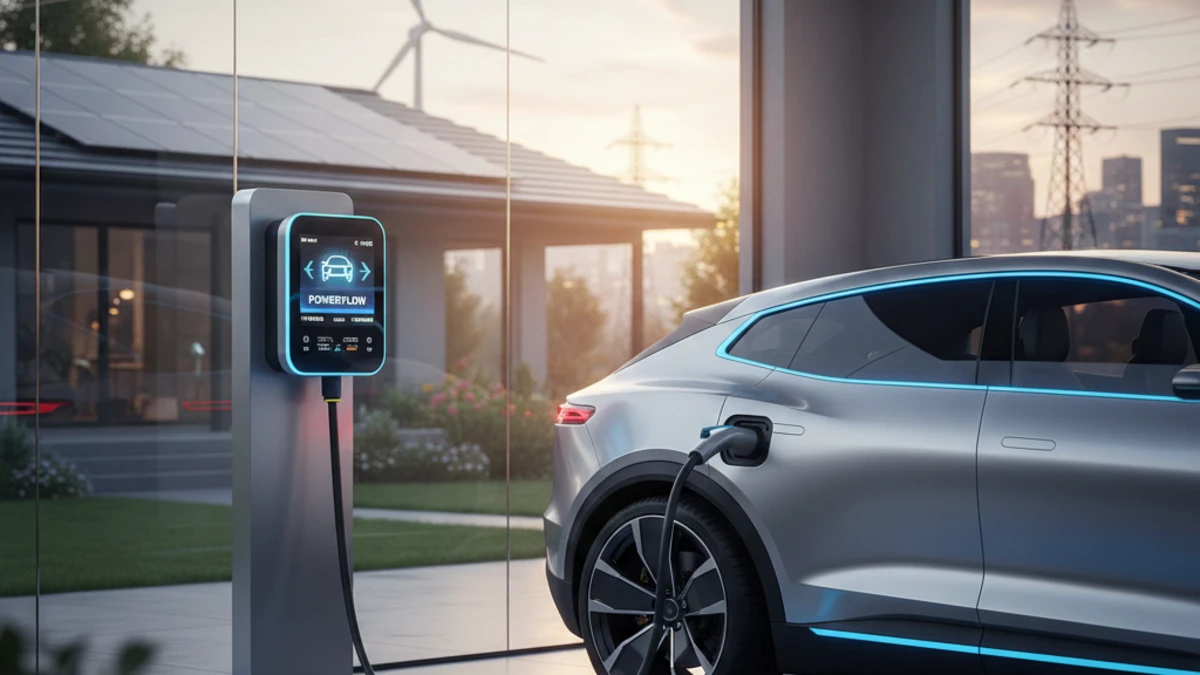
Imagine your electric car doing more than just getting you from point A to point B. What if it could power your home during a blackout? Or even help stabilize the entire electrical grid? That’s not science fiction anymore.
Vehicle-to-Grid (V2G) technology is transforming electric vehicles from simple transportation tools into dynamic energy assets. These vehicles can send power back to the grid, support renewable energy integration, and potentially save you money on your electricity bill.
In this article, you’ll discover how V2G technology works and which electric vehicles currently support it. You’ll learn about the real-world benefits and challenges. And you’ll understand what this emerging technology means for the future of energy management. Whether you’re an EV owner curious about maximizing your vehicle’s potential or someone interested in sustainable energy solutions, understanding V2G could change how you think about your car’s battery pack.
What Is Vehicle-to-Grid (V2G) Technology?
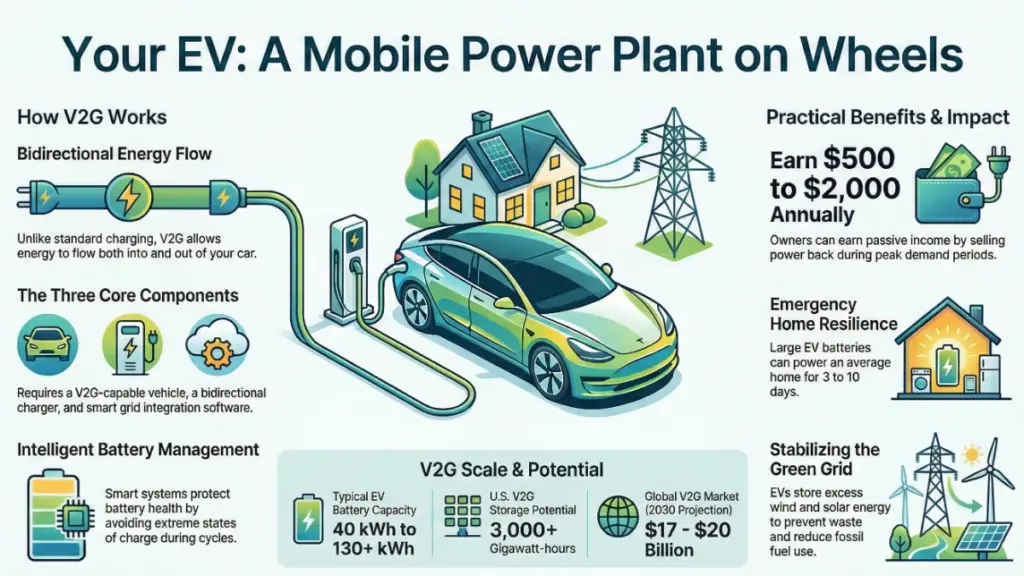
Vehicle-to-Grid technology enables bidirectional energy flow between your electric vehicle and the power grid. Traditional charging only moves electricity one way—from the grid to your car. V2G allows your EV’s battery to discharge stored energy back into the grid when needed.
Think of your electric car as a mobile battery bank on wheels. Modern EVs like the Ford F-150 Lightning contain battery packs ranging from 40 kWh to over 130 kWh. That’s enough to power an average American home for 2-10 days. V2G technology taps into this massive storage capacity, turning millions of parked vehicles into a distributed energy resource.
How V2G Works in Practice
When you plug your V2G-capable EV into a compatible bidirectional charger, sophisticated software monitors grid conditions and electricity prices. During peak demand periods, electricity is expensive and the grid is stressed. Your car can automatically send power back to the grid.
Off-peak hours bring cheap and abundant electricity. This often happens when wind and solar production is high. Your car recharges during these times. You set parameters to ensure your vehicle always maintains enough charge for your driving needs.
The technology requires three key components:
- A V2G-capable electric vehicle with bidirectional charging hardware
- A bidirectional charger (also called a two-way charger) installed at your location
- Grid integration software that manages energy flow and communicates with utility companies
Current Market Status
As of early 2025, V2G technology is moving from pilot programs to real-world deployment. The Nissan Leaf has supported V2G capabilities since 2013 in certain markets. Newer models are joining the V2G-ready lineup, including the Ford F-150 Lightning, Volkswagen ID.4, and Hyundai Ioniq 5 and 6.
However, widespread adoption still faces regulatory, technical, and infrastructure hurdles that we’ll explore later in the article.
The Practical Benefits of V2G Technology
Grid Stabilization and Renewable Energy Integration
One of V2G’s most compelling benefits addresses a critical challenge in our transition to renewable energy: intermittency. Solar panels don’t generate power at night. Wind turbines stop when the air is calm.
V2G-enabled vehicles create a massive, distributed battery network. This network can store excess renewable energy when production is high and release that energy when needed.
A Real-World Scenario
Consider this scenario: On a sunny, windy afternoon, California’s grid might generate more renewable energy than it can immediately use. Instead of curtailing (wasting) that clean energy, it flows into thousands of parked EVs throughout the state.
Later that evening, people come home and turn on air conditioning. Solar production drops to zero. Those same vehicles feed power back to the grid, preventing the need to fire up fossil fuel “peaker” plants.
The National Impact
According to recent modeling by the National Renewable Energy Laboratory, the potential is enormous. If just 30% of light-duty vehicles in the U.S. were V2G-capable EVs, they could provide over 3,000 gigawatt-hours of mobile storage. That’s more than five times the current grid-scale battery storage capacity nationwide.
Financial Benefits for EV Owners
V2G technology opens several revenue streams for electric vehicle owners willing to participate in grid services.
Energy Arbitrage Opportunities
You charge your vehicle when electricity rates are low. This typically happens overnight or during high renewable production periods. Discharging back to the grid when rates are high, usually during early evening peak demand, creates profit opportunities.
Depending on your local rate structure and participation level, early V2G pilot programs have shown earnings potential of $500-$1,500 per vehicle annually.
Demand Response Payments
Utilities will pay you to be “on call” with your vehicle’s battery. You remain ready to provide power during grid emergencies or peak demand events. Capacity payments provide steady income even when your vehicle isn’t actively discharging.
Frequency Regulation Services
The grid must constantly balance supply and demand to maintain a stable 60 Hz frequency. Your EV can make tiny adjustments—charging slightly faster or slower, or discharging small amounts to help maintain grid balance.
While individual transactions are small, they happen continuously and can add up.
Real-World Example
The University of California San Diego operates one of North America’s largest V2G programs with over 50 electric vehicles. Participants reported earning between $1,000-$2,000 annually per vehicle while helping the campus microgrid operate more efficiently.
Emergency Backup Power and Energy Resilience
Beyond grid services, V2G-capable vehicles can serve as emergency backup power sources during outages. Vehicle-to-home (V2H) or vehicle-to-load (V2L) capabilities enable this function. This benefit is becoming increasingly valuable as climate change intensifies extreme weather events.
Home Backup Capabilities
The Ford F-150 Lightning can power an average home for up to three days on a full charge. With careful rationing, it can last up to ten days. During the 2021 Texas winter storm, millions were left without power. EV owners with backup capabilities kept their homes warm and refrigerators running while neighbors suffered through the blackout.
Beyond Weather Emergencies
This resilience extends beyond weather emergencies. In California, planned Public Safety Power Shutoffs (PSPS) are becoming routine during wildfire season. V2G-capable vehicles offer peace of mind and practical solutions for maintaining power to critical home systems.
Technical Considerations and Current Limitations
Battery Degradation Concerns
The most common question EV owners ask about V2G is whether all this extra charging and discharging will prematurely wear out their battery. It’s a legitimate concern—battery degradation is real, and replacement costs remain high.
Recent research provides reassuring news, however. A 2024 study from Warwick University found that V2G operations caused minimal additional degradation when properly managed. The degradation was comparable to regular charging patterns.
Smart Battery Management
The key lies in smart battery management systems that:
- Avoid extreme states of charge (keeping batteries between 20-80% rather than fully cycling them)
- Limit charging/discharging rates to reduce thermal stress
- Optimize charging patterns based on battery temperature and age
- Use shallow discharge cycles rather than deep ones
Modern Battery Durability
Modern EV batteries are remarkably durable. Most manufacturers warranty their batteries for 8-10 years or 100,000-150,000 miles, guaranteeing at least 70% capacity retention. In practice, many batteries exceed these expectations.
Tesla Model S vehicles with over 200,000 miles often retain 85-90% of their original capacity.
The bottom line: With intelligent management systems, V2G operations add minimal wear compared to the natural degradation that occurs simply from time and regular use. Some studies even suggest that keeping batteries active with smart V2G cycling might be healthier than letting them sit unused for extended periods.
Infrastructure and Compatibility Challenges
The V2G ecosystem still faces significant infrastructure hurdles that limit widespread adoption.
Bidirectional Charger Availability
Standard Level 2 chargers cost $500-$1,500 installed. Bidirectional chargers capable of V2G currently cost $3,000-$7,000 or more. These specialized units must meet stringent safety and grid interconnection standards, adding complexity and expense.
Prices are dropping as production scales up, however. Early 2025 has seen new models enter the market at under $2,500.
Vehicle Compatibility
Not all electric vehicles support bidirectional charging, even as a theoretical capability. The technology requires specific hardware in the vehicle’s charging system and compatible battery management software.
As of early 2025, V2G-capable EVs include:
- Nissan Leaf (select model years and markets)
- Ford F-150 Lightning
- Ford Mustang Mach-E (select trims with available home integration system)
- Volkswagen ID.4, ID.5, and ID. Buzz (in markets with V2G support)
- Hyundai Ioniq 5 and 6
- Kia EV6
- Select Chinese market EVs from BYD, NIO, and others
Many popular EVs currently lack V2G capability, including most Teslas. This is changing, however. Tesla has announced plans to enable bidirectional charging in future vehicles and through software updates for compatible existing models.
Charging Standard Fragmentation
The automotive industry uses multiple charging standards, and not all support bidirectional power flow equally well. The CHAdeMO standard has included V2G specifications since its inception.
CCS (Combined Charging System) and the North American Charging Standard (NACS, formerly Tesla’s standard) have taken longer to fully integrate bidirectional capabilities. This fragmentation complicates charger development and vehicle-to-grid interoperability.
Regulatory and Utility Barriers
Perhaps the biggest obstacles to V2G adoption aren’t technical but regulatory. The electric utility industry operates under complex regulations that vary by state and utility territory. Many existing rules weren’t written with V2G in mind.
Interconnection Requirements
Connecting a distributed energy resource to the grid requires approval from your utility company. Your V2G-capable EV becomes exactly that—a distributed energy resource.
Some utilities have streamlined this process. Others require extensive paperwork, engineering reviews, and safety inspections that can take months and cost hundreds to thousands of dollars.
Net Metering and Compensation Structures
How much should utilities pay for electricity from your EV? Some jurisdictions apply net metering rules, crediting you at retail electricity rates. Others offer wholesale rates that are significantly lower. The lack of standardized compensation frameworks creates uncertainty for potential V2G participants.
Liability and Insurance Questions
Who’s responsible if something goes wrong? If your vehicle causes a grid disturbance, liability becomes murky. If a grid event damages your battery, the same questions arise.
Insurance companies are still developing products to cover these scenarios. Many homeowners’ policies don’t explicitly address V2G operations.
Metering and Billing Complexity
Traditional utility billing assumes one-way power flow. V2G requires sophisticated bi-directional metering and billing systems that can track energy flows in both directions, apply time-of-use rates correctly, and account for efficiency losses.
Not all utilities have upgraded their systems to handle this complexity.
Regulatory Progress
The good news? Regulatory frameworks are evolving. California’s CPUC issued guidelines in 2024 streamlining V2G interconnection. Several other states are following suit. As V2G becomes more common, expect regulations to adapt and simplify participation.
Real-World V2G Programs and Success Stories
Commercial and Fleet Applications Leading the Way
While residential V2G adoption remains limited, commercial fleets are embracing the technology and demonstrating its viability. Fleet applications often make the most economic sense because vehicles spend predictable hours parked at central locations, making grid integration simpler.
School Bus Fleets
School bus fleets represent one of the most promising V2G opportunities. School buses typically operate only a few hours daily, sitting idle the rest of the time—perfect for grid services.
A single electric school bus with a 200+ kWh battery can provide substantial grid support. When 50 or 100 buses are aggregated together, the impact multiplies.
Highland Electric Fleets Case Study
Highland Electric Fleets is a leading electric school bus operator that has deployed V2G-enabled buses across multiple states. Their buses charge overnight when electricity is cheapest and cleanest, then provide grid services during peak afternoon hours when the buses are parked and fully charged.
The company estimates earning $2,000-$4,000 per bus annually from grid services, significantly offsetting operational costs.
Corporate Fleets
Corporate fleets are also moving forward. In the UK, Octopus Energy partnered with Nissan to offer V2G services to Leaf owners. Over 1,000 vehicles were participating by early 2025. Participants reported saving an average of £725 annually on energy costs while supporting grid stability.
Pilot Programs Demonstrating Home V2G Viability
Several utilities and automotive manufacturers are running residential V2G pilot programs that provide valuable real-world data.
Ford Intelligent Backup Power
Ford partnered with Sunrun to offer F-150 Lightning owners the ability to use their trucks as home backup power sources. The program is primarily vehicle-to-home (V2H) rather than full V2G, but it demonstrates consumer interest in bidirectional charging.
Over 50,000 F-150 Lightning owners had enrolled in related programs by late 2024.
California’s V2G Initiative
California’s Self-Generation Incentive Program (SGIP) offers rebates of up to $1,000 per kilowatt for bidirectional charging equipment. This makes V2G more accessible to residential customers.
Early results show high satisfaction among participants, with most earning $30-$80 monthly from grid services.
European Programs
Countries like Denmark, the Netherlands, and Germany have been V2G leaders. Denmark’s Parker project demonstrated that V2G can provide profitable grid services while maintaining vehicle availability for users.
Participants earned approximately €500-€1,000 annually per vehicle while reducing grid stress during peak periods.
Key Findings
These programs consistently show similar results. When properly implemented with user-friendly interfaces and fair compensation, V2G delivers value to participants, utilities, and the broader grid.
The Future of V2G: What’s Coming Next
Technological Advancements on the Horizon
V2G technology is rapidly evolving, with several developments poised to accelerate adoption.
Improved Battery Longevity
Next-generation battery chemistries promise longer lifespans with minimal degradation. Solid-state batteries expected in production vehicles by 2026-2027 will handle intensive cycling exceptionally well, making V2G operations even less concerning for vehicle owners.
Wireless Bidirectional Charging
Several companies are developing wireless V2G charging pads that eliminate cables entirely. Simply parking over a pad would enable automatic bidirectional energy flow based on your preferences and grid needs.
Expect to see these systems in commercial deployments by 2026, with residential availability following shortly after.
AI-Powered Optimization
Artificial intelligence and machine learning are being integrated into V2G management systems. These systems learn your driving patterns and predict your energy needs. They optimize charging/discharging cycles to maximize your financial returns while ensuring your car is always ready when you need it.
Vehicle-to-Everything (V2X)
Beyond just grid and home applications, future EVs will support even more capabilities. These include vehicle-to-vehicle (V2V), vehicle-to-building (V2B), and vehicle-to-device functionality.
Your EV could charge your e-bike, power construction equipment on a job site, or keep your camping equipment running on a weekend getaway.
Market Growth Projections
Industry analysts project explosive growth in V2G technology over the next decade. According to recent forecasts:
- The global V2G market was valued at approximately $3.5 billion in 2024 and is expected to reach $17-20 billion by 2030
- V2G-capable EV sales are projected to grow from roughly 500,000 vehicles in 2024 to over 8 million annually by 2030
- Bidirectional charger installations are expected to increase tenfold between 2025 and 2028 as costs decline and awareness grows
Growth Drivers
This growth will be driven by several factors, including increasing EV adoption overall, regulatory mandates in certain markets requiring V2G capability, falling equipment costs, and growing consumer awareness of the technology’s benefits.
Policy and Regulatory Evolution
Governments worldwide are recognizing V2G’s potential to support grid decarbonization and resilience. Several policy trends are emerging.
Standardization Efforts
International standards bodies are working to harmonize V2G technical specifications, making it easier for manufacturers to design vehicles and chargers that work everywhere.
Incentive Programs
Following California’s lead, more states and countries are offering rebates, tax credits, and other financial incentives for V2G-capable vehicles and bidirectional charging equipment.
Grid Service Market Access
Regulatory changes are opening energy markets to allow individual EV owners and small aggregators to participate in grid services. These services were previously limited to large utilities and independent power producers.
Building Codes
Some jurisdictions are beginning to require V2G-ready electrical infrastructure in new construction. This lowers future installation costs and encourages adoption.
Is V2G Right for You?
Who Benefits Most from V2G Technology?
V2G isn’t equally beneficial for everyone. You’re likely to gain the most from V2G if you meet certain criteria.
You Have Predictable Driving Patterns
If your daily commute is consistent, you can accurately predict your charging needs. You’ll feel comfortable allowing your vehicle to participate in grid services without worrying about being stranded.
You Park at Home Regularly
V2G requires a bidirectional charger installation, which typically happens at your residence. Apartment dwellers or those who rely primarily on public charging face significant challenges implementing V2G.
You Live in Areas With Time-of-Use Electricity Rates
The financial benefits of V2G multiply when electricity prices vary significantly throughout the day. States like California with dramatic peak/off-peak rate differences offer better earning potential than areas with flat rates.
You Experience Frequent Power Outages
Do you live in an area prone to grid outages from extreme weather, wildfires, or aging infrastructure? The backup power capability of V2G-equipped vehicles provides valuable resilience.
You Own a Larger-Battery EV
Vehicles with 70+ kWh batteries have more capacity to share without compromising your driving range. If you drive a smaller EV with a 40 kWh battery and need most of that capacity for your commute, V2G participation becomes trickier.
You’re Comfortable With Technology
Current V2G systems require more technical setup and monitoring than simple plug-in-and-forget charging. If you enjoy optimizing systems and tracking your energy flows, you’ll appreciate V2G more than someone who wants a hands-off experience.
Questions to Ask Before Committing
Before investing in V2G capability, consider these important questions.
What Are the Upfront Costs?
Factor in the bidirectional charger cost ($3,000-$7,000), installation expenses ($500-$2,000), any utility interconnection fees, and upgraded electrical panel requirements if needed. Compare this to potential annual earnings to calculate your payback period.
What Does My Utility Offer?
Contact your electric utility to understand available V2G programs, compensation rates, interconnection requirements, and time-of-use rate structures. Some utilities actively encourage V2G, while others have no programs in place.
Will This Void My Vehicle Warranty?
Check your EV manufacturer’s warranty terms. Most modern EVs explicitly allow V2G operations, but some older vehicles or certain programs might have restrictions.
How Much Control Do I Maintain?
Ensure any V2G program you join allows you to set minimum state-of-charge thresholds and override grid demands when you need your vehicle. You should always have final say over your battery’s use.
What’s the Tax Situation?
Income from V2G services might be taxable. Consult a tax professional to understand reporting requirements and potential deductions for equipment costs.
Key Takeaways: The V2G Revolution Is Beginning
Vehicle-to-Grid technology represents a fundamental shift in how we think about electric vehicles. They’re no longer passive consumers of electricity but active participants in energy systems.
While widespread adoption still faces hurdles, the technology is moving from concept to reality faster than many experts predicted just a few years ago.
The Essential Points to Remember
V2G enables bidirectional energy flow. Your EV can supply power back to the grid, your home, or other devices.
Financial benefits are real but vary widely based on your location, utility programs, and participation level. Expect $500-$2,000 annually for residential users in favorable markets.
Battery degradation concerns are largely unfounded when V2G systems use proper management protocols.
Infrastructure and regulatory challenges remain the primary barriers to mass adoption, but these are actively being addressed.
Fleet and commercial applications are leading the way, proving V2G’s viability before widespread residential deployment.
The technology is rapidly evolving, with costs falling, capabilities expanding, and regulatory frameworks maturing.
Taking the Next Step
If you’re considering V2G participation, start by checking whether your current or planned EV supports bidirectional charging. Then contact your utility to learn about available programs.
Even if full V2G isn’t available in your area yet, many utilities offer demand response or time-of-use programs that can reduce your charging costs and prepare you for future V2G participation.
A Vision for the Future
The convergence of electric vehicles, renewable energy, and distributed grid resources is creating opportunities we couldn’t have imagined a decade ago. Your next electric car might not just be transportation—it could be your contribution to a cleaner, more resilient energy future.
Have questions about V2G technology or experiences to share? The technology is still new enough that user experiences and insights help shape its development. Stay informed, engage with your utility, and consider how your next EV purchase might do double duty as both transportation and energy asset.