Have you ever wondered what happens to an electric vehicle battery after it’s powered its last mile? With over 14 million EVs on roads worldwide in 2025 and projections reaching 300 million by 2030, we’re facing a critical question: how do we responsibly handle millions of spent lithium-ion batteries? The answer lies in innovative recycling processes that are transforming potential waste into valuable resources.
Here’s what might surprise you: an EV battery doesn’t simply “die” and head straight to a recycling facility. Instead, most batteries retain 70-80% of their original capacity even after automotive use, opening up exciting second-life applications. Furthermore, when recycling does happen, we’re recovering up to 95% of critical materials like lithium, cobalt, and nickel—creating a circular economy that reduces mining dependency and environmental impact.
In this comprehensive guide, you’ll discover how battery recycling actually works, why it’s becoming increasingly profitable, what happens during second-life applications, and how emerging technologies are revolutionizing resource recovery. Whether you’re an EV owner planning for the future, an investor eyeing the recycling market, or simply curious about sustainable technology, understanding this process is crucial to grasping the true environmental story of electric mobility.
Understanding EV Battery Lifespan and End-of-Life Scenarios
Before we dive into recycling, let’s clarify when and why EV batteries need replacement. Unlike your smartphone that might need a new battery after two years, electric vehicle batteries are engineered for longevity that often exceeds the vehicle’s operational life.
When Does an EV Battery Reach “End of Life”?
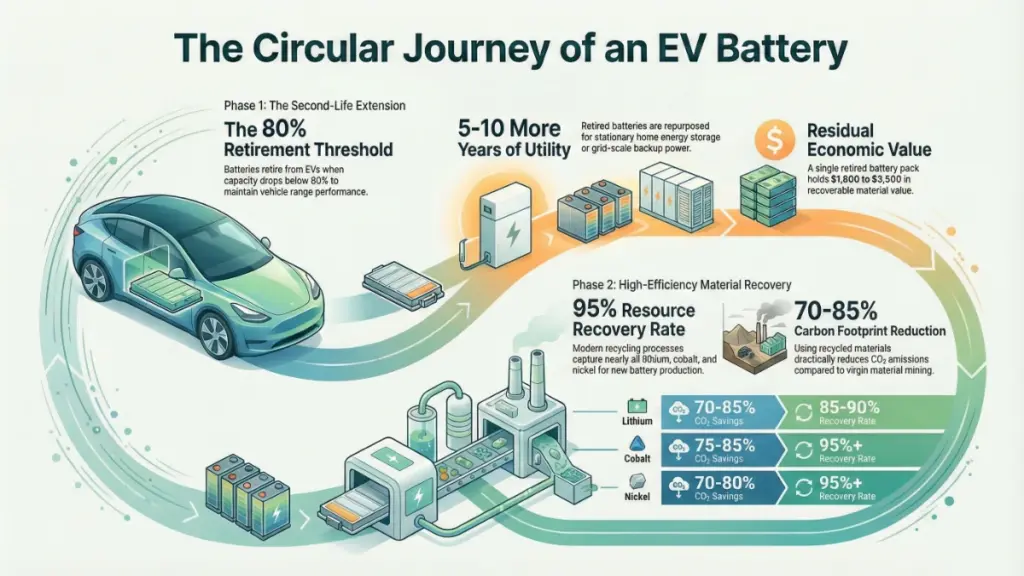
In the automotive industry, a battery is considered at end-of-life when it drops below 80% of its original capacity. Accordingly, this threshold typically represents the point where range anxiety becomes a real concern for drivers. For instance, a vehicle that once traveled 300 miles per charge might now achieve only 240 miles—still functional, but no longer meeting original performance expectations.
Generally speaking, most modern EV batteries reach this point after 8-15 years of use, depending on several factors:
- Charging habits: Frequent fast-charging accelerates degradation compared to regular Level 2 charging
- Climate conditions: Extreme heat or cold stress battery chemistry
- Depth of discharge: Regularly draining to near-zero impacts longevity
- Battery chemistry: LFP (lithium iron phosphate) batteries often outlast NMC (nickel manganese cobalt) variants
Meanwhile, manufacturers like Tesla, BMW, and Nissan typically warranty their batteries for 8 years or 100,000-150,000 miles, whichever comes first. In fact, real-world data from Tesla Model S vehicles shows battery degradation averaging only 12% after 200,000 miles—demonstrating these warranties are conservative estimates.
The Critical Distinction: Retirement vs. Recycling
Here’s where it gets interesting. When an EV battery drops below 80% capacity, it doesn’t immediately become waste. That “degraded” battery still holds 70-80% charge capacity—more than sufficient for less demanding applications. Consequently, this creates two distinct pathways:
Second-Life Applications (typically 5-10 additional years):
- Stationary energy storage for homes and businesses
- Grid-scale renewable energy storage
- Backup power systems
- Lower-demand electric vehicles (golf carts, forklifts)
Direct Recycling (when batteries are damaged, defective, or economically unviable for reuse):
- Recovery of raw materials
- Manufacturing new batteries
- Reducing dependency on virgin mining
Currently, industry estimates suggest only 25-30% of retired EV batteries proceed directly to recycling. In contrast, the majority enter second-life markets, maximizing resource utilization before eventual material recovery.
The Battery Recycling Process: From Collection to Resource Recovery
Once a battery reaches its true end-of-life—whether after automotive use or a second-life application—it enters a sophisticated recycling ecosystem. Therefore, let’s break down this multi-stage process.
Stage 1: Collection and Safety Assessment
Battery recycling begins with safe transportation and handling. Unlike aluminum cans or paper, lithium-ion batteries pose fire risks if damaged or improperly stored. As a result, recycling facilities follow strict protocols:
- Discharge verification: Batteries must be depleted to safe voltage levels (typically below 25% state of charge)
- Thermal monitoring: Temperature sensors prevent thermal runaway during storage
- Physical inspection: Identifying damaged cells that require special handling
- Documentation: Tracking battery chemistry, manufacturer, and condition
Notably, major automakers have established take-back programs. For example, Nissan partners with Redwood Materials to collect Leaf batteries across North America. Similarly, Tesla operates its own recycling loop at Gigafactory Nevada, processing batteries that never leave their ecosystem.
Stage 2: Disassembly and Component Separation
Modern EV battery packs aren’t monolithic blocks—they’re complex assemblies containing hundreds of individual cells, cooling systems, battery management electronics, and structural components. Accordingly, disassembly happens in phases:
Manual Disassembly:
- Removing the protective casing and structural housing
- Disconnecting battery management systems (BMS) and wiring harnesses
- Separating cooling systems (liquid or air-based)
- Sorting aluminum, steel, and plastic components for conventional recycling
Module-Level Processing:
- Breaking down battery modules into individual cell groups
- Identifying cell chemistry (critical for downstream processing)
- Sorting cells by condition and chemistry type
Importantly, this stage recovers approximately 20-25% of battery weight in non-cell materials—mostly aluminum and steel from casings, which enter standard metal recycling streams.
Stage 3: Cell Processing and Material Recovery
Here’s where the magic happens. Currently, three primary technologies compete in the marketplace, each with distinct advantages:
Pyrometallurgy (High-Temperature Smelting)
Think of this as the “blast furnace” approach. Essentially, batteries are heated to 1,400-1,500°C (2,550-2,730°F), melting everything into a molten alloy.
Recovery rates:
- Cobalt: 95%+
- Nickel: 95%+
- Copper: 95%+
- Lithium: Lost in slag (not recovered)
- Aluminum: Lost in slag
Pros: Simple, robust, handles mixed chemistries without pre-sorting Cons: Energy-intensive (requires fossil fuels), lithium loss, air emissions
For instance, companies like Umicore in Belgium and Glencore in Canada operate large pyrometallurgical facilities processing thousands of tons annually.
Hydrometallurgy (Chemical Leaching)
This method uses chemical solutions to selectively dissolve and extract metals. In other words, it’s like using different solvents to separate ingredients from a mixture.
Typically, the process involves:
- Mechanical shredding: Breaking cells into small fragments
- Leaching: Soaking in acids (sulfuric acid is common) to dissolve metals
- Precipitation: Adding chemicals that cause specific metals to solidify
- Purification: Filtering and refining individual elements
Recovery rates:
- Lithium: 85-90%
- Cobalt: 95%+
- Nickel: 95%+
- Manganese: 90%+
Pros: Recovers lithium effectively, lower energy consumption than pyrometallurgy, high purity outputs Cons: Chemical waste generation, longer processing time, requires chemistry-specific protocols
Notably, Redwood Materials, Li-Cycle, and Ascend Elements have scaled hydrometallurgical operations across North America, processing battery materials back to “battery-grade” quality suitable for new cell manufacturing.
Direct Recycling (The Emerging Game-Changer)
The newest approach aims to preserve the actual cathode and anode materials rather than breaking everything down to elemental form. In essence, imagine refurbishing worn parts instead of melting them down and starting over.
The process:
- Carefully disassemble cells without destroying internal structure
- Separate cathode and anode materials chemically or mechanically
- Refresh materials by reintroducing depleted lithium
- Reassemble materials into new electrodes
Potential recovery rates: 95%+ for all materials Energy savings: Up to 80% less energy than producing virgin cathode materials
Pros: Massively reduced energy consumption, preserves material structure, highest potential recovery rates Cons: Still largely experimental, requires precise chemistry matching, not yet proven at commercial scale
Currently, companies like Onto Technology, Princeton NuEnergy, and ReJoule are pioneering direct recycling, though commercial deployment remains limited in 2025.
The Economics of Battery Recycling: From Cost Center to Profit Center
For years, battery recycling was viewed as an environmental necessity with questionable economics. However, that narrative has fundamentally changed.
Why Recycling Is Becoming Profitable
Specifically, three factors have transformed the economics:
1. Material Value Surge
Battery-grade materials have experienced dramatic price appreciation:
- Lithium carbonate: From $6,000/ton (2020) to $25,000-35,000/ton (2024-2025)
- Cobalt: Consistently $30,000-40,000/ton due to supply concentration in the Democratic Republic of Congo
- Nickel: $18,000-25,000/ton with growing demand from battery sector
Moreover, a typical 75 kWh EV battery pack contains roughly:
- 8-12 kg of lithium
- 8-15 kg of cobalt (in NMC chemistries)
- 30-40 kg of nickel
- 30-40 kg of graphite
- Aluminum and copper in housings/connectors
At current prices, the recoverable material value in a single battery pack ranges from $1,500 to $3,500—often exceeding the cost of recycling.
2. Supply Chain Security Concerns
The geopolitical reality of battery materials is stark: China controls approximately 60% of global lithium refining, 80% of cobalt refining, and 70% of battery cell production. Consequently, Western nations view recycling as strategic infrastructure to reduce import dependency.
Additionally, the U.S. Inflation Reduction Act (2022) and similar European policies incentivize domestic recycling with tax credits and subsidies. Meeting “domestic content” requirements for EV tax credits increasingly requires recycled materials.
3. Environmental Regulations and Extended Producer Responsibility
The European Union’s Battery Regulation (effective 2024) mandates:
- Minimum recycled content: 12% cobalt, 4% lithium, 4% nickel by 2030
- Rising to 20% cobalt, 10% lithium, 12% nickel by 2035
- Collection and recycling rate targets: 65% by 2025, 70% by 2030
Similarly, China implemented “Extended Producer Responsibility” requirements, making automakers financially responsible for battery end-of-life management.
These regulations guarantee steady material streams to recyclers while creating compliance costs for non-participation.
Current Market Dynamics
The global EV battery recycling market was valued at approximately $8.5 billion in 2024 and projects to reach $35-40 billion by 2030 (McKinsey estimates). This explosive growth reflects:
- Increasing battery retirement volumes (following early EV adoption curves)
- Rising recovered material values
- Scaling of recycling technologies
- Regulatory mandates driving compliance
Nevertheless, near-term challenges exist. In 2025, available retired battery volumes remain relatively small—most EVs sold before 2018 are still operating with original batteries. Therefore, the recycling industry is essentially scaling infrastructure in anticipation of the coming wave, expected to materialize between 2028-2035 as first-generation EVs reach end-of-life.
Second-Life Applications: Extending Battery Value Before Recycling
Before we consign batteries to recycling, there’s an entire chapter of their life story worth exploring. Indeed, second-life applications represent both environmental wins and economic opportunities.
What Makes a Battery Suitable for Second Life?
Not all retired EV batteries qualify for second-life use. Specifically, ideal candidates share these characteristics:
- Retained capacity: 70-80% of original capacity
- Cell uniformity: Minimal variation between individual cells within the pack
- Physical condition: No structural damage, leakage, or safety concerns
- Battery management data: Complete charging/usage history available
- Standardized design: Easier integration into stationary systems
Interestingly, batteries degraded by time (calendar aging) rather than intensive use cycles often make excellent candidates. For instance, a five-year-old vehicle driven conservatively might have a battery in better condition than a three-year-old rideshare vehicle with 150,000 hard miles.
Common Second-Life Applications
Home Energy Storage
Companies like Nissan (xStorage), BMW, and Renault repackage EV batteries for residential use. For example, a 40 kWh Nissan Leaf battery at 75% capacity still provides 30 kWh—enough to power an average home for a full day or provide backup during outages.
Benefits for homeowners:
- Store cheap nighttime electricity or solar generation
- Provide backup power during grid outages
- Participate in demand response programs
- Cost: Often 30-50% less than new stationary batteries
Commercial and Industrial Applications
Businesses use repurposed battery packs for:
- Peak shaving: Reducing demand charges by supplementing grid power during high-use periods
- Renewable integration: Storing solar/wind energy for use during production lulls
- Backup power: Supporting critical operations during outages
- EV charging stations: Buffering grid demand at fast-charging sites
A notable example: Johan Cruijff Arena in Amsterdam uses 148 repurposed Nissan Leaf batteries (totaling 3 megawatt-hours) for backup power and grid services.
Grid-Scale Energy Storage
Utility companies are piloting large-scale storage using aggregated second-life batteries. These installations:
- Stabilize grid frequency
- Store renewable energy generated during low-demand periods
- Defer expensive grid infrastructure upgrades
- Provide black-start capability during major outages
Notably, California’s investor-owned utilities have deployed multiple second-life battery projects exceeding 10 megawatt-hours, demonstrating technical viability at scale.
The Economics and Challenges of Second-Life Use
Economic Case: A second-life battery system typically costs 40-60% less than equivalent new lithium-ion storage. Therefore, for applications where space isn’t constrained and peak performance isn’t critical, this creates compelling value.
Technical Challenges:
- Testing and certification: Verifying actual capacity and safety requires sophisticated diagnostics
- Standardization: Every EV model uses different pack designs, complicating integration
- Warranty and liability: Who bears responsibility if a repurposed battery fails?
- Degradation uncertainty: Predicting remaining useful life is inexact
Overall, industry consensus suggests second-life applications extend total battery service life by 5-10 years, substantially improving the overall sustainability equation while delaying—but not eliminating—eventual recycling needs.
Environmental Impact: The Sustainability Case for Battery Recycling
Let’s address the core question: does battery recycling actually deliver meaningful environmental benefits, or is it greenwashing?
Carbon Footprint Comparison: Virgin vs. Recycled Materials
Life cycle assessments consistently show recycling delivers substantial emissions reductions:
Lithium production:
- Virgin lithium (brine or hard-rock mining): 15-20 tons CO₂ per ton of lithium carbonate
- Recycled lithium (hydrometallurgy): 2-5 tons CO₂ per ton
- Savings: 70-85% reduction
Cobalt production:
- Virgin cobalt (typically from DRC copper-cobalt mines): 6-10 tons CO₂ per ton
- Recycled cobalt: 1-2 tons CO₂ per ton
- Savings: 75-85% reduction
Nickel production:
- Virgin nickel (sulfide ore mining and refining): 12-16 tons CO₂ per ton
- Recycled nickel: 2-4 tons CO₂ per ton
- Savings: 70-80% reduction
As a result, for a typical 75 kWh NMC battery pack, using recycled materials instead of virgin materials saves approximately 1.5-2.5 tons of CO₂—equivalent to driving a gasoline car about 4,000-6,000 miles.
Beyond Carbon: Resource Conservation and Ecosystem Protection
The environmental case extends beyond carbon emissions:
Water consumption: Lithium brine extraction in South America (Chile, Argentina, Bolivia) consumes massive quantities of fresh water in arid regions. Specifically, some operations use 500,000 gallons per ton of lithium produced, stressing local water tables. In contrast, recycling eliminates this impact entirely.
Habitat disruption: Hard-rock lithium mining, nickel mining, and cobalt mining involve extensive land disturbance, habitat destruction, and tailings disposal. Conversely, recycling bypasses these impacts.
Toxic waste reduction: Mining and refining generate substantial hazardous waste—acid mine drainage, heavy metal contamination, processing chemical disposal. Although recycling generates waste too (particularly hydrometallurgy), it does so at far smaller volumes.
Circular economy benefits: Every ton of recycled material is one less ton requiring extraction from the earth—a fundamentally more sustainable model as EV adoption scales.
The Honest Assessment: Challenges and Limitations
Recycling isn’t a perfect solution. Indeed, current challenges include:
Energy intensity: Pyrometallurgy requires significant energy, often from fossil fuels. While still better than mining, the emissions gap narrows if smelting relies on coal power.
Chemical waste: Hydrometallurgical processes generate acidic waste streams requiring treatment and disposal.
Not 100% recovery: Even best-in-class facilities lose 5-15% of materials in processing. Some degradation is inevitable.
Transportation emissions: Collecting distributed batteries and shipping to centralized facilities adds carbon costs.
The verdict? Battery recycling delivers clear environmental benefits—particularly when powered by renewable energy—but should be viewed as one component of a broader sustainability strategy including longer battery life, second-life reuse, and eventually, reduced reliance on the most problematic materials.
The Future of Battery Recycling: Emerging Technologies and Industry Trends
The battery recycling landscape is evolving rapidly. Therefore, several trends will reshape the industry over the next decade.
Technology Evolution: The Shift Toward Direct Recycling
Industry consensus increasingly favors direct recycling as the long-term ideal. Here’s why:
Traditional recycling (pyro and hydrometallurgy) essentially destroys the sophisticated cathode structure—taking precisely engineered materials and reducing them to elemental components, which must then be remanufactured into new cathodes. In other words, it’s like demolishing a house to recover bricks and rebuilding from scratch.
In contrast, direct recycling preserves that cathode structure, requiring only “refreshment” of depleted lithium. Consequently, energy savings are dramatic—up to 80% less compared to virgin cathode production.
Current state (2025):
- Still primarily pilot and demonstration scale
- Handling 1,000-5,000 tons annually (versus 50,000+ for established pyrometallurgy)
- Requires precise matching of recycled cathodes to new battery chemistry
- Backed by major investments from battery manufacturers (CATL, LG Energy Solution)
Expected evolution: By 2030-2035, direct recycling could capture 30-40% of the market as processes scale and battery designs standardize to facilitate disassembly and material recovery.
Design for Recycling: Upstream Solutions
Forward-thinking manufacturers are redesigning batteries with end-of-life in mind:
Modular designs: Standardized cell-to-pack architectures where modules can be easily replaced or repurposed
Disassembly-friendly construction: Bolted connections instead of adhesives, documented disassembly procedures, accessible connection points
Digital passports: Embedded data chips tracking battery chemistry, usage history, and optimal recycling pathway (mandated in EU by 2027)
Reduced material complexity: Moving away from mixed chemistries toward simpler, more easily recyclable compositions
Interestingly, Tesla’s structural battery packs (4680 cells integrated into vehicle chassis) represent a fascinating dilemma—they’re brilliant for vehicle performance but potentially problematic for recycling, requiring sophisticated automated disassembly.
Chemistry Shifts Impacting Recycling Economics
The industry’s gradual shift toward LFP (lithium iron phosphate) batteries introduces interesting recycling challenges:
LFP advantages:
- Longer lifespan (potentially delaying recycling needs)
- Better thermal stability and safety
- Lower cost (no cobalt, less nickel)
LFP recycling challenges:
- Much lower recovered material value: Without cobalt and minimal nickel, recycling economics deteriorate
- Lithium recovery becomes critical, requiring hydrometallurgy or direct recycling
- Pyrometallurgy becomes economically questionable
As a result, this shift is driving investment in lithium-focused recycling technologies and direct recycling approaches that can profitably handle lower-value chemistries.
Regulatory Landscape: Mandates Driving Industry Structure
Expect recycling mandates to intensify globally:
EU trajectory:
- Collection targets: 65% by 2025 → 70% by 2030 → likely 80%+ by 2035
- Recycled content minimums increasing
- Carbon footprint declarations mandatory
United States:
- Federal incentives through IRA continuing through 2032
- California considering extended producer responsibility legislation
- DOE funding battery recycling R&D and infrastructure
China:
- Already mandated producer responsibility
- Developing domestic recycling capacity to reduce import dependency
- Targeting 60%+ collection rates by 2026
These policies essentially guarantee robust recycling infrastructure development regardless of near-term material price fluctuations.
The Role of AI and Automation
Emerging recycling facilities increasingly deploy:
Computer vision systems: Identifying battery chemistry and condition during intake
Robotic disassembly: Safely and precisely breaking down packs and modules
AI-optimized sorting: Directing materials to optimal recycling pathways
Predictive analytics: Forecasting battery retirement volumes and chemistry mix
For example, Redwood Materials’ Nevada facility, processing 10,000+ tons annually, uses extensive automation to achieve 95%+ recovery rates with minimal human handling of hazardous materials.
What This Means for EV Owners and the Industry
For Current and Prospective EV Owners
Your battery has residual value: A degraded EV battery isn’t worthless. Therefore, expect trade-in value or buyback programs to emerge as recycling infrastructure scales. In fact, some manufacturers already offer $1,000-2,000 credits for battery returns.
Extended useful life: Between automotive use, second-life applications, and recycling, your battery could serve productively for 20-30 years. Consequently, this extended service life significantly improves EVs’ total environmental footprint.
Warranty coverage: Most batteries are warrantied for 8-10 years. Furthermore, recycling infrastructure ensures responsible disposal even for out-of-warranty failures.
Future-proofing: As recycling infrastructure matures, replacement battery costs should gradually decrease as recycled material content increases, eventually making battery replacement economically viable rather than vehicle-totaling.
For the Broader EV Industry
Closed-loop potential: Manufacturers like Tesla, VW, and BMW are building “cradle-to-cradle” systems where recycled materials feed directly back into new battery production. In fact, Tesla claims their recycling process already recovers materials sufficient for new batteries with zero mining input.
Supply chain resilience: Domestic recycling capacity reduces vulnerability to global supply disruptions and geopolitical tensions around raw material sources.
Sustainability credentials: Automakers can credibly claim environmental leadership by demonstrating measurable recycled content and closed-loop material flows—moving beyond vague “green” marketing.
Economic opportunity: The battery recycling industry represents a genuine growth sector, creating thousands of skilled jobs in materials science, chemical engineering, automation, and logistics.
Key Takeaways: The Recycling Revolution Ahead
As we’ve explored throughout this guide, battery recycling has transformed from a theoretical environmental necessity into a practical, profitable, and increasingly sophisticated industry. Here are the essential points to remember:
Recycling is economically viable today: Rising material values, regulatory mandates, and improving technologies have created positive economics. In other words, this isn’t charity—it’s business.
Second-life applications maximize value: Most batteries enjoy 5-10 additional years in stationary storage before recycling, fundamentally improving overall sustainability.
Multiple recycling pathways exist: Pyrometallurgy, hydrometallurgy, and emerging direct recycling each have roles. Therefore, the industry is diversifying, not consolidating around a single approach.
Environmental benefits are real and measurable: Recycling reduces carbon emissions by 70-85% compared to virgin material production, while avoiding mining’s land, water, and ecosystem impacts.
The industry is scaling rapidly: Global recycling capacity is expanding from thousands of tons annually today to hundreds of thousands by 2030, tracking anticipated battery retirement volumes.
Design innovation is accelerating: Next-generation batteries will be easier to disassemble, recycle, and repurpose, creating a true circular economy.
Regulation is driving standardization: Mandatory collection, recycling rates, and recycled content requirements are creating predictable market structures and investment frameworks.
The future of electric mobility isn’t just about how many EVs we put on roads—it’s about building sustainable systems that keep those batteries cycling through productive use for decades. Moreover, battery recycling, far from being an afterthought, is becoming central to the EV value proposition.
As battery chemistries evolve, recycling technologies improve, and collection infrastructure matures, we’re moving toward a future where the battery in your EV could literally be reborn multiple times—powering vehicles, storing renewable energy, and eventually returning as raw materials for the next generation of batteries.
That’s not just recycling. That’s reimagining how we think about resources, waste, and sustainability in the electric age.