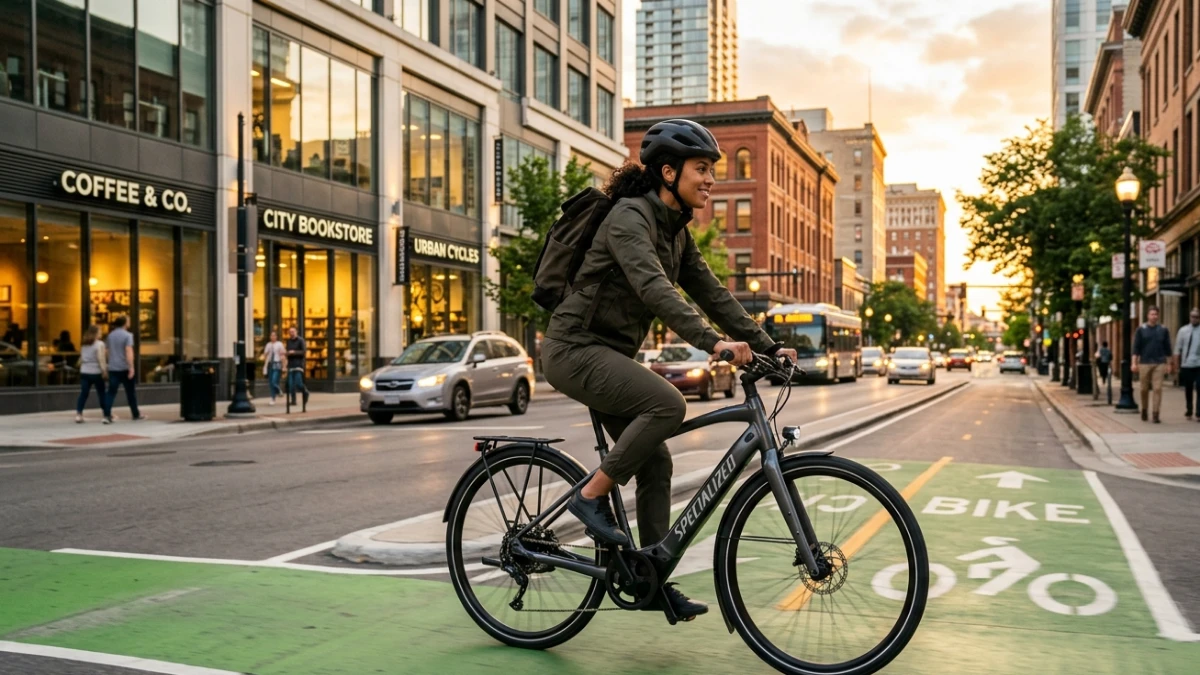
Electric bikes are transforming urban commuting in 2025 by offering a faster, cheaper, and greener alternative to cars. With low operating costs, reduced emissions, and growing city infrastructure, e-bikes help commuters avoid traffic, parking fees, and fuel expenses. Choosing the right class, battery range, and safety-certified components can make daily travel more efficient, affordable, and enjoyable for years to come.
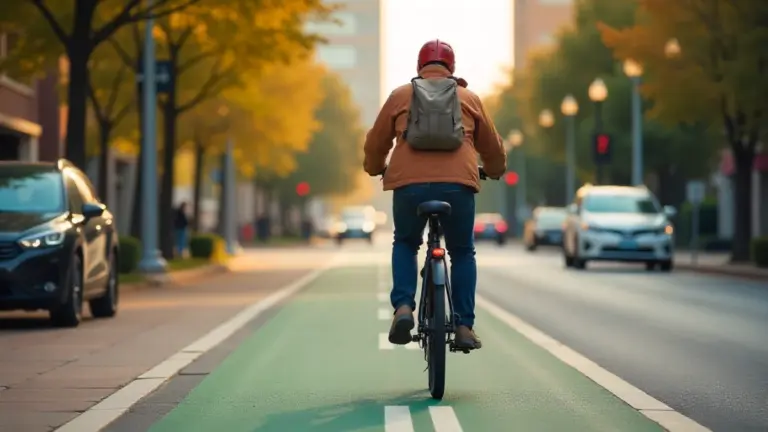
Picture this: it’s 8:15 on a Tuesday morning. Your coworker is stuck in gridlock, burning gas and patience in equal measure, while you coast through the city on your electric bike, arriving at the office in 22 minutes flat — no parking lot required, no transit card needed, and not even a damp shirt in sight. Sound too good to be true? For a growing wave of urban commuters across America, that’s just a regular Tuesday.
Electric bikes — e-bikes — have quietly crossed a threshold in 2025. They’re no longer a niche gadget for tech enthusiasts or a seasonal splurge. About 1.5 million e-bikes were sold in the US in 2025 alone, and the global market now sits at over $54 billion. Cities are building infrastructure around them. Delivery fleets are deploying them. And everyday commuters are ditching their car keys for handlebars — and never looking back.
But is an e-bike actually right for your commute? What should you look for when buying one? And how do they stack up against cars, public transit, or a regular pedal bike? In this guide, I’ll answer every one of those questions with current data, real-world context, and the kind of honest perspective that helps you make a smart decision — not just a trendy one.
$54.7BGlobal e-bike market value in 2025
1.5ME-bikes sold in the US in 2025
8.5%Projected annual market growth to 2036
3×More rides per bike in share programs vs. pedal bikes
Why Urban Commuters Are Making the Switch
Let’s be honest about what commuting by car in an American city actually costs you. It’s not just gasoline. It’s parking — which in major metros can run $200–$400 a month. It’s the wear and tear on your vehicle. It’s the cumulative stress of sitting in stop-and-go traffic, day after day. And it’s time: the average American commuter loses about 52 minutes a day to their commute.
E-bikes attack all of those pain points at once. Once you’ve covered the upfront cost of a good commuter model, the ongoing expenses are remarkably low — electricity to charge a battery typically runs just a few cents per charge. Maintenance is minimal compared to a car: no oil changes, no transmission fluid, no $800 brake jobs. And because you can use bike lanes and cut through traffic, your commute time often drops significantly.
“In many cities, e-bikes are now the fastest point-to-point mode of transport — even beating cars and transit during rush hour.”— Urban Transport Reports, 2025
The environmental argument is increasingly hard to ignore too. E-bikes emit a fraction of the CO₂ that cars produce, even accounting for the electricity used to charge them. If your city’s grid draws from any renewable sources — and most do, increasingly — the carbon math tilts even further in the e-bike’s favor. Pair that with the health benefits of light physical activity each day, and you’ve got a mode of transport that pays dividends well beyond your wallet.
[ INFOGRAPHIC: E-bike vs. car commute cost breakdown over 3 years — purchase, fuel/charging, maintenance, parking ]
Understanding E-Bike Classes: What’s Legal on Your Commute?
Before you spend a dollar on an e-bike, you need to understand the class system — because not all e-bikes are treated the same under the law, and using the wrong one in the wrong place can land you in legal hot water.
In the US, e-bikes fall into three federally recognized classes, though state and local rules can vary:
| Class | Motor Type | Top Assisted Speed | Where It’s Allowed | Best For |
|---|---|---|---|---|
| Class 1 Most popular | Pedal-assist only | 20 mph | Most bike lanes, paths, trails | Urban commuters seeking broad access |
| Class 2 | Throttle + pedal-assist | 20 mph | Bike lanes, roads (varies by city) | Riders who want throttle control for hills |
| Class 3 Check local rules | Pedal-assist only | 28 mph | Roads, some bike lanes — varies | Longer suburban commutes, faster riders |
For most city commuters, Class 1 is the sweet spot. It’s allowed in the widest range of locations, provides a natural riding feel that mirrors traditional cycling, and keeps you compliant with most local regulations without having to research every jurisdiction. Class 3 bikes can shave 5–8 minutes off a 10-mile commute compared to Class 2 models, but always verify what’s permitted on your specific route before buying.
Quick tip: Check your city’s official transportation website before purchasing. Some cities restrict e-bikes on certain shared paths or require registration for Class 3 models. A five-minute Google search before you buy can save real headaches later.
What to Look for When Buying a Commuter E-Bike
The e-bike market has exploded with options ranging from $800 budget models to $6,000+ premium machines. Navigating it can feel overwhelming. Here’s how to cut through the noise and focus on what actually matters for a daily urban commute.
Battery range: the number that defines your ride
For most city commutes, a battery offering 30–50 miles of range per charge is plenty — and then some. Look for a 500Wh to 750Wh battery pack. One important nuance: advertised range figures are typically measured under ideal conditions. Real-world range in cold weather can run 15–25% lower, so factor that into your math if you commute year-round. If your round trip is 20 miles and the bike advertises 40, you probably have enough buffer — but 30 miles advertised on a cold January morning might leave you nervous.
Motor placement and power: hub vs. mid-drive
Hub motors (in the wheel) are common, affordable, and reliable for flat city riding. Mid-drive motors (in the crank) deliver a more natural pedaling feel and handle hills more efficiently — they’re worth the extra cost if your commute involves meaningful elevation changes. For typical urban commuting, a 250W–500W motor provides more than enough power. Bigger isn’t always better; overpowered bikes can actually make lane and crowd navigation harder in dense city environments.
Brakes: non-negotiable quality
Stop-and-go city traffic demands reliable stopping power in all weather. Hydraulic disc brakes are now the standard to look for on any serious commuter model. They perform consistently whether it’s bone dry in July or drizzling in November. Mechanical disc brakes are acceptable on budget models; rim brakes should be a dealbreaker for urban use.
Frame weight and portability
If you live in an apartment and need to carry your bike upstairs, or plan to mix your ride with public transit, weight matters enormously. Many urban commuter models weigh 45–55 lbs — manageable but not light. If portability is a priority, look at folding e-bikes (the Urtopia Carbon Fold 1 weighs just 29 lbs with a carbon fiber frame) or models specifically engineered for multi-modal commutes. Folding e-bikes grew significantly in 2025 precisely because urban riders increasingly chain their commutes across modes.
Safety certification
Battery fires have been a real concern in the e-bike industry. Look for batteries certified to UL 2271, CE, or EN-15194 standards. In 2025, battery certification has become a primary purchasing consideration — more important, arguably, than motor wattage for most buyers. Don’t skip this check.
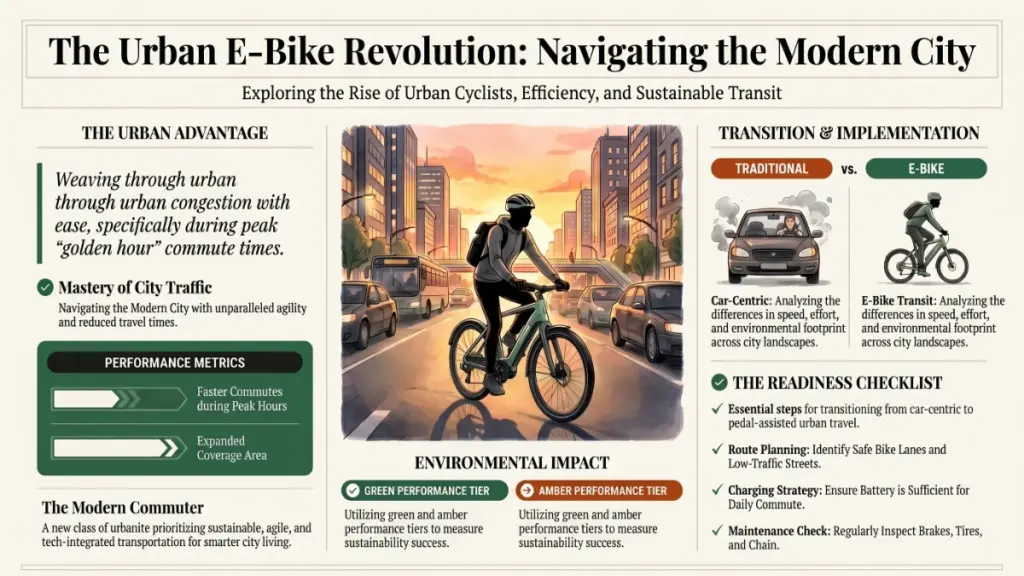
Top Commuter E-Bike Models Worth Considering in 2025
There’s no single “best” commuter e-bike — it depends on your budget, commute distance, storage situation, and riding style. But these models consistently earn high marks from long-term commuters, and they represent different points on the spectrum:
| Model | Class | Range | Weight | Price Range | Best For |
|---|---|---|---|---|---|
| Specialized Turbo Vado 5.0 | Class 3 | Up to 80 mi | ~50 lbs | $5,500+ | Performance-focused commuters |
| Trek Allant+ 8 | Class 3 | Up to 75 mi | ~53 lbs | $4,000–$5,000 | Suburban commuters with service access |
| Urtopia Carbon Fold 1 | Class 2 | Up to 50 mi | 29 lbs | $2,500–$3,000 | Multi-modal, apartment storage |
| Fifield Seaside 4.0 | Class 1 | ~60 mi | ~48 lbs | $2,200–$2,800 | Year-round city riders |
| Macfox X1S | Class 2 | ~40 mi | ~55 lbs | $1,200–$1,600 | Budget-conscious beginners |
One owner in Boston, commuting daily on the Fifield Seaside 4.0, reported achieving 95% car-free days over 18 months — a striking figure that speaks to how reliably a well-chosen e-bike can replace short car trips. Real-world testimonials like these are increasingly common as the first generation of serious e-bike commuters logs years (not just months) on their rides.
The Real Costs: E-Bike vs. Car vs. Public Transit
Numbers matter here. Let’s be direct about the financial picture, because it’s more compelling than most people realize — and more nuanced than e-bike marketing materials let on.
- Upfront cost: A solid commuter e-bike runs $1,200–$4,000. A used car purchase plus insurance, registration, and the first year of maintenance easily exceeds $5,000–$10,000.
- Monthly operating cost: Charging an e-bike battery costs roughly $0.05–$0.15 per charge. Compare that to $150–$300/month in fuel for a typical car commuter.
- Parking: E-bikes park for free (or nearly free). Downtown parking can run $150–$400/month in major cities.
- Maintenance: Annual e-bike maintenance averages $100–$200 for brake pads, tires, and chain. Annual car maintenance averages $1,000–$1,500.
- Insurance: Not required in most states for e-bikes (though renters/homeowners policies often cover theft). Car insurance averages $1,700/year nationally.
- Health benefits: The light exercise of e-bike commuting has documented links to reduced cardiovascular risk — a benefit that’s genuinely hard to put a dollar figure on, but very real.
The break-even math is surprisingly fast. A commuter who replaces even three car trips per week with e-bike rides can typically recoup the cost of a mid-range e-bike within 18–24 months. After that, every ride is money in your pocket.
“Rising fuel prices and urban congestion are encouraging consumers to adopt cost-efficient personal mobility — e-bikes offer significantly lower operating costs while providing faster travel in congested environments.”— Grand View Research, 2025 E-Bike Market Report
Practical Tips for Making E-Bike Commuting Work Every Day
Buying the bike is the easy part. The riders who stick with e-bike commuting long-term are the ones who set themselves up for success with a little planning upfront.
Solve charging before day one
Most commuter e-bike batteries charge fully in 4–6 hours from a standard wall outlet. If you have a garage or dedicated outlet near your parking spot, you’re set. Apartment dwellers should confirm their building allows bikes inside (most do with modern lease agreements) and identify where they’ll charge. Some employers now offer e-bike charging stations — worth asking your facilities team.
Invest in a serious lock
A $1,500 e-bike deserves more than a $25 cable lock. A quality U-lock plus a secondary chain lock is the standard recommendation. Lock both the frame and the rear wheel to a fixed object. Consider registering your bike’s serial number with your local police department and a national registry — recovery rates for registered stolen bikes are meaningfully higher.
Gear for weather, not just style
E-bike commuting year-round requires appropriate gear. A good rain jacket, waterproof panniers or a bag cover, and fenders on your bike will make the difference between a wet, miserable February and a surprisingly pleasant one. Riding in light rain on an e-bike is far more tolerable than most people expect — especially when you’re moving at a brisk, comfortable pace.
Plan your route deliberately
Your car route and your e-bike route are rarely the same. Spend 15 minutes with Google Maps or a dedicated cycling app before your first commute to find the path that maximizes bike lane use and minimizes time on high-traffic roads. The extra two minutes on a safer, calmer route will make your commute more enjoyable every single day.
The Bottom Line: Is an E-Bike Right for You?
If your commute is somewhere between 5 and 20 miles each way, you live in a city or dense suburb with at least some cycling infrastructure, and you’re tired of the cost and stress of driving or the limitations of transit — yes, an e-bike is almost certainly worth serious consideration in 2025.
Here’s what we’ve covered:
- The global e-bike market is surging, with 1.5 million units sold in the US in 2025 alone — reflecting genuine mass-market adoption.
- Class 1 pedal-assist e-bikes offer the broadest access to bike lanes and paths; always verify local regulations before buying.
- Look for UL-certified batteries, hydraulic disc brakes, and a range with 20–30% buffer over your actual commute distance.
- The total cost of e-bike commuting is dramatically lower than car ownership — most riders break even within two years.
- Success comes down to planning: charging logistics, security, appropriate gear, and a deliberate route.
The best commute isn’t the fastest one — it’s the one that doesn’t cost you your morning before the workday even starts. An e-bike might just give you that morning back.