TL;DR: Winter cuts EV range by 20-40% due to cold battery chemistry and heating demands, but smart preconditioning while plugged in, using seat heaters over cabin heat, driving smoothly at moderate speeds, installing winter tires, and planning routes with extra charging buffer can minimize losses. Always charge indoors when possible, maintain tire pressure, and never drop below 20% battery in extreme cold. With these strategies, EVs remain practical and reliable even in harsh winters.
Why Winter Changes Everything for EV Drivers
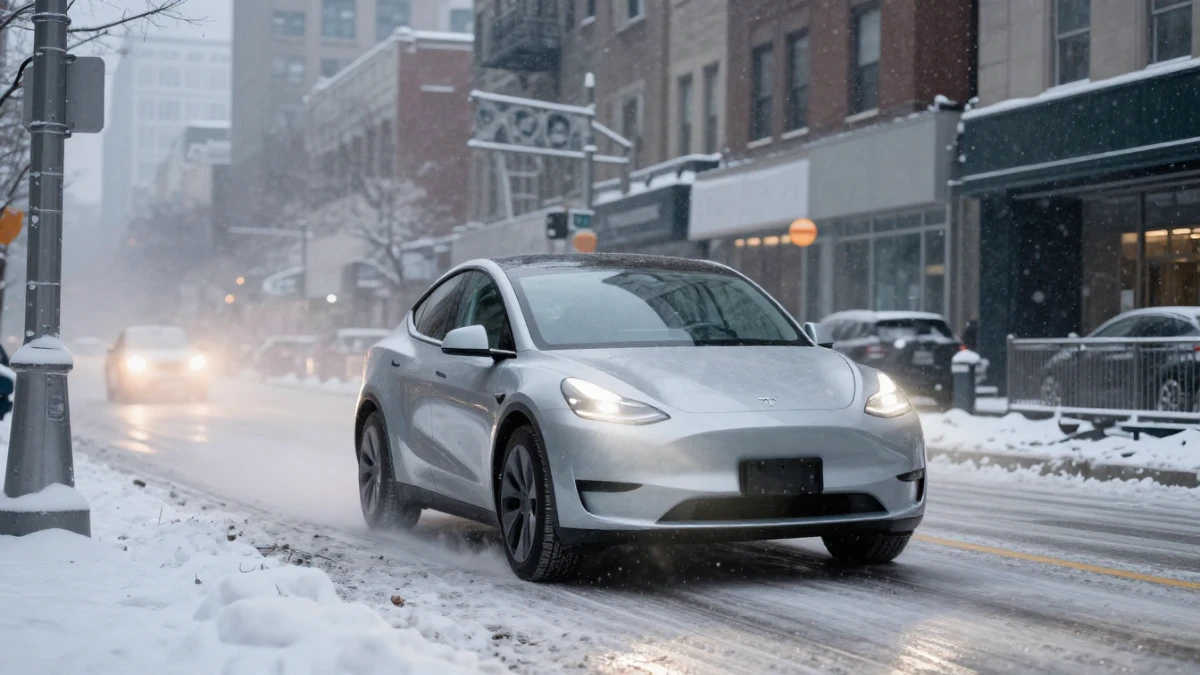
Let me paint you a picture. It’s 7 AM in Queens, NY. The thermometer reads 18°F (-8°C). Your Tesla Model Y shows 180 miles of range—plenty for your 60-mile commute, right? But by the time you reach Manhattan, you’ve burned through 100 miles of indicated range, and your palms are sweating despite the heated steering wheel.
Sound familiar? You’re not alone.
As someone who’s tested electric vehicles through countless New York winters, I can tell you that cold weather is the ultimate test of EV ownership. The good news? Once you understand how winter affects your battery and adopt the right strategies, you’ll drive with confidence while your gas-powered neighbors are scraping ice and warming up their engines.
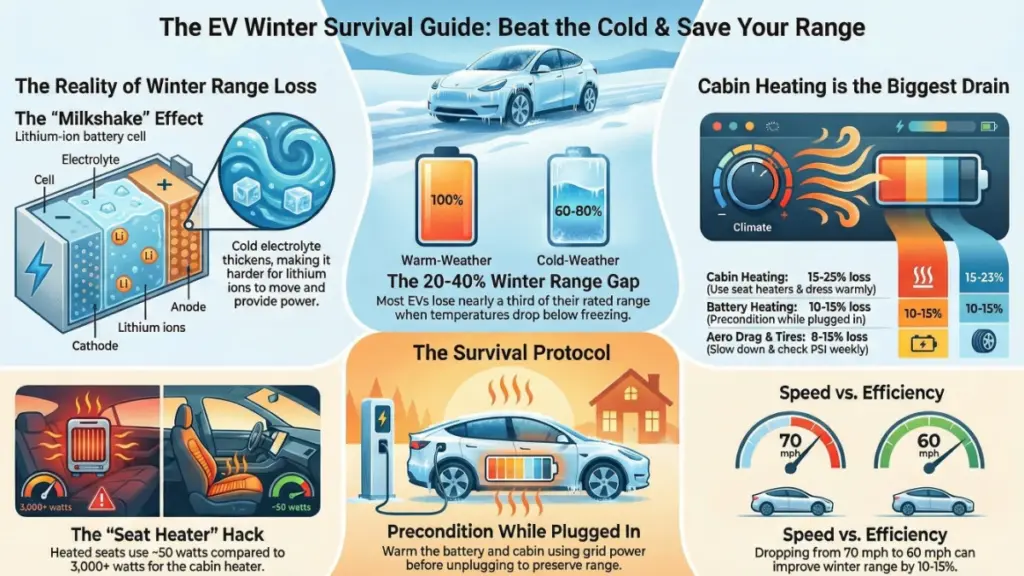
Here’s the reality check: electric vehicles can lose 20% to 40% of their rated range when temperatures drop below freezing. But here’s what most articles won’t tell you—much of that loss is preventable with the right approach.
The Cold Hard Truth: Why Your Battery Hates Winter
The Chemistry Behind the Problem
Your EV’s battery is essentially a chemical reactor. Lithium ions shuttle between electrodes, creating the electricity that powers your drive. But chemistry slows down when it gets cold—way down.
When temperatures drop below 40°F (4°C), three things happen inside your battery pack:
- The electrolyte thickens—imagine trying to drink a milkshake through a coffee stirrer. That’s what your lithium ions experience.
- Ion movement slows dramatically—less flow means less power available instantly.
- Internal resistance increases—your battery works harder to deliver the same energy, generating waste heat instead of motion.
But here’s the kicker: your car knows this. That’s why modern EVs divert precious energy to battery thermal management—essentially building a tiny climate control system for your battery pack. Clever? Yes. Energy-intensive? Absolutely.
Where Your Winter Range Actually Goes
Let me break down exactly why that 300-mile EPA rating becomes 220 miles in January:
| Energy Consumer | Typical Winter Impact | What You Can Do |
|---|---|---|
| Battery Heating | 10-15% range loss | Precondition while plugged in |
| Cabin Heating | 15-25% range loss | Use seat heaters, dress warmly |
| Aerodynamic Drag | 5-10% range loss | Slow down on highways |
| Tire Resistance | 3-5% range loss | Maintain pressure, use winter tires |
| Chemical Limitations | 10-20% range loss | Keep battery above 20% charge |
The brutal math: In extreme cold (-10°F / -23°C), you could see up to 50% range reduction. But in typical winter conditions (20-32°F / -6 to 0°C), expect 20-30% loss—manageable if you plan for it.
Preconditioning: Your Secret Weapon Against Winter
If you remember nothing else from this guide, remember this: preconditioning is the single most effective way to preserve winter range.
What Preconditioning Actually Means
Preconditioning is simply warming your car’s battery and cabin while still connected to a charger. Instead of draining your battery to heat itself and you, you’re using grid electricity—cheap, abundant, and range-neutral.
Think of it like this: would you rather use your phone battery to power a hand warmer, or plug it in and stay cozy? Exactly.
The Roy K. Miller Preconditioning Protocol
After years of testing in New York winters, here’s my foolproof routine:
Step 1: Smart Charging Schedule Set your EV to finish charging 30-60 minutes before departure. A fully charged battery that’s been sitting cold all night is less efficient than one that just finished charging (which generates some heat).
Step 2: Climate Activation Use your smartphone app to start cabin heating 15-30 minutes before leaving. Target 68-70°F (20-21°C)—comfortable but not wasteful.
Step 3: Battery Optimization If your EV supports battery preconditioning for fast charging or navigation, activate it. This is crucial for road trips.
Step 4: The Departure Window Unplug and go immediately after preconditioning completes. Every minute you sit with a warm car unplugged is wasted energy.
Pro Tips from the Field
- Level 1 vs. Level 2: Even a standard 120V outlet provides enough power for cabin preconditioning, though Level 2 (240V) is needed for aggressive battery warming.
- The “Route to Charger” Hack: In Teslas and many newer EVs, navigating to a fast charger automatically preconditions the battery for optimal charging speeds. Use this even if you know the way—it can cut charging time by 30-50%.
- Don’t Overdo It: I’ve seen drivers precondition for an hour with the cabin at 80°F. That’s wasteful. Fifteen minutes at moderate temperatures is usually sufficient.
Driving Techniques That Actually Save Range
The Smooth Operator Approach
Electric motors deliver instant torque—that’s fun, but it’s expensive in winter. When your battery is already struggling, aggressive acceleration is like throwing money into a fire.
Instead:
- Accelerate gradually—imagine there’s an egg under your accelerator pedal
- Anticipate stops—regenerative braking recaptures energy; friction brakes waste it
- Maintain steady speeds—cruise control is your friend on flat highways
Speed Kills (Your Range)
Here’s some math that might hurt: aerodynamic drag increases with the square of speed, and cold air is denser than warm air. Translation? That 75 mph cruise on I-95 costs you significantly more in January than in July.
Real-world impact: Dropping from 70 mph to 60 mph can improve winter efficiency by 10-15%. On a 200-mile trip, that’s the difference between arriving with 20% battery or 5%.
Climate Control Mastery
Seat Heaters Are Your Best Friend Heated seats use 50-100 watts. Cabin heating uses 3,000-6,000 watts. Do the math. I drive with a light jacket, heated seat on medium, and cabin temp at 65°F. Comfortable and efficient.
The Heat Pump Advantage If you’re shopping for an EV and live in a cold climate, prioritize models with heat pump systems (Tesla Model Y, Hyundai Ioniq 5, Kia EV6, BMW iX, newer Nissan Leafs). They’re 2-3x more efficient than resistance heaters. In a New York winter, that alone can save 30-40 miles of range.
Recirculate Strategically Once your cabin is warm, switch to recirculation mode. Heating fresh 20°F air constantly is energy-expensive. Just don’t recirculate so long that windows fog—safety first.
Route Planning: Winter Edition
The 30% Rule
In summer, I plan charging stops at 20% battery. In winter? I never go below 30% without a charging plan. Here’s why:
- Unexpected detours due to weather
- Charging stations possibly iced over or occupied
- Slower charging speeds requiring longer stops
- The psychological comfort of knowing you have options
Finding the Right Chargers
Indoor is Gold Whenever possible, charge indoors or under cover. Shopping malls, parking garages, and hotel parking structures offer protected charging that keeps you and the equipment warmer. In Queens, I know every indoor charger within 20 miles.
Check Before You Go Apps like PlugShare and A Better Route Planner are essential, but in winter, check recent check-ins. A station that worked yesterday might be snowed in today. I always identify backup options.
The Preconditioning Stop For long trips, I plan my first charging stop about 30-45 minutes into the drive. Why? By then, my battery is warm from driving and will accept faster charging speeds. This is especially important for non-Tesla DC fast charging.
Winter Maintenance: EV-Specific Essentials
Tires: The Make-or-Break Factor
Winter Tires Are Non-Negotiable All-season tires are a compromise that fails in real winter. Below 45°F (7°C), their rubber hardens and loses grip. For EVs, this matters doubly:
- Safety: Instant torque + cold all-seasons = wheel spin
- Efficiency: Hard tires have higher rolling resistance
- Range: Proper winter tires can actually improve efficiency in cold conditions compared to cold all-seasons
Pressure Monitoring For every 10°F the temperature drops, tires lose approximately 1 PSI. I check weekly in winter. Underinflation costs range and creates dangerous handling.
Battery Care in Extreme Cold
The 20% Floor In temperatures below 0°F (-18°C), avoid letting your battery drop below 20%. Deep discharge in extreme cold can cause permanent damage in some battery chemistries.
Garage Parking If you have a garage, use it. Keeping your EV at 40°F instead of 10°F overnight makes a measurable difference in morning efficiency and battery health.
Software Updates Manufacturers constantly improve cold-weather algorithms. That “annoying” update notification might contain significant winter performance improvements. Install promptly.
Exterior Maintenance
Charging Port Care Ice in your charging port prevents connection and can damage pins. I keep a can of de-icer in my trunk and apply silicone spray to the port seal monthly in winter.
Washer Fluid Use fluid rated for at least -20°F (-29°C). Frozen washer systems are annoying; frozen lines that burst are expensive.
Model-Specific Winter Strategies
Tesla Model 3/Y
- Use the “Scheduled Departure” feature in the app—it learns your routine
- Navigate to Superchargers for automatic battery preconditioning
- Model Y’s heat pump is a game-changer; trust the “Auto” climate setting
- “Camp Mode” maintains climate for extended stops without draining excessively
Hyundai Ioniq 5 / Kia EV6
- Excellent heat pump efficiency—use “Auto” mode
- 800V architecture charges fast even in cold if preconditioned
- Use the “Winter Mode” if available for optimized battery heating
Nissan Leaf
- Older models lack active battery cooling/heating—garage parking is crucial
- Use the Climate Control Timer religiously
- Expect more range variation than premium EVs
- Consider an aftermarket battery heater for extreme climates
Ford Mustang Mach-E
- FordPass app allows excellent preconditioning scheduling
- “Whisper” drive mode provides smoothest acceleration for slippery conditions
- Heat pump models (2022+) perform significantly better
Chevrolet Bolt EV/EUV
- Hill Top Reserve (or 90% charge limit) preserves regenerative braking space
- Remote Start via app is essential for preconditioning
- One-Pedal Driving works well once battery warms slightly
Safety First: Winter Emergency Preparedness
Your EV Winter Kit
Every electric vehicle in cold climates should carry:
- Blankets and warm clothing (wool or synthetic, not cotton)
- High-energy snacks and water
- Portable phone charger/power bank
- Flashlight with extra batteries
- First aid kit
- Collapsible shovel and ice scraper
- Traction mats or cat litter
- Tow strap rated for your vehicle’s weight
- Portable tire inflator
- Chemical hand warmers
Driving Safety in Snow and Ice
Weight Distribution Advantage EVs carry heavy battery packs low in the chassis, providing excellent stability. However, rear-wheel-drive models (older Tesla Model S, some BMWs) benefit from weight in the trunk and definitely need winter tires.
Regenerative Braking Caution On ice, aggressive regenerative braking can cause rear-wheel lockup in RWD vehicles. Reduce regen settings or use “low” regen modes in slippery conditions. AWD EVs handle this better but still require caution.
The “Cold Soak” Effect If your EV sits in extreme cold for hours, the battery will be sluggish initially. Drive gently for the first few miles to allow everything to warm up.
The Future is Bright (and Warm)
Technologies Coming Soon
Solid-State Batteries By 2027-2030, solid-state batteries promise to maintain performance at much lower temperatures. Companies like Toyota and QuantumScape are leading this charge—literally.
AI-Powered Thermal Management Machine learning is beginning to predict optimal preconditioning schedules based on weather forecasts, your calendar, and electricity rates. Your future EV will automatically be ready exactly when you need it, maximally efficient.
Infrastructure Evolution Heated charging cables and pads are being tested in Norway and Canada. Battery swap stations (popular in China with NIO) eliminate cold-weather charging delays entirely.
Frequently Asked Questions
How much range do EVs actually lose in winter? Most drivers experience 20-30% reduction in typical winter conditions. Extreme cold can push this to 40-50%, but proper preconditioning and driving technique can recover half that loss.
Can I charge my EV in freezing temperatures? Yes, but expect slower speeds. DC fast charging can be 30-50% slower in extreme cold. Preconditioning the battery before arrival helps maintain speeds.
Are EVs safe in snow? Very. The low center of gravity and instant torque provide excellent traction. However, winter tires are essential—EVs are heavy, and all-season tires struggle with that weight on snow.
Should I buy an EV if I live in Minnesota/Alaska/northern Canada? Absolutely. Norwegians—who know cold—have the highest EV adoption rate in the world. You need home charging (preferably Level 2) and realistic expectations, but the benefits outweigh the challenges.
Does using the heater kill my range? Cabin heating is the biggest energy consumer after propulsion. Use seat heaters, dress warmly, and keep temperatures moderate. Heat pump-equipped EVs reduce this impact significantly.
Final Thoughts: Embracing the Electric Winter
Winter EV ownership isn’t without challenges, but neither is winter gasoline car ownership—dead batteries, frozen fuel lines, and sluggish engines plagued my pre-EV days. The difference? With an EV, I start every morning with a “full tank,” never visit a gas station in freezing rain, and enjoy instant cabin heat.
The keys to success are simple:
- Precondition religiously while plugged in
- Dress for the weather and use seat heaters
- Plan with buffer and know your charging options
- Invest in winter tires—safety and efficiency
- Stay informed about your specific vehicle’s capabilities
Electric vehicles have transformed my winter driving experience in New York. With the strategies in this guide, they’ll transform yours too. Drive safe, stay warm, and enjoy the quiet confidence of electric winter mobility.