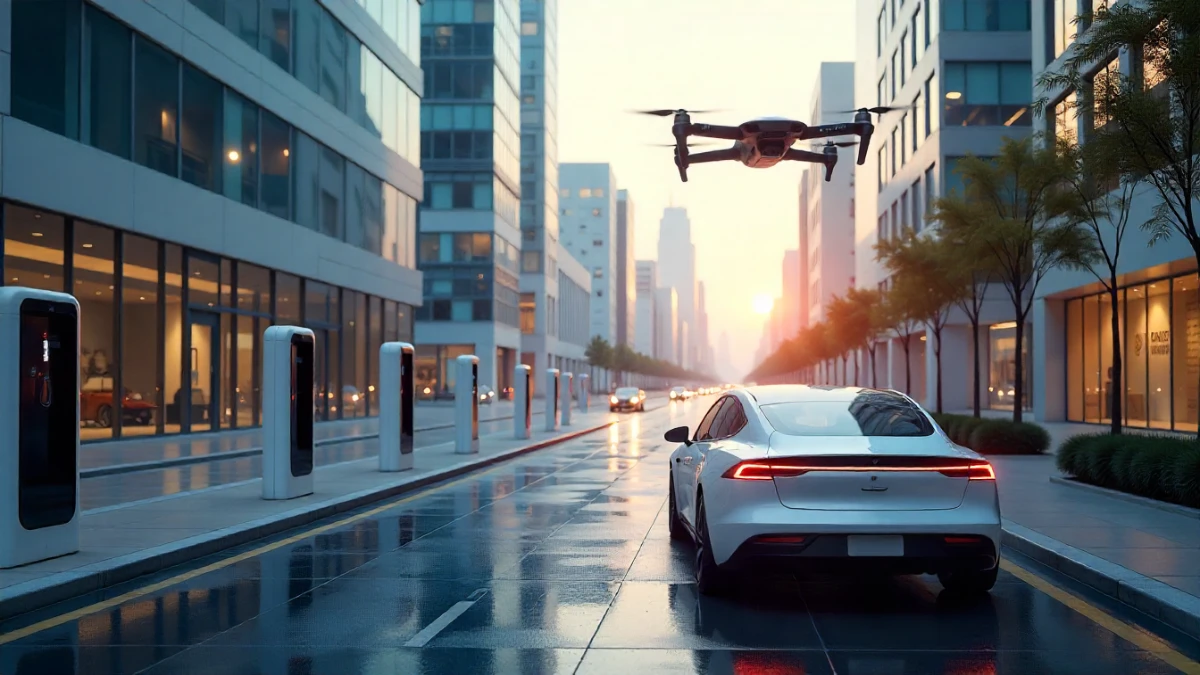
Picture this: You’re sitting in traffic in 2030, watching an electric delivery van glide silently past while an air taxi zips overhead, ferrying passengers across the city in minutes instead of hours. Your phone pings—it’s your EV reminding you that charging at home tonight will cost 60% less than that gas station down the street used to charge five years ago. Sound like science fiction? It’s closer than you think
We’re standing at one of those rare moments in history where everything changes at once. The electric mobility revolution isn’t just about swapping gas tanks for batteries—it’s reshaping how we move, where we live, and how our cities breathe. Between now and 2030, we’ll witness transformations that seemed impossible just a few years ago. But here’s what nobody tells you: it’s going to be messy, exciting, and full of surprises.
Let me walk you through what’s really happening on the ground—the breakthroughs, the bottlenecks, and the innovations that are about to change everything about how we get around.
The EV Adoption Surge: Numbers That Actually Matter
Let’s start with the big picture, because the numbers are staggering. Global passenger EV sales are projected to climb from 17.6 million in 2024 to 39 million by 2030. That’s more than double in just six years. But here’s where it gets interesting—this growth isn’t happening everywhere at the same pace.
China achieved a major milestone in the second half of 2024, with electric cars capturing over 50% of new car sales, and projections suggest this could reach 80% by 2030. Think about that for a second. In the world’s largest car market, EVs aren’t the future anymore—they’re the present. Walk down any street in Shanghai or Beijing, and you’ll see more electric vehicles than gas-guzzlers. The crazy part? Many of these EVs are actually cheaper than their gasoline equivalents.
Europe’s taking a different path but getting there too. The UK hit nearly 30% EV sales share in 2024, jumping from 24% the previous year, largely driven by the Vehicle Emissions Trading Scheme. Norway? They’re basically done with the transition already—88% of car sales in Norway are battery electric vehicles. Meanwhile, across the EU, stricter emissions standards are pushing that number toward 25% in 2025 and potentially 60% by 2030.
But here’s the uncomfortable truth: not everywhere is celebrating. The US market is projected to grow from 1.6 million EVs in 2025 to 4.1 million by 2030, but policy uncertainty has led to revised projections showing 14 million fewer cumulative EV sales than previously expected. Political winds matter more than we’d like to admit.
Why Some Cars Cost $17,000 While Others Cost $50,000
You know what really gets people excited—or frustrated? Price. And this is where the story gets complicated.
In China, the price war is brutal but brilliant for consumers. Chinese manufacturers now offer more electric models than conventional ones, with some models starting at prices equivalent to under $17,000. BYD, which you might not have heard of five years ago, is now outselling Tesla globally in battery-electric vehicles. They’re doing it by making EVs that regular people can actually afford.
Europe’s a different beast. Most EVs there still cost above €50,000, making them toys for the wealthy rather than transportation for everyone. But change is coming. Affordable models like the Renault 5, Citroën ë-C3, and Volkswagen ID.2 are targeting prices under €25,000, aiming to make EVs accessible to average buyers. Will they succeed? That’s the €25,000 question.
Here’s a reality check from someone who’s been watching this space: the “affordable EV” promise has been around for years. We’re finally seeing it happen, but there’s a catch. Many of these cheaper models have shorter ranges, slower charging, and fewer fancy features. For city driving? Perfect. For your annual 800-mile road trip? You might want to think twice.
The Charging Infrastructure: It’s Not About Quantity Anymore
Remember when everyone obsessed about “range anxiety”? Well, here’s the thing—charging anxiety has now overtaken range anxiety as the primary concern for EV drivers, revolving around the reliability, availability, and complexity of charging networks rather than vehicle range. It’s not “will I make it?” anymore—it’s “will the charger actually work when I get there?”
Let me paint you a real scenario that happened to a friend: She pulled into a charging station after a long drive, battery at 10%. Three of the four chargers were broken. The fourth one? Occupied. She waited 45 minutes, stressed and furious, texting her meeting to say she’d be late. That’s charging anxiety, and it’s a bigger deal than running out of juice.
But the good news? The buildout is happening fast. In Europe, approximately 210,000 public charging points need to be added annually through 2030, with fast chargers increasing their share and average power ratings improving significantly. France is going big—a charge point operator association committed to investing €4 billion to expand ultra-fast charging from 17,000 points today to 40,000 by 2028.
In the US, the pace is picking up too. Forecasts suggest 16,700 new fast charging ports will open in 2025—three times as many as opened in 2021, with the total expected to surpass 100,000 ports by 2027. The “Charging 2.0” wave is here, with big retailers like Walmart and automakers like Mercedes building their own networks.
Here’s what matters most: While the number of EVs per charging point will increase from less than 15 in 2024 to close to 25 in 2030, public charging capacity per vehicle will actually grow to over 2 kW per electric vehicle in Europe. Translation? Smarter, faster chargers compensating for fewer charging points per car.
But let’s be honest—the experience still sucks sometimes. EV users often must juggle different plug types, payment options, and multiple apps across various networks, creating layers of complexity that traditional drivers never experienced. Imagine needing three different credit cards, four apps, and a PhD just to fill up your tank. That’s the EV charging experience in many places today.
Fleet Electrification: When Corporations Lead the Way
Here’s something that doesn’t get enough attention: while consumers debate whether to buy an EV, corporations are quietly electrifying entire fleets. And they’re doing it fast.
Major logistics company DHL aims for 66% of its pickup and delivery operations worldwide to be electric by 2030, while Element Fleet Management has already achieved 27% of its target to transition 350,000 client vehicles to electric. Amazon’s got 20,000 electric delivery vans on the road, aiming for 100,000 by 2030. FedEx wants half its parcel fleet electric by 2025.
Why are they moving so fast? Simple math. Electric vehicles have lower operating costs due to cheaper fuel and reduced maintenance compared to conventional vehicles. When you’re running thousands of vehicles, those savings add up to millions—sometimes billions—of dollars.
But it’s not all smooth sailing. The main challenge companies face is the insufficient charging infrastructure, leading many to install private charging facilities at their depots. UPS, DHL, and FedEx aren’t waiting for public charging—they’re building their own ecosystems.
And heavy-duty transport? Global electric truck sales surged nearly 80% in 2024, hitting 2% of total truck sales, with companies like Volvo and Scania releasing long-range electric trucks with over 600 km of range. Your Amazon package might already be arriving in an electric truck. The semi-trailer hauling goods across the country? That’s going electric too, just more slowly.
Europe vs. China: The Battle Nobody Expected
Here’s where things get spicy. The European auto industry—home to Mercedes, BMW, Volkswagen, and centuries of engineering excellence—is getting its lunch eaten by Chinese newcomers.
Chinese car brands now sell more cars in Europe than Audi or Renault, with MG (owned by China’s SAIC) outselling both Tesla and Fiat. Let that sink in. A British brand owned by China is beating some of Europe’s most storied names.
How did this happen? Chinese manufacturers positioned themselves as technology-focused companies offering competitively priced vehicles with features like big screens, flashy interfaces, voice assistants, and even refrigerators and massage functions. In the UK, BYD’s Dolphin Surf starts at £18,650—less than half the cost of a Tesla Model 3 at around £39,000.
But Europe’s fighting back. The European Commission imposed tariffs of up to 48% on Chinese-made EVs, varying by manufacturer—17% for BYD, 18.8% for Geely, and 35.3% for state-owned SAIC. It’s a trade war disguised as climate policy, and the stakes couldn’t be higher.
The irony? Chinese hybrid vehicles sold in Europe increased ninefold in the first half of 2025 compared to 2024, helping Europe meet its emission targets while sidestepping tariffs that only apply to pure battery-electrics. Smart play, right?
Meanwhile, European carmakers’ collective market share in China fell to 15% in 2024, down from 24% in 2020. They’re losing at home and abroad. Ouch.
Smart Cities and Urban Air Mobility: The Sky’s (Literally) the Limit
Now let’s talk about the really cool stuff that makes you feel like you’re living in the future.
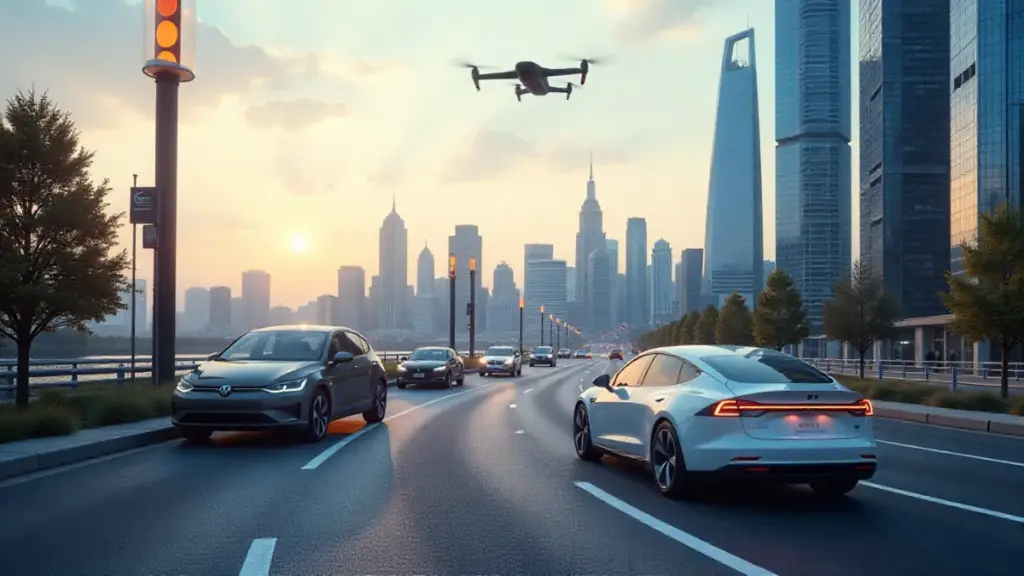
Urban air mobility—basically flying taxis—is no longer science fiction. Archer Aviation began piloted test flights of its Midnight air taxi in June 2025, following over 400 autonomous flights in 2024, with commercial operations planned for Los Angeles, Miami, New York City, and San Francisco by 2026.
Tokyo has laid out plans to introduce commercial urban air taxi service by 2030, with Archer Aviation, Joby Aviation, and SkyDrive participating in pilot projects starting from 2025 to 2027. The Middle East is all in too—both Archer and Joby have signed deals to test and potentially launch commercial operations in Saudi Arabia and the UAE.
But let’s pump the brakes on the hype train. Industry experts suggest that entry into service by 2026 or early 2027 is optimistic, with the first commercial air taxi likely being hybrid-electric rather than fully electric due to range limitations. Also, regulatory constraints, high aircraft prices, and the fact that current air traffic systems aren’t designed for thousands of small electric aircraft mean these services will likely remain premium offerings for the wealthy in the near term.
Will you summon a flying taxi with your phone by 2030? In Dubai or Los Angeles, maybe. In Des Moines? Probably not yet.
The Real Talk: What’s Holding Us Back
Alright, let’s get real about the problems nobody wants to talk about at cocktail parties.
First, charging reliability is terrible in many places. A 2022 study found nearly 30% of non-Tesla public chargers in California’s Bay Area were non-functional, and a 2023 national study reached similar conclusions. Imagine if three out of ten gas pumps were just… broken. That’s where we are with EV charging.
Second, public fast charging now costs more per mile than gasoline in Europe and the US, though home charging remains 25-60% cheaper. The financial argument for EVs assumes you can charge at home. No home charger? You might actually pay more to run an EV than a gas car. Nobody mentions this in the commercials.
Third, the weight issue. Modern EVs are heavy—sometimes 1,000+ pounds heavier than equivalent gas cars. That means more tire wear, more road damage, and higher insurance costs. France implemented a weight tax on plug-in hybrids, causing buyers to rush purchases in December before the tax took effect.
Fourth, there’s the elephant in the room: where’s all the electricity coming from? Electricity demand from EVs, e-buses, and electric two- and three-wheelers is expected to increase 2.4 times from 2025 to 2030, with EVs in China alone now consuming more electricity than a country like Sweden. Are we just shifting emissions from tailpipes to power plants? That depends entirely on how green your local grid is.
What This Means for You (The Part Everyone Actually Cares About)
So what should you actually do with all this information? Here’s my take after years watching this space:
If you’re buying a car in the next year: Consider your specific use case. City dweller with home charging? An EV makes sense, especially with prices dropping. Long-distance driver in rural Wyoming? Maybe wait another year or two—or consider a plug-in hybrid.
If you’re a fleet manager: The math is already working. Start transitioning now, but invest heavily in your own charging infrastructure. Don’t rely on public networks.
If you’re a policy maker: For the love of all that’s holy, fix charging reliability before adding more chargers. A network that works 70% of the time at twice the size is worse than a smaller network that works 99% of the time.
If you’re just curious: The transition is happening whether we’re ready or not. The global electric vehicle market is projected to grow from $1.3 trillion in 2024 to $6.5 trillion by 2030, at a compound annual growth rate of 32.5%. This isn’t a trend—it’s a transformation.
Looking Ahead: 2030 and Beyond
Five years from now, you’ll look back at 2025 as the tipping point—the moment when electric mobility stopped being a niche thing and became just… normal. Your Uber will probably be electric. The delivery trucks in your neighborhood definitely will be. And yeah, there might be an air taxi route connecting downtown to the airport in major cities.
By 2028-2030, several cities in Asia, the Middle East, and parts of Africa will have regular air taxi services, though fully autonomous operation will likely wait until 2030-2035 for most locations. Norway is projected to have more EVs than gas cars by 2030, followed by China in 2033, California in 2037, and Germany in 2039.
But here’s what I want you to remember: this transition isn’t smooth, linear, or guaranteed. It’s messy, regional, and full of surprises. Winners and losers are still being determined. Business models are being invented and discarded monthly. What works in Oslo might fail in Ohio.
The future of mobility is electric—that part’s pretty clear. But the path to get there? That’s still being written, one broken charger, one price war, and one breakthrough at a time. And honestly? That’s what makes it exciting.
The world’s changing faster than ever, and for once, you get to watch it happen in real-time. Buckle up—it’s going to be one hell of a ride.