Airports worldwide are accelerating the shift to electric ground transportation, replacing diesel-powered shuttles, rental fleets, ride-share vehicles, and ground support equipment with cleaner alternatives. Major hubs like Amsterdam Schiphol, Zurich, LAX, and JFK are investing heavily in EV infrastructure to cut emissions, reduce noise, and improve air quality. While power-grid capacity and infrastructure costs remain challenges, airport electrification is rapidly transforming the future of sustainable travel.
Every time you step off a plane, you’re entering one of the most energy-intensive ecosystems on the planet. Between the shuttle buses looping endlessly between terminals, the baggage tugs weaving across tarmacs, the rental car fleets stretching across multi-story garages, and the ride-share vehicles idling curbside — airports are, in a very real sense, small cities with enormous carbon footprints.
But something significant is changing. Airports across the United States and around the world are in the middle of a green transportation revolution, and electric vehicles are at the center of it. Whether you’re a frequent flyer, an EV enthusiast, or just someone who wonders what that quiet electric shuttle you just boarded says about the future — this article breaks it all down.
Here’s what you’ll learn: why airports are going electric, how the transformation is happening right now, what the real challenges look like on the ground, and how this shift directly affects your travel experience.
Why Airports Are One of the Biggest Targets for EV Adoption
Let’s be honest — airports have a massive emissions problem. It’s not just the planes. The ground-level activity at a busy international airport generates substantial greenhouse gas emissions that rarely get talked about.
Think about everything that moves on the ground: passenger shuttles, baggage handlers, fuel trucks, de-icing vehicles, mobile stair units, pushback tractors, rental car fleets, and taxis. Traditionally, almost all of these ran on diesel or gasoline. Multiply that across thousands of daily operations at a hub airport and you’re looking at a significant local pollution problem — one that affects both airport workers and surrounding communities.
That’s why decarbonizing ground transportation isn’t just a feel-good initiative. It’s quickly becoming a regulatory requirement, an economic imperative, and — increasingly — a passenger expectation.
Over 270 airports in Europe have formally committed to achieving near-zero carbon emissions by 2050. In the United States, California’s Zero-Emission Airport Shuttle Regulation requires the 13 largest airports in the state to transition to 100% zero-emission shuttle vehicles by 2035, with all new shuttle purchases after 2023 already required to be zero-emission. That’s not a distant goal — that policy is reshaping procurement decisions at airports like LAX, SFO, and SAN right now.
The Ground Support Equipment Revolution: It’s Already Happening
When most people think about electric vehicles at airports, they picture Tesla rentals or charging stations in the parking garage. But the most dramatic transformation is happening out of sight, on the tarmac.
Ground support equipment (GSE) — the vehicles and machinery that service aircraft between flights — is being electrified at a pace that’s genuinely impressive.
Zurich and Amsterdam Are Leading the Way
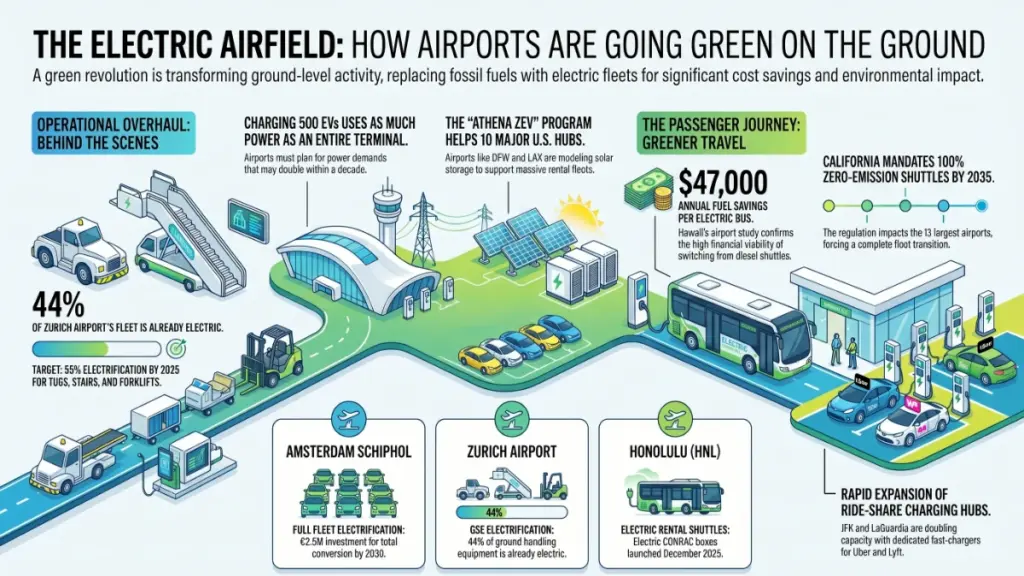
Zurich Airport’s green initiative targets the electrification of baggage transport vehicles, conveyor belts, mobile stairs, service vehicles, and forklifts. Currently, 44% of the ground handling equipment at Zurich Airport is electric, with a goal to reach 55% by the end of 2025. That’s not a pilot program — that’s a fleet-wide transformation.
Amsterdam Airport Schiphol has committed even further. The airport invested €2.5 million in electric vehicles as part of a plan to convert its entire motorized ground handling fleet to electric by 2030. In 2025, it partnered with Kempower to install three new charging sites to support 58 new electric apron buses and additional ground support equipment — all part of its mission to become energy-positive by 2050.
The U.S. Is Building Infrastructure for the Long Game
In the United States, Seattle-Tacoma International Airport was an early pioneer, having already replaced 30% of its diesel fleet with EVs back in 2014. That early experiment proved the operational and financial feasibility of electric GSE — and it’s been influencing airport planning decisions ever since.
Today, a National Renewable Energy Laboratory program called Athena Zev is helping 10 major U.S. airports — including Dallas-Fort Worth, LAX, JFK, LaGuardia, Denver, Phoenix, Seattle, Salt Lake City, and Indianapolis — model exactly how much power capacity they’ll need as EV fleets expand. This is critical forward planning. The program’s $4.3 million Phase Two is already generating data-driven models to optimize charging infrastructure and integrate solar energy storage.
Here’s a number that puts it in perspective: charging just 500 EVs in a single day can require the same amount of electricity as an entire airport terminal. At LAX, between 4,000 and 7,000 rental cars are returned daily. Dallas-Fort Worth’s rental fleet alone numbers 22,000 vehicles. The power demand implications are staggering — and airports need to plan for it now.
Electric Shuttles and Buses: The Passenger Experience Is Getting Greener
The next time you’re riding a shuttle from a remote parking lot to your terminal, there’s a good chance that bus might soon — or already — be electric. For passengers, this is one of the most noticeable changes in the airport EV transition.
Honolulu Sets a Real-World Benchmark
In December 2025, Hawaii’s Daniel K. Inouye International Airport launched electric buses for its rental car shuttle service (CONRAC route). The numbers behind the decision are telling: a state study conducted as early as 2018 found that switching one bus from diesel to electric saves roughly $47,000 per year in fuel costs alone.
With 22 million passengers moving through HNL annually, the environmental and financial math is compelling. Those savings compound quickly across an entire fleet.
California’s Electric Shuttle Mandate Is Reshaping the Industry
California’s Zero-Emission Airport Shuttle (ZEAS) Regulation is arguably the most ambitious airport ground transport policy in the United States. Fixed-route airport shuttles operating at 13 California airports must transition to 100% zero-emission vehicles by 2035. New shuttle vehicles with a gross vehicle weight above 14,000 pounds must be zero-emission starting with model year 2026.
This regulation doesn’t just apply to airport-owned shuttles. Hotel shuttles, parking lot buses, and off-airport car rental operations all fall under the mandate if they’re serving those airports regularly. It’s a sweeping change that will fundamentally transform the curbside experience at airports across the state.
Rental Cars and Ride-Share: The High-Stakes EV Transition
This is where things get genuinely interesting — and a little complicated.
Airport rental car fleets are one of the highest-volume EV use cases in the world. Rental vehicles at airports are used intensively, driven short-to-medium distances, and returned to centralized locations — a nearly perfect operating profile for electric vehicles.
A 2024 analysis using Denver International (DEN) and Minneapolis-St. Paul (MSP) as case studies found that by 2050, both airports could require nearly five times their current electric power capacity, with the biggest demand surge expected between 2025 and 2030, driven directly by rental car electrification and ride-share staging areas.
The Rental Car Companies Are Still Figuring It Out
Here’s the honest reality: the rental car industry’s EV transition has been more turbulent than anticipated. EVs currently make up approximately 3% of total U.S. rental car fleet vehicles, according to the American Car Rental Association.
Hertz — which had pushed hard toward 10% EV fleet penetration — reversed course in 2024, shedding around 20,000 EVs after encountering higher-than-expected repair costs, parts shortages, and extended vehicle downtime. Avis Budget Group pivoted to focus on a $1 billion adjusted EBITDA target for 2025, signaling more cautious capital deployment during the EV transition.
That said, the long-term trajectory is still firmly toward electrification. The economics in high-utilization rental cycles increasingly favor EVs. Fleet analysis shows that 10 electric pickup trucks can generate over $677,000 in savings over a decade through reduced maintenance and fuel costs. Federal tax credits of $7,500 per eligible vehicle improve the total cost of ownership further.
Ride-Share Is Moving Faster
For Transportation Network Companies like Uber and Lyft, the regulatory pressure is real and accelerating. California’s Clean Miles Standard requires TNCs to achieve 90% of their vehicle miles traveled in zero-emission vehicles by 2030. That’s not a long runway.
Airports are responding by building dedicated EV charging infrastructure for ride-share vehicles. JFK Airport opened a new fast-charging site in late 2024 with 24 DC fast chargers in its for-hire vehicle lot — doubling its EV charging network capacity overnight. LaGuardia Airport is constructing a 48-port charging facility specifically for Uber, Lyft, and taxi drivers. The same pattern is playing out globally, from Los Angeles to Oslo.
What Travelers Can Expect at the Airport in 2025 and Beyond
If you’re flying through a major hub today, here’s what the sustainable ground transportation picture looks like for you as a passenger:
Electric Rental Cars Are Available — But Availability Varies
Major airports like LAX, JFK, BOS, SFO, and MIA offer growing electric rental fleets, with options including Tesla Model 3s, Polestar 2s, and various other EVs from Sixt, Avis, and Enterprise. That said, EVs remain a small share of total rental fleets — often in the low single digits at most locations.
If you specifically want an electric rental, here’s practical advice: book early and call ahead to confirm the VIN. Some rental platforms list EVs as “Tesla Model 3 or similar,” which in practice can mean you get a hybrid or a gasoline car if EV inventory is tight. Especially during peak travel windows, confirmed EV reservations matter.
Charging Infrastructure Is Expanding Rapidly
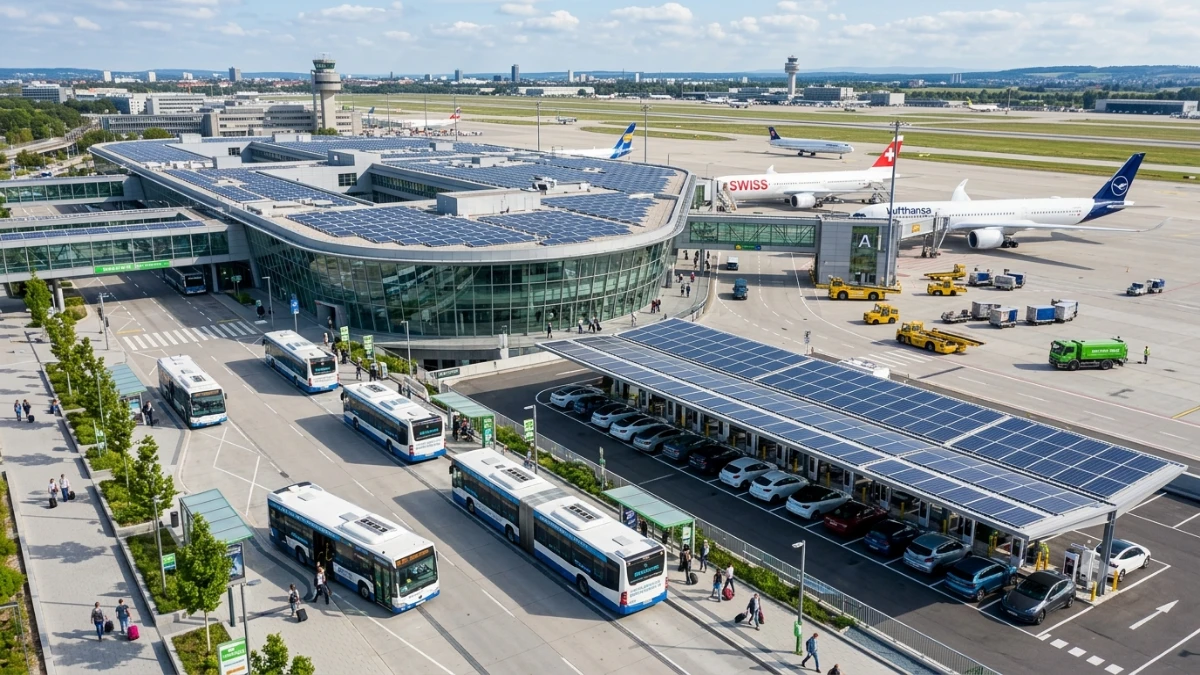
JFK expanded to 46 fast chargers by early 2025, doubling its previous capacity. Airports nationwide are integrating EV charging across parking garages, rental car facilities, and ride-share staging areas. Some forward-thinking airports are pairing chargers with solar canopies to generate renewable energy on-site — reducing grid dependency while serving growing demand.
Quieter, Cleaner Curbside Experiences
One underappreciated benefit of the airport EV transition: less noise and exhaust at the curb. Electric shuttles and EVs don’t idle the same way diesel vehicles do. If you’ve ever stood at a curbside pickup zone with a diesel bus idling two feet away, you’ll understand why this is a quality-of-life improvement for passengers and airport workers alike.
The Honest Challenges: What Makes This Hard
I’d be doing you a disservice if I painted this as a smooth, seamless transition. There are real, substantial challenges airports and the industry are working through.
Power grid capacity is the biggest. Electricity demand at airports may double within a decade or less, according to the National Academies of Sciences. Utility interconnection upgrades for loads above 5 megawatts require 2-3 years of lead time — and the fleet electrification mandates that create that demand arrive in 2028-2030. The timeline is tight.
Cost recovery is complicated. Airport EV charging infrastructure is increasingly being recognized as a service obligation rather than a revenue opportunity. At LAX, the financial analysis shows that direct revenues from EV charging cover less than 1% of project costs. Financing these programs requires creative approaches involving federal grants, utility partnerships, and rate adjustments.
Regulatory uncertainty adds another layer. In March 2026, the Trump Administration’s Department of Transportation filed suit to stop enforcement of California’s EV mandates, alleging conflict with federal fuel economy law. That litigation remains unresolved and could affect the pace of mandatory demand growth in California — though most infrastructure planning is proceeding regardless, given the long lead times involved.
A Comparison: Leading Airports in Sustainable Ground Transportation
| Airport | Key Initiative | EV Progress |
|---|---|---|
| Amsterdam Schiphol | Full fleet electrification by 2030 | 58 new electric apron buses (2025) |
| Zurich Airport | GSE electrification targets | 44% electric fleet, targeting 55% by end of 2025 |
| Seattle-Tacoma (SEA) | Early EV adopter | 30% ICE fleet replaced by 2014 |
| LAX | Charging infrastructure expansion | 46+ fast chargers; ZEAS compliance underway |
| JFK (New York) | Ride-share EV hub | 24 DC fast chargers in for-hire vehicle lot (2024) |
| Honolulu (HNL) | Electric rental shuttles | Electric CONRAC buses operational since Dec 2025 |
| Dallas-Fort Worth | Power capacity planning | Part of NREL Athena Zev program |
The Road Ahead: What to Watch in 2026 and Beyond
The trajectory is clear, even if the timeline has bumps. Here are the developments worth watching:
- Electric aircraft ground support moving toward airside operations. Pushback tractors, fueling vehicles, and de-icing trucks are all in the electrification queue. Kempower and others are building ultra-fast, high-power charging specifically designed for this equipment.
- Renewable energy integration. The best airports won’t just charge EVs from the grid — they’ll generate solar energy on-site to feed the charging network. DFW, Denver, and others are modeling exactly this.
- State mandates accelerating fleet turnover. Regardless of federal litigation, most major airports in EV-forward states are continuing infrastructure investments on the assumption that fleet electrification mandates will hold.
- Advanced Clean Fleet rules in California will capture medium- and heavy-duty commercial fleets — including rental car companies and ground transport operators at airports — likely locking in substantial EV demand through the late 2020s.
Key Takeaways
Here’s what matters most from everything we covered:
- Airport ground transportation is one of the highest-impact areas for EV adoption, spanning shuttles, rental fleets, ride-share vehicles, and behind-the-scenes ground support equipment.
- Leading airports in Europe — particularly Zurich and Amsterdam — are already demonstrating that large-scale electric fleets are operationally viable and financially sensible.
- In the U.S., California’s ZEAS regulation and the Athena Zev program are driving serious infrastructure planning and investment at the country’s largest airports.
- The rental car industry’s EV transition is real but uneven — availability varies significantly by airport and company, and the economics are still being worked out.
- Power grid capacity and financing are the two biggest structural challenges, and airports that haven’t started utility infrastructure upgrades may face a time crunch by 2028-2030.
The next time you’re at an airport, look around. That quiet shuttle pulling up to the curb, that luggage tug gliding silently across the tarmac, those chargers lined up in the rental car return — these are early signals of a much larger transformation that’s already underway.
As someone who has spent years tracking the EV space, I can tell you: the electrification of airport ground transportation isn’t a futuristic idea. It’s a logistical challenge that’s being solved right now, one vehicle and one charging station at a time.