Have you ever sat in traffic, watching exhaust fumes shimmer in the air, and wondered if there’s a better way? You’re not alone. As climate concerns intensify and urban congestion worsens, sustainable transportation has emerged as one of the most critical solutions for our future. But what exactly does “sustainable transportation” mean, and how does it impact your daily life?
Sustainable transportation refers to any mode of travel that minimizes environmental impact, reduces carbon emissions, and can be maintained long-term without depleting natural resources. This includes electric vehicles, public transit, cycling, walking, and emerging technologies like hydrogen fuel cells and autonomous shared mobility.
In this guide, you’ll discover the core principles of sustainable transportation, explore the most promising eco-friendly options available today, understand the real-world benefits and challenges, and learn practical ways you can make more sustainable transportation choices right now. Whether you’re considering an electric vehicle, curious about your city’s public transit expansion, or simply want to reduce your carbon footprint, this article will give you the knowledge you need to navigate the future of mobility.
Understanding Sustainable Transportation: More Than Just Electric Cars
When most people hear “sustainable transportation,” they immediately think of Tesla and other electric vehicles. And while EVs are certainly a significant piece of the puzzle, sustainable transportation encompasses a much broader vision of how we move people and goods.
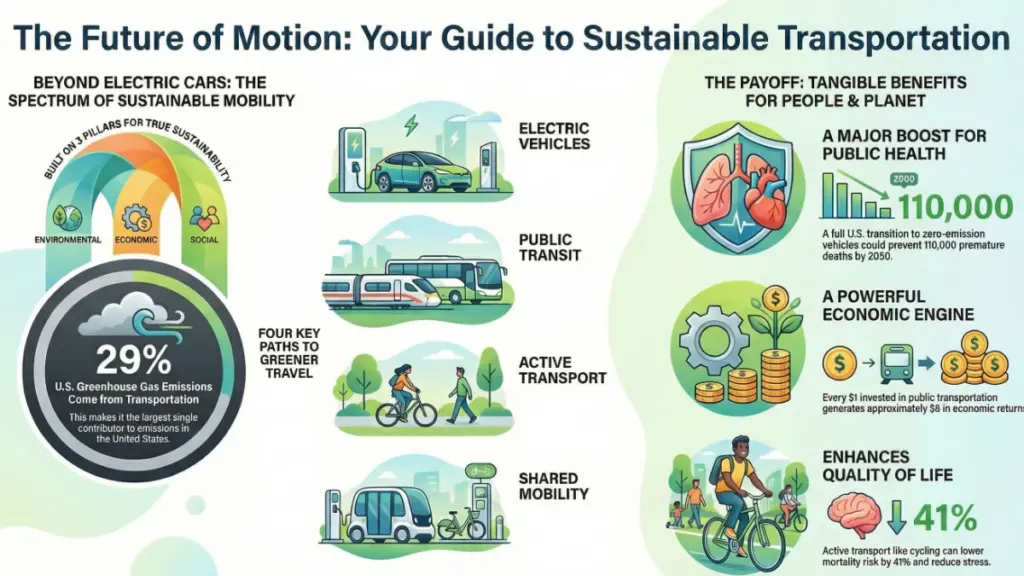
At its core, sustainable transportation is built on three foundational pillars: environmental sustainability (reducing emissions and pollution), economic sustainability (creating systems that are financially viable long-term), and social sustainability (ensuring equitable access to mobility for all communities).
Think of it this way: a city could theoretically replace every gas-powered car with an electric one, but if those EVs still sit in gridlock for hours daily, consume massive amounts of electricity from coal plants, and remain unaffordable for lower-income residents, the system isn’t truly sustainable. Real sustainable transportation requires rethinking not just what we drive, but how, when, and how often we travel.
The transportation sector currently accounts for approximately 27% of global CO2 emissions, according to the International Energy Agency. In the United States, that figure climbs to nearly 29%, making it the largest contributor to greenhouse gas emissions domestically. These numbers make it clear: transforming how we move is absolutely essential to addressing climate change.
But here’s the encouraging part—sustainable transportation isn’t just about sacrifice or inconvenience. Many sustainable options actually improve quality of life. Cities with robust public transit systems report lower stress levels among residents. People who bike or walk regularly experience better physical health. Electric vehicle owners enjoy lower fuel costs and quieter rides. The transition to sustainable transportation isn’t just necessary; it’s genuinely beneficial.
The Full Spectrum of Sustainable Transportation Options
Sustainable mobility isn’t one-size-fits-all. Different solutions work better for different contexts, communities, and needs. Let’s explore the major categories:
Electric and Zero-Emission Vehicles
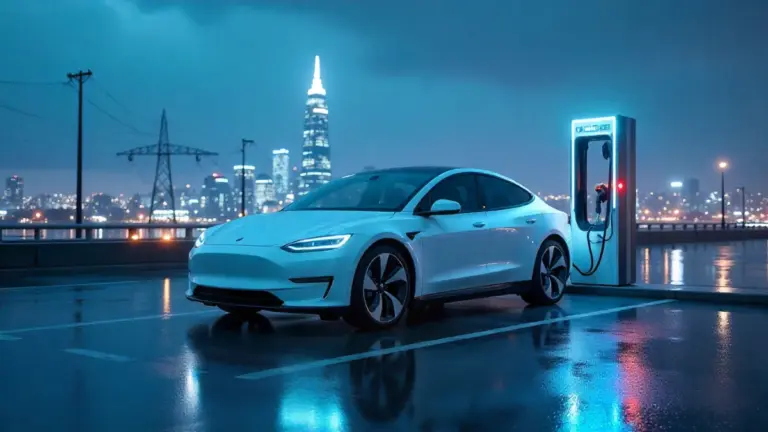
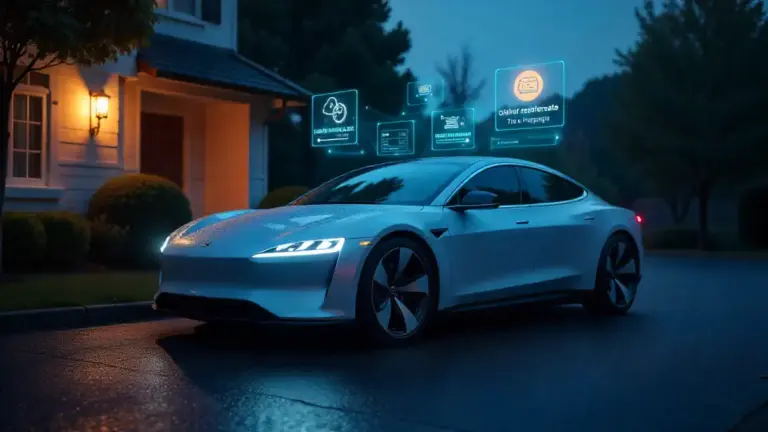
Battery Electric Vehicles (BEVs) have exploded in popularity, with global sales reaching over 14 million units in 2024—a 35% increase from the previous year. Models like the Tesla Model 3, Ford F-150 Lightning, and Hyundai IONIQ 6 are proving that EVs can match or exceed conventional vehicles in performance, range, and practicality.
The key advantages? Zero tailpipe emissions, significantly lower operating costs (electricity costs roughly one-third as much as gasoline per mile), and reduced maintenance needs since there’s no engine oil to change or transmission to service. Modern EVs now offer ranges exceeding 300 miles on a single charge, effectively eliminating “range anxiety” for most drivers.
Plug-in Hybrid Electric Vehicles (PHEVs) serve as a bridge technology, offering 20-50 miles of electric-only range for daily commuting while maintaining a gasoline engine for longer trips. They’re particularly useful in regions where charging infrastructure remains limited.
Hydrogen Fuel Cell Vehicles represent another zero-emission option. Cars like the Toyota Mirai and Hyundai NEXO convert hydrogen into electricity, emitting only water vapor. While the technology is promising, hydrogen refueling infrastructure remains sparse outside California and a few international markets.
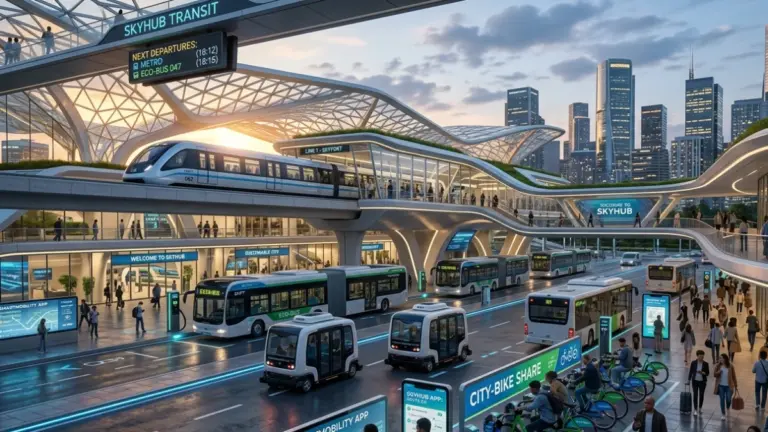
Public Transportation and Mass Transit
Here’s a fact that surprises many people: a single full bus removes approximately 40 cars from the road. When you scale that to rail systems—subways, light rail, and commuter trains—the impact multiplies dramatically.
Cities investing heavily in public transit are seeing remarkable results. Copenhagen’s Metro system reduced car traffic in the city center by 18% within its first five years. Portland’s MAX light rail system serves over 122,000 daily riders, preventing an estimated 45 million car trips annually.
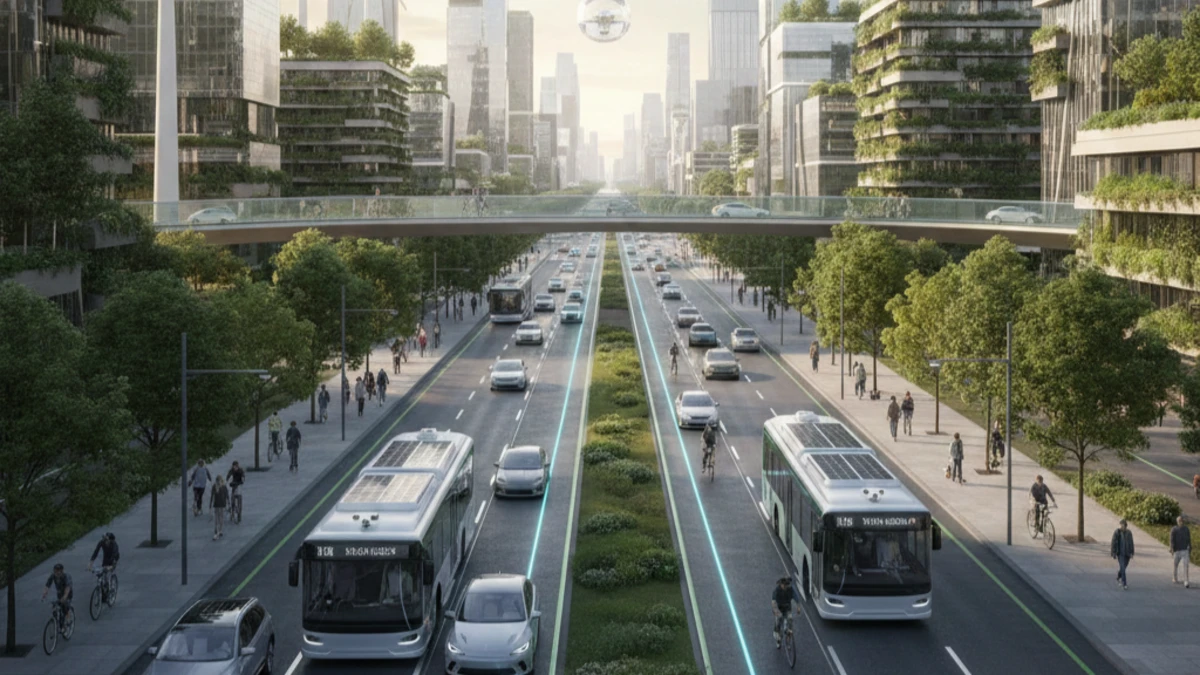
Modern public transit is evolving rapidly. Electric buses are replacing diesel fleets in cities worldwide—Shenzhen, China has converted its entire 16,000-bus fleet to electric. Many systems now feature real-time tracking apps, contactless payment, and improved accessibility features that make public transit genuinely competitive with private vehicles.
The environmental math is compelling: public transit produces 45% less carbon dioxide per passenger mile compared to private vehicles, according to the American Public Transportation Association.
Active Transportation: Walking and Cycling
Sometimes the most sustainable transportation is the simplest. Active transportation—walking, cycling, and using micro-mobility devices like e-scooters—produces zero emissions while providing health benefits.
The cycling revolution is being accelerated by e-bikes, which have demolished the “too far, too hilly, too sweaty” objections that kept many people from commuting by bicycle. E-bike sales in the U.S. surpassed 1.1 million units in 2024, and European markets are seeing even faster adoption. These electric-assist bikes extend practical cycling range to 15-20 miles comfortably, making them viable car replacements for millions of commuters.
Cities are responding by building protected bike lanes, expanding bike-share programs, and creating safer infrastructure. Amsterdam and Copenhagen, with their extensive cycling networks, show what’s possible: in both cities, over 40% of all trips are made by bicycle. These aren’t just short recreational rides—residents routinely cycle year-round, including in winter weather.
Shared Mobility and Transportation as a Service
The future of sustainable transportation may involve owning less and sharing more. Shared mobility services—including ride-sharing (Uber, Lyft), car-sharing (Zipcar, Turo), bike-sharing (Citi Bike, Lime), and emerging autonomous vehicle networks—promise to reduce the total number of vehicles needed.
Consider this: the average personal vehicle sits parked and unused 95% of the time. It’s a staggering waste of resources. Shared mobility aims to maximize vehicle utilization, potentially reducing the total number of cars needed by 60-80% in urban areas, according to studies by the Rocky Mountain Institute.
The concept of “Mobility as a Service” (MaaS) takes this further by integrating multiple transportation options into a single app and payment system. You might take a bus to a train station, grab an e-scooter for the last mile to work, and use a car-share service for an evening errand—all coordinated and paid through one platform. Helsinki, Finland pioneered this approach with its Whim app, which offers subscription plans covering all local transportation needs.
The Real-World Benefits: Why Sustainable Transportation Matters
Understanding the “what” of sustainable transportation is important, but grasping the “why” is what drives meaningful change. Let’s look at the tangible benefits that make this transition so critical.
Environmental Impact
The numbers here are striking. Transportation electrification alone could reduce global carbon emissions by 1.5 gigatons annually by 2030—equivalent to taking 300 million cars off the road permanently. That’s according to Bloomberg NEF’s Electric Vehicle Outlook.
But the benefits extend beyond just carbon. Traditional vehicles emit nitrogen oxides, particulate matter, and other pollutants that cause respiratory diseases, cardiovascular problems, and premature deaths. The American Lung Association estimates that transitioning to zero-emission vehicles would prevent 110,000 premature deaths in the U.S. by 2050 and generate $1.2 trillion in public health benefits.
Cities that have prioritized sustainable transportation report measurably cleaner air. Oslo, Norway—which banned cars from its city center and invested heavily in electric buses and cycling infrastructure—saw nitrogen dioxide levels drop by 19% in just three years.
Economic Advantages
Sustainable transportation creates significant economic value at both personal and societal levels. EV owners save an average of $800-1,200 annually on fuel costs, plus hundreds more on maintenance. Over a vehicle’s lifetime, that adds up to $10,000-15,000 in savings.
At the community level, investing in public transit generates impressive economic returns. Every dollar invested in public transportation generates approximately $5 in economic returns, according to APTA. Why? Better mobility means better job access, increased property values near transit stations, reduced healthcare costs from improved air quality, and less money flowing out of local economies to oil-producing regions.
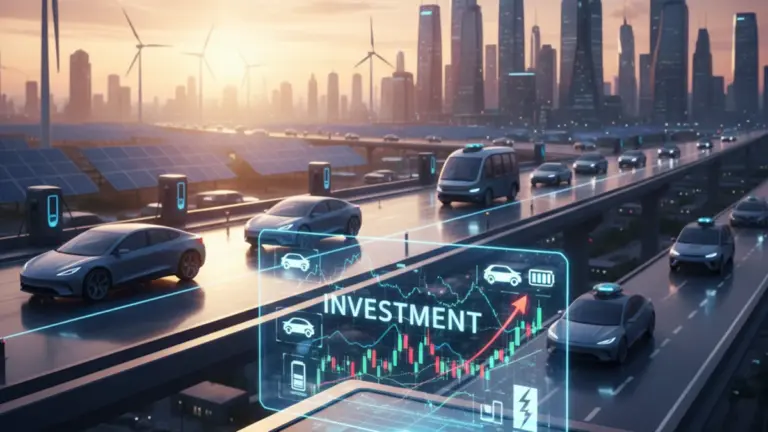
The sustainable transportation industry itself is becoming a massive economic driver. The global EV market is projected to reach $1.5 trillion by 2027. Battery manufacturing, charging infrastructure installation, and electric bus production are creating hundreds of thousands of jobs—many in regions previously dependent on fossil fuel industries.
Social Equity and Accessibility
Here’s something we don’t discuss enough: sustainable transportation can be profoundly democratizing. Not everyone can afford a $40,000+ vehicle, gasoline, insurance, parking, and maintenance. But a $95 monthly transit pass? That’s accessible to millions more people.
Quality public transportation, safe cycling infrastructure, and walkable neighborhoods give mobility options to seniors who can’t drive, young people without licenses, people with disabilities, and lower-income families. This isn’t just nice—it’s essential for economic opportunity. Studies consistently show that access to reliable transportation is one of the strongest predictors of upward economic mobility.
However, we must acknowledge the challenges. Many low-income communities and rural areas have been underserved by public transit investment. EV incentives primarily benefit middle and upper-income buyers who can afford new vehicles. True sustainable transportation requires intentional policies ensuring equitable access across all communities.
Health and Quality of Life
The health benefits of sustainable transportation extend far beyond cleaner air. Active transportation—walking and cycling—directly combats the sedentary lifestyle epidemic. Regular cyclists have a 41% lower risk of all-cause mortality compared to non-cyclists, according to research published in the British Medical Journal.
Noise pollution, often overlooked, significantly impacts health and well-being. Electric vehicles operate at a whisper compared to combustion engines. Cities transitioning to electric buses and reducing car traffic report measurably lower noise levels, which correlates with reduced stress, better sleep, and improved mental health among residents.
Perhaps most importantly, sustainable transportation enhances livability. Streets designed for people rather than just cars become social spaces. Neighborhoods with good transit connections and bike infrastructure report higher levels of social interaction and community cohesion. These “soft” benefits are difficult to quantify but profoundly important to human flourishing.
Challenges and Barriers: The Road Ahead Isn’t Without Obstacles
Let’s be honest—if sustainable transportation were easy and universally beneficial with no trade-offs, we would have already made the switch. Understanding the challenges is crucial for developing realistic solutions.
Infrastructure Investment Needs
The infrastructure gap is enormous. The U.S. needs approximately 500,000 public EV charging stations by 2030 to support projected EV adoption, but currently has fewer than 65,000. The disparity is even more stark for fast-charging stations capable of adding 200 miles of range in 20-30 minutes.
Public transit faces similar challenges. The American Society of Civil Engineers gives U.S. public transit infrastructure a grade of D-, noting that 45% of buses and 25% of rail transit assets are past their useful life. Fixing and expanding these systems requires hundreds of billions in investment.
Many cities lack safe cycling infrastructure entirely. Building protected bike lanes, secure bike parking, and connected networks requires not just money but also political will to reallocate road space from cars to other uses—a move that often faces fierce resistance.
Range Anxiety and Practical Concerns
Despite massive improvements in EV range and charging speed, range anxiety persists. The concern isn’t entirely irrational—if you live in an apartment without charging access, or regularly drive to remote areas with sparse charging infrastructure, an EV may genuinely be impractical today.
Cold weather performance remains a legitimate concern in northern climates. EVs can lose 20-40% of their range in freezing temperatures due to battery chemistry and cabin heating demands. While newer models handle cold better, it’s a real consideration for potential buyers.
Charging time, even with fast chargers, still takes longer than filling a gas tank. For the vast majority of EV owners, overnight home charging eliminates this concern entirely—you start each day with a “full tank.” But for people without home charging, or on long road trips, charging requires more planning and time than conventional refueling.
Cost and Affordability
Initial purchase price remains the biggest barrier to EV adoption. While EVs cost less to operate, they typically carry higher upfront costs—though this gap is closing rapidly. The average new EV in 2024 cost about $55,000, compared to $48,000 for conventional vehicles. However, numerous models now start under $40,000, and the used EV market is expanding quickly.
Federal tax credits (up to $7,500 in the U.S.) and various state incentives help, but many lower-income buyers don’t have the tax liability to claim credits or the capital for even a reduced purchase price. This creates an equity challenge where the environmental benefits of EVs remain inaccessible to those who could most benefit from lower operating costs.
Public transit faces affordability challenges too—not for riders, but for municipalities. Building and operating transit systems requires sustained public funding, which often conflicts with competing budget priorities and anti-tax political sentiments.
Grid Capacity and Energy Sources
Here’s a critical question: if we plug in millions of electric vehicles, will the electrical grid collapse? The short answer is no, but the longer answer is “not if we’re smart about it.”
Mass EV adoption will increase electricity demand by 20-30% by 2050, according to grid operators. This requires significant upgrades to generation capacity, transmission infrastructure, and distribution systems. The good news? This load increase is manageable with proper planning, especially with smart charging systems that charge vehicles during off-peak hours.
The cleanliness of EVs depends entirely on the grid’s energy mix. An EV charged by coal-generated electricity produces more lifetime emissions than an efficient hybrid vehicle. However, even on today’s U.S. grid (about 60% fossil fuels), EVs produce roughly half the lifetime emissions of comparable gasoline vehicles. As the grid becomes cleaner—renewable energy now accounts for 30% of U.S. electricity and growing rapidly—EVs become even more sustainable.
Behavioral and Cultural Barriers
Never underestimate the power of habit. Many people have been driving gasoline cars their entire lives. Change feels risky, uncomfortable, and unnecessary—especially when the climate impacts of their individual choices seem abstract and distant.
Car culture runs deep, particularly in the United States. Personal vehicle ownership represents freedom, status, and independence to many people. Suggesting someone take the bus or ride a bike can feel like an attack on their lifestyle or identity. Overcoming this requires not just logical arguments but compelling alternatives that genuinely compete on convenience and desirability.
There’s also significant misinformation circulating about EVs—from exaggerated claims about battery mining impacts to false assertions about fire risks. While every technology has legitimate concerns worth discussing, much of the narrative is driven by industries threatened by change.
Making Sustainable Transportation Choices: Practical Steps You Can Take
Feeling overwhelmed by all this information? You’re not alone. But here’s the good news: you don’t need to revolutionize your entire life overnight. Sustainable transportation is a spectrum, and every step toward more sustainable mobility makes a difference.
Assess Your Transportation Needs
Start with honest self-reflection. Track your typical travel patterns for a week. How far do you commute? How often do you make trips over 200 miles? Could any regular trips be done differently?
You might discover that 80% of your driving is within a 30-mile radius—easily handled by even modestly-ranged EVs. Or perhaps you drive 100+ miles daily for work, making a plug-in hybrid or efficient conventional vehicle more practical right now. Understanding your actual needs versus perceived needs is the first step.
Consider questions like: Does your commute have public transit options you’ve dismissed without trying? Are there safe bike routes you haven’t explored? Could you combine errands to reduce trips? There’s no judgment here—just honest assessment.
Explore Your Local Options
Research your local sustainable transportation infrastructure. Many cities have resources you might not be aware of:
- Public Transit: Check route maps and schedules. Many systems now offer apps with real-time arrival information that make transit far more convenient than it was a decade ago. Many also offer reduced-fare or free trial periods.
- Bike Infrastructure: Does your city have bike-share programs? Are there protected bike lanes or multi-use paths you haven’t discovered? Google Maps now has a cycling layer showing bike-friendly routes.
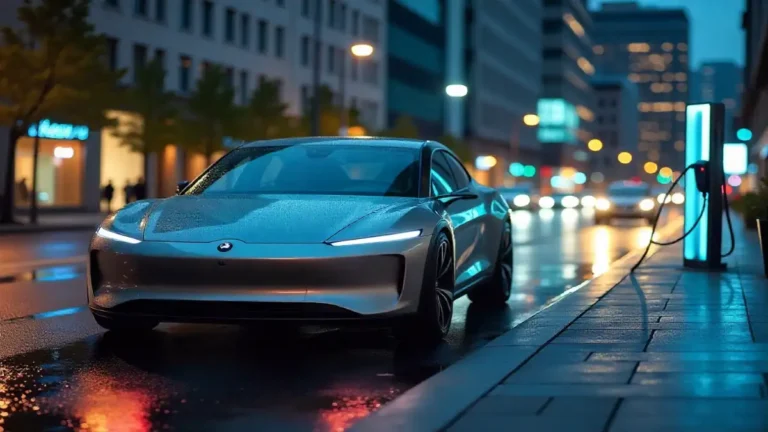
- EV Charging: Use apps like PlugShare to see where charging stations are located near your home, work, and common destinations. You might be surprised how many options exist.
- Car-Share Services: If you only occasionally need a car, services like Zipcar or Turo might offer better value than ownership.
Start Small with High-Impact Changes
You don’t need to sell your car and buy an e-bike tomorrow. Try these graduated approaches:
Phase 1: Optimize Current Transportation
- Combine errands to reduce trips
- Carpool when possible
- Keep your vehicle well-maintained for optimal fuel efficiency
- Try public transit for your commute once or twice a week
Phase 2: Experiment with Alternatives
- Bike to nearby destinations on weekends
- Use ride-sharing for occasional needs instead of owning a second vehicle
- Try an e-bike rental or bike-share for a week
- Take public transit for special events instead of driving and parking
Phase 3: Make Bigger Changes
- Replace one household vehicle with an EV when it’s due for replacement
- Commit to public transit or cycling as your primary commute method
- Relocate to a more transit-accessible or walkable neighborhood (when feasible)
- Advocate for better sustainable transportation infrastructure in your community
Financial Considerations and Incentives
Take advantage of available incentives:
- Federal EV tax credits (up to $7,500 for new vehicles, up to $4,000 for used)
- State and local rebates (some states offer additional thousands in incentives)
- Utility company programs offering reduced electricity rates for EV charging during off-peak hours
- Employer benefits like subsidized transit passes or bike commuter programs
- HOV lane access for EVs and hybrids in many states
Calculate total cost of ownership, not just purchase price. An EV costing $5,000 more upfront might save $10,000 over five years in fuel and maintenance, making it the more economical choice.
Advocate for Systemic Change
Individual choices matter, but systemic change creates the biggest impact. Here’s how you can be part of that:
- Attend city council or transportation planning meetings to support sustainable infrastructure investments
- Vote for political candidates prioritizing climate action and sustainable transportation
- Support businesses that facilitate sustainable transportation (bike shops, EV charging companies, transit-oriented developments)
- Share your positive experiences with sustainable transportation to help normalize these choices
- Push your employer to offer bike parking, EV charging, or transit subsidies
The most powerful thing you can do might be making sustainable transportation visible and normal in your community. When neighbors see you happily biking to work or charging your EV at home, it plants seeds of possibility.
The Future of Sustainable Transportation: What’s Coming Next
The pace of change in transportation is accelerating dramatically. Understanding emerging trends helps you make informed decisions and prepare for what’s ahead.
Autonomous Vehicles and Smart Mobility
Self-driving technology is advancing faster than most people realize, though full autonomy remains years away. Companies like Waymo are already operating truly driverless taxi services in limited areas of Phoenix, San Francisco, and Los Angeles.
The sustainability implications are complex. Autonomous vehicles could dramatically reduce transportation emissions by optimizing routes, enabling shared rides, and eliminating the need for parking infrastructure in city centers. However, they could also increase total miles traveled if they make car travel so convenient that people abandon transit and active transportation.
The key is ensuring autonomous vehicles are electric, shared, and integrated into multimodal transportation systems rather than simply replacing today’s private cars with driverless private cars.
Battery Technology Breakthroughs
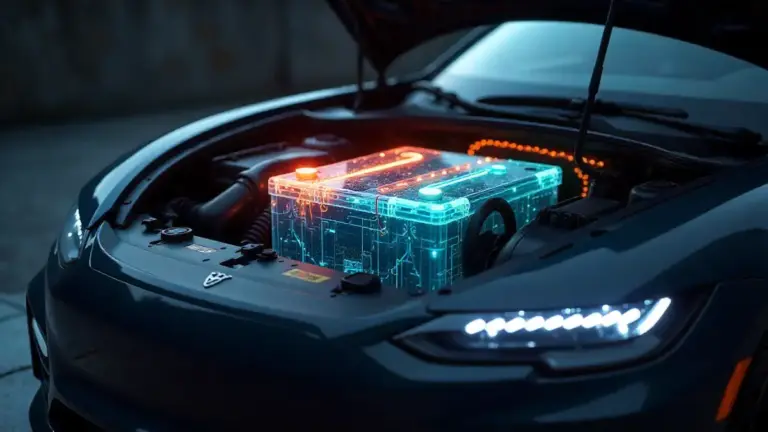
Solid-state batteries—using solid electrolytes instead of liquid—promise to revolutionize EVs within the next 3-5 years. They offer potentially 50% more range, faster charging (10 minutes for 80% charge), improved safety, and longer lifespan.
Companies like Toyota, QuantumScape, and Solid Power are racing to bring solid-state batteries to market by 2027-2028. When they arrive, many current objections to EVs will become obsolete.
Simultaneously, battery recycling technology is maturing. Companies can now recover over 95% of valuable materials from used EV batteries, and many used batteries get “second lives” as stationary energy storage before eventual recycling. This dramatically improves the lifecycle sustainability of EVs.
Urban Planning and 15-Minute Cities
The concept of “15-minute cities“—where residents can access most daily needs within a 15-minute walk or bike ride—is gaining traction globally. Paris, Barcelona, Melbourne, and Portland are leading implementations.
This urban design philosophy fundamentally changes transportation by reducing the need for it. When homes, workplaces, schools, shops, and services are closely integrated, many trips become unnecessary, and those that remain become easy to make on foot or by bike.
Critics worry about restriction of movement or property value impacts, but early results show improved quality of life, stronger local businesses, and reduced car dependence without restricting anyone’s freedom to travel farther when desired.
Infrastructure Innovations
Wireless charging technology is moving from concept to reality. Induction charging pads embedded in parking spaces could automatically charge EVs without plugging in. Some cities are testing electrified road segments that charge vehicles while driving, though this remains experimental and expensive.
Battery swap stations, popular in China, allow EVs to exchange depleted batteries for fresh ones in under five minutes. While not widely adopted elsewhere, the technology offers an alternative to fast charging for specific use cases like taxi fleets or delivery vehicles.
Solar-integrated infrastructure is expanding. Bus shelters with solar panels, parking structures generating electricity, and roadways incorporating solar cells (still experimental) all contribute to creating transportation systems that generate their own clean energy.
Policy Developments
Government policies are accelerating the transition. The European Union has mandated that all new cars sold must be zero-emission by 2035. California—representing the world’s fifth-largest economy—has adopted the same target, with several states following suit.
The U.S. Inflation Reduction Act invested $369 billion in climate and energy programs, including substantial EV incentives and charging infrastructure funding. Even conservative-led states are investing in EV infrastructure, recognizing the economic opportunities.
Globally, at least 20 countries have announced plans to phase out internal combustion engine vehicles by 2035 or earlier. These policy signals provide certainty for automakers, accelerating their electric transition plans.
Integration of Renewable Energy
The true potential of sustainable transportation emerges when combined with renewable energy. Vehicle-to-grid (V2G) technology allows EVs to not only charge from the grid but also discharge power back to it during peak demand periods.
Imagine your EV acting as a distributed battery, storing excess solar energy during the day and feeding it back to your home or the grid in the evening. This creates a synergistic relationship where transportation and energy systems support each other, dramatically improving both sustainability and grid resilience.
By 2030, analysts project that EV batteries could provide more grid storage capacity than all utility-scale batteries combined—a remarkable resource for balancing renewable energy’s variability.
Key Takeaways: Your Roadmap to Sustainable Transportation
As we’ve explored throughout this guide, sustainable transportation is multifaceted, evolving rapidly, and increasingly accessible. Here are the essential points to remember:
Sustainable transportation encompasses diverse options beyond just electric cars—including public transit, cycling, walking, and shared mobility services. The best solution depends on your specific circumstances, community infrastructure, and travel patterns. There’s no one-size-fits-all answer.
The environmental and health benefits are substantial and scientifically documented. Transportation electrification, combined with grid decarbonization, can reduce emissions by billions of tons annually while improving air quality and public health. These aren’t abstract future possibilities—they’re measurable impacts happening right now in cities making the transition.
Economic advantages exist at both personal and societal levels, from lower fuel and maintenance costs for EV owners to broader economic returns from public transit investment. The upfront costs are real but decreasing, and the total cost of ownership often favors sustainable options.
Challenges remain around infrastructure, affordability, and behavior change, but none are insurmountable. Technology is advancing rapidly, costs are falling, infrastructure is expanding, and public attitudes are shifting. The transition is well underway and accelerating.
Individual actions matter, but systemic change is essential. You can make sustainable transportation choices in your own life while also advocating for the infrastructure, policies, and cultural shifts that make sustainable mobility accessible to everyone.
Taking Your Next Steps
So where do you go from here? Start by honestly assessing your current transportation patterns and exploring what sustainable options exist in your community. Maybe that means testing your local public transit system this week. Perhaps it’s researching EVs and calculating whether one makes financial sense when your current vehicle needs replacing. Or it could be as simple as trying to bike to a nearby destination instead of driving.
The transition to sustainable transportation is one of the most important shifts our society will make in the coming decades. It’s not just about addressing climate change—though that’s critically important. It’s about building communities that are healthier, more equitable, more economically vibrant, and frankly, more pleasant places to live.
Every trip you take is a choice. Not every choice needs to be perfect, but every choice in a more sustainable direction contributes to the future we’re collectively creating. The question isn’t whether sustainable transportation will become the norm—the trends make clear it will. The question is how quickly we’ll get there and whether the transition will be equitable and accessible to all.
What will your next trip look like?