You’ve made the leap to electric—congratulations! But now you’re probably wondering: Where exactly do I take this thing when it needs service? Unlike your old gas-powered car where any corner mechanic could handle an oil change, electric vehicles require specialized knowledge and equipment. The good news? Finding qualified EV technicians is getting easier every day, and I’m here to show you exactly how to locate the right service providers in your area.
In this guide, you’ll discover how to identify certified EV technicians, what qualifications actually matter, when you should head to a dealership versus an independent shop, and smart questions to ask before anyone touches your electric vehicle. Whether you’re dealing with routine maintenance or unexpected repairs, you’ll know exactly where to turn.
Understanding What Makes EV Maintenance Different
Here’s something that surprises many new EV owners: electric cars actually require less maintenance than traditional vehicles. There’s no oil to change, no transmission fluid to flush, no spark plugs to replace, and no exhaust system to worry about. According to the U.S. Department of Energy, EVs typically cost about half as much to maintain over their lifetime compared to gas-powered vehicles.
But—and this is important—the maintenance they do require is specialized. We’re talking about high-voltage battery systems (often 400 volts or more), complex regenerative braking systems, electric motors with different torque characteristics, and sophisticated thermal management systems. This isn’t your grandfather’s automotive technology.
What EVs Still Need Regular Attention
Even with fewer moving parts, your electric vehicle needs routine care:
- Tire rotations and replacements (often more frequently due to instant torque)
- Brake fluid checks (yes, even with regenerative braking)
- Cabin air filter replacements
- Coolant system maintenance for battery and motor cooling
- Software updates and diagnostics
- Battery health monitoring
- Brake pad inspections (they last longer but still need checking)
The specialized nature of these systems means not every mechanic can—or should—work on your EV. That’s why finding the right technician matters so much.
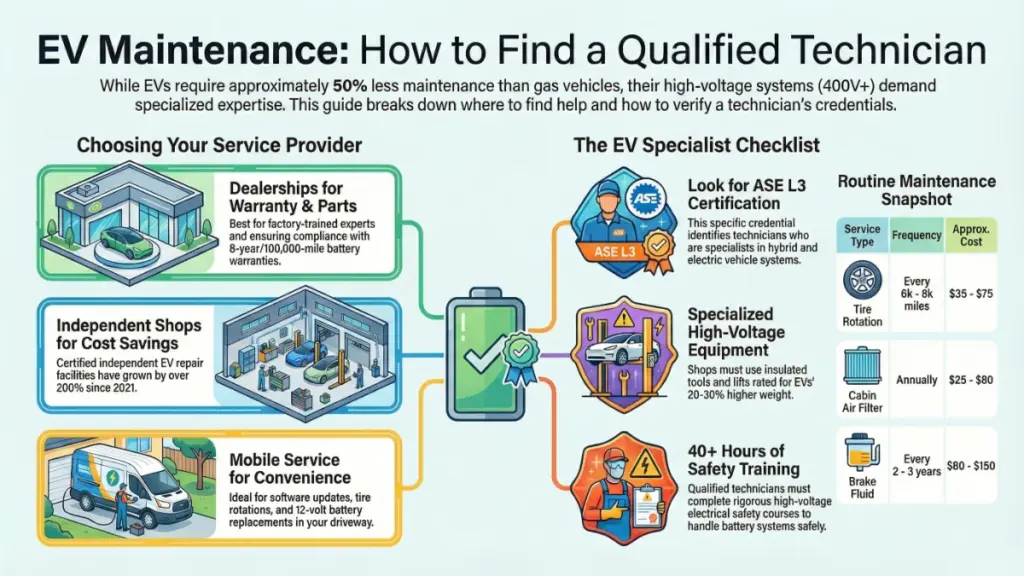
Start with Your Dealership’s Service Center
Let’s address the obvious choice first: your vehicle’s dealership. If you bought a Tesla, Rivian, Nissan Leaf, Chevy Bolt, or any other EV from a manufacturer, their service centers should be your first consideration—especially if your vehicle is still under warranty.
Why Dealership Service Centers Make Sense
Factory-trained technicians: These mechanics have gone through manufacturer-specific training programs. For example, Tesla technicians complete comprehensive courses on high-voltage safety, battery systems, and proprietary repair procedures. They know your exact model inside and out.
Specialized diagnostic equipment: Dealerships invest in manufacturer-specific diagnostic tools and software. A 2024 Ford Mustang Mach-E, for instance, requires Ford’s proprietary diagnostic system to properly assess battery health and electrical system performance.
Warranty compliance: This is crucial. If your EV is under warranty (most new EVs come with 8-year/100,000-mile battery warranties), using unauthorized repair facilities could potentially void coverage for certain components. Always check your warranty terms.
Genuine parts availability: Dealerships have direct access to OEM (Original Equipment Manufacturer) parts, which can be critical for high-voltage components where aftermarket options may not exist or meet safety standards.
The Dealership Trade-Off
The dealership downside? Cost. You’ll typically pay premium prices for labor and parts. However, during your warranty period, this is often your safest bet.
How to find your nearest dealership service center:
- Visit your vehicle manufacturer’s website
- Use their “Find a Dealer” or “Service Center Locator” tool
- Call ahead to verify they have EV-certified technicians on staff
- Ask about appointment availability (some EV service centers book weeks in advance)
Certified Independent EV Repair Shops: Your Budget-Friendly Alternative
Once your warranty expires—or if you’re comfortable venturing beyond the dealership—certified independent shops can offer significant savings while maintaining quality service. The key word here is certified.
Independent shops specializing in EV maintenance have exploded in growth. According to industry data, the number of independent repair facilities with EV certification has increased by over 200% since 2021. These shops undergo rigorous training and invest in the proper equipment to safely service electric vehicles.
What to Look for in an Independent EV Shop
ASE (Automotive Service Excellence) L3 Certification: This is the gold standard. ASE L3 certification specifically covers hybrid and electric vehicle specialist skills. When you call a shop, ask: “Do you have ASE L3-certified technicians on staff?” Don’t just settle for general ASE certification.
High-voltage safety training: Working on EV battery systems can be dangerous without proper training. Technicians should have completed high-voltage electrical safety courses, typically 40+ hours of specialized training. Ask about their safety protocols and training credentials.
Proper equipment: A qualified EV shop needs insulated tools rated for high-voltage work, battery diagnostic equipment, thermal imaging cameras, and lift equipment rated for heavier EV weights (EVs typically weigh 20-30% more than comparable gas vehicles due to battery packs).
Brand-specific experience: While not as crucial as dealership work, shops with experience on your specific brand or platform (like Volkswagen’s MEB platform or General Motors’ Ultium platform) will be more efficient and knowledgeable.
How to Locate Certified Independent Shops Near You
Finding the right independent shop requires a bit of research, but these resources make it easier:
- Use AAA’s Approved Auto Repair facility search (if you’re a member): Many AAA-approved shops now offer EV services
- Check the National Institute for Automotive Service Excellence (ASE) shop locator at ase.com
- Search online for “ASE L3 certified EV repair near me” or “certified electric car mechanic [your city]”
- Ask in local EV owner groups (Facebook groups, Reddit’s r/electricvehicles, or brand-specific forums)
- Check reviews on Google, Yelp, and specialized automotive review sites like RepairPal
Mobile EV Service: The Convenience Factor
Here’s an option that didn’t exist a few years ago: mobile EV technicians who come to your home or workplace. Tesla pioneered this model with their Mobile Service fleet, but now independent mobile mechanics are entering the market across the country.
Mobile service works exceptionally well for EVs because many common maintenance tasks don’t require a lift or extensive shop equipment. Software updates, 12-volt battery replacements, tire services, brake inspections, and even some high-voltage connector work can be performed in your driveway.
When Mobile Service Makes Sense
Mobile technicians excel at handling these services:
- Software updates and diagnostics
- Tire rotations and replacements
- 12-volt battery service
- Minor electrical repairs
- Warranty-covered repairs (if offered by manufacturer)
- Brake inspections and fluid service
When You’ll Need a Traditional Shop
Certain repairs still require full shop capabilities:
- Major battery pack repairs
- Drivetrain component replacement
- Alignment services
- Extensive bodywork
- Suspension overhauls
Finding Mobile EV Technicians
For Tesla owners, schedule through the Tesla app—it’s incredibly convenient. For other brands, search for “mobile EV mechanic [your city]” or check services like Wrench, YourMechanic, or RepairSmith, which are expanding EV capabilities in major metro areas. Always verify the technician’s EV-specific certifications before booking.
Questions to Ask Before Choosing a Service Provider
Whether you’re considering a dealership, independent shop, or mobile service, here are the essential questions that will help you separate qualified providers from those who might be in over their heads:
About Certifications and Training
- “Do you have ASE L3-certified technicians on staff?”
- “What specific training have your technicians completed for electric vehicle service?”
- “Are your technicians trained on my specific vehicle make and model?”
About Equipment and Capabilities
- “What diagnostic equipment do you use for EV battery systems?”
- “Do you have the manufacturer-specific diagnostic software for my vehicle?”
- “Are your tools rated for high-voltage electrical work?”
About Experience
- “How many electric vehicles do you service monthly?”
- “Have you worked on [your specific model] before?”
- “Can you provide references from other EV owners?”
About Service Details
- “What’s your average turnaround time for routine maintenance?”
- “Do you provide loaner vehicles or shuttle service?”
- “How do you handle warranty claims if applicable?”
- “What is your parts sourcing policy—OEM, aftermarket, or both?”
A reputable shop will answer these confidently and transparently. If you sense hesitation or vague responses, that’s your cue to keep looking.
Understanding EV Maintenance Costs and Scheduling
Let’s talk money. One of the biggest advantages of EV ownership is the reduced maintenance schedule, but you should still budget appropriately and know what to expect.
Typical EV Maintenance Schedule
| Service Type | Frequency | Approximate Cost |
|---|---|---|
| Tire rotation | Every 6,000-8,000 miles | $35-$75 |
| Cabin air filter replacement | Annually or 15,000 miles | $25-$80 |
| Brake fluid replacement | Every 2-3 years | $80-$150 |
| Coolant system service | Every 4-5 years | $100-$200 |
| Battery coolant replacement | Every 4-8 years (model-specific) | $150-$400 |
| Brake pad inspection | Annually (replacement far less frequent) | Inspection: $0-$50 |
| Software updates | As released (often free) | $0-$150 |
Compare this to a gas vehicle requiring oil changes every 5,000 miles ($50-$100 each), transmission service every 30,000-60,000 miles ($150-$300), and more frequent brake replacements, and the savings become obvious.
Cost-Saving Tips
Join owner forums and groups: Fellow EV owners are goldmines of information about reliable, affordable service providers in your area. Facebook groups like “[Your Car Model] Owners Group” or Reddit communities often have running lists of recommended mechanics.
Bundle services: Schedule multiple maintenance items together to save on shop labor fees and reduce trips.
Learn DIY basics: Many EV maintenance tasks are actually easier than gas car equivalents. Cabin air filters, 12-volt batteries, and windshield washer fluid are simple DIY projects. Just stay away from high-voltage components—that’s where professionals are absolutely necessary.
Compare prices: Don’t assume the dealership is always more expensive for out-of-warranty work. Sometimes their service specials compete with independent shops, especially for routine maintenance.
Regional Considerations: Urban vs. Rural EV Service Access
Your location significantly impacts your service options. If you’re in a major metropolitan area like Los Angeles, Seattle, or Austin, you’re spoiled for choice with multiple dealerships, independent EV specialists, and mobile service options all competing for your business.
But what if you’re in rural Ohio—where I’m based—or another less densely populated area? The landscape looks different, but you’re not out of options.
For Rural or Underserved Areas
Expand your search radius: You might need to drive 30-60 miles to reach a qualified EV service center. Plan ahead for scheduled maintenance rather than waiting until something breaks.
Establish a relationship with a forward-thinking local mechanic: Some independent shops in smaller towns are investing in EV training even if they don’t advertise it heavily. Call around and ask directly—you might be surprised.
Utilize mobile service when available: If you’re within a major manufacturer’s mobile service area (Tesla, Rivian, Polestar), take advantage of it. These companies are actively expanding coverage.
Plan for less frequent, more comprehensive service visits: Rather than multiple short trips, coordinate annual check-ups that cover everything at once.
Consider manufacturer-specific service networks: Some brands like Tesla and Rivian have service centers in unexpected locations because they’re strategically placed along major highways. Check your manufacturer’s coverage map.
The Growing Service Infrastructure
The EV service infrastructure is rapidly expanding. According to the International Energy Agency, the number of EV-certified service points in North America grew by 40% in 2024 alone, with particular growth in previously underserved markets.
What About Charging Station Maintenance and Issues?
While this article focuses on vehicle maintenance, it’s worth briefly addressing home charging equipment since it’s part of your EV ecosystem.
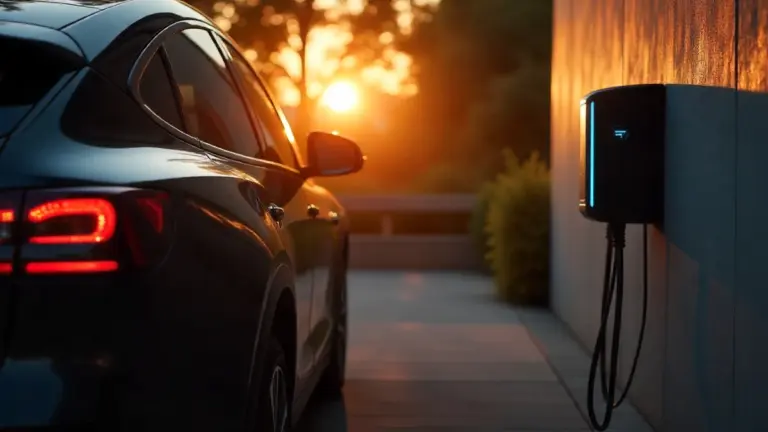
Most EV charging issues aren’t actually car problems—they’re charger problems. If you have a Level 2 home charger installed, know that these also require occasional maintenance and troubleshooting.
For Home Charging Equipment
- Contact the charger manufacturer first (ChargePoint, JuiceBox, Tesla Wall Connector, etc.)
- Many offer remote diagnostics and can troubleshoot over the phone
- For installation or electrical issues, use a licensed electrician familiar with EV charging equipment
For Public Charging Problems
- Report issues through the charging network’s app (Electrify America, EVgo, ChargePoint)
- These are infrastructure issues, not vehicle issues—don’t take your car to a mechanic for charging station malfunctions
The Future of EV Service: What’s Coming
The EV service landscape is evolving rapidly, and the next few years will bring significant improvements:
Increased Service Center Density
Major automakers are investing heavily in expanding their service networks. Ford, for example, has certified over 3,000 dealerships for EV service as of 2024, with plans to double that by 2026.
Better Parts Availability
As EV adoption accelerates, aftermarket parts suppliers are ramping up production, which will reduce costs and wait times for common components.
More ASE L3-Certified Technicians
Vocational schools and community colleges are adding EV technology programs. The skilled technician shortage is gradually being addressed.
Advanced Remote Diagnostics
Many EVs can now transmit diagnostic data directly to service centers before you even arrive, allowing technicians to order parts and prepare for your visit, reducing downtime.
Over-the-Air Updates Reducing Service Needs
Software updates that once required service center visits can now be performed wirelessly, much like updating your smartphone.
Key Takeaways: Making the Right Choice for Your EV
Finding qualified electric car maintenance near you doesn’t have to be complicated. Here’s what you need to remember:
Start with your manufacturer’s dealership, especially during the warranty period. They have the training, tools, and parts to service your vehicle correctly while protecting your warranty coverage.
Look for ASE L3 certification when considering independent shops. This certification proves the technician has the specialized knowledge to work safely on high-voltage vehicle systems.
Don’t skip the vetting process. Ask detailed questions about certifications, equipment, and experience. A qualified shop will be proud to discuss their credentials.
Consider mobile service for routine maintenance if available in your area. It’s convenient and often less expensive than traditional shop visits.
Plan ahead if you’re in a rural area. Establish relationships with service providers before you need emergency repairs.
Remember, electric vehicles are simpler mechanically than gas cars, but their electrical systems require specialized expertise. The right technician will keep your EV running efficiently for years while the wrong one could create expensive problems or even safety hazards.
The EV service infrastructure is improving rapidly. What might feel challenging today—finding a qualified technician in your area—will become increasingly easier as adoption grows and more shops invest in proper training and equipment.
Your electric car represents the future of automotive technology. Make sure you’re entrusting it to service providers who are equally forward-thinking and properly equipped for that future. Take the time to find the right technician now, and you’ll have peace of mind for years of electric driving ahead.