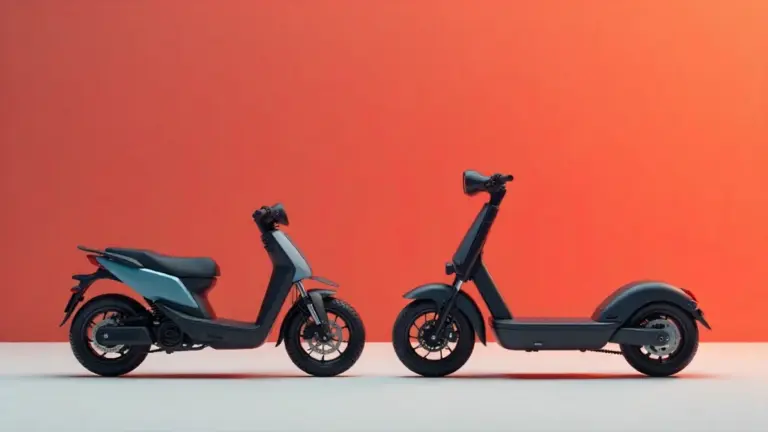
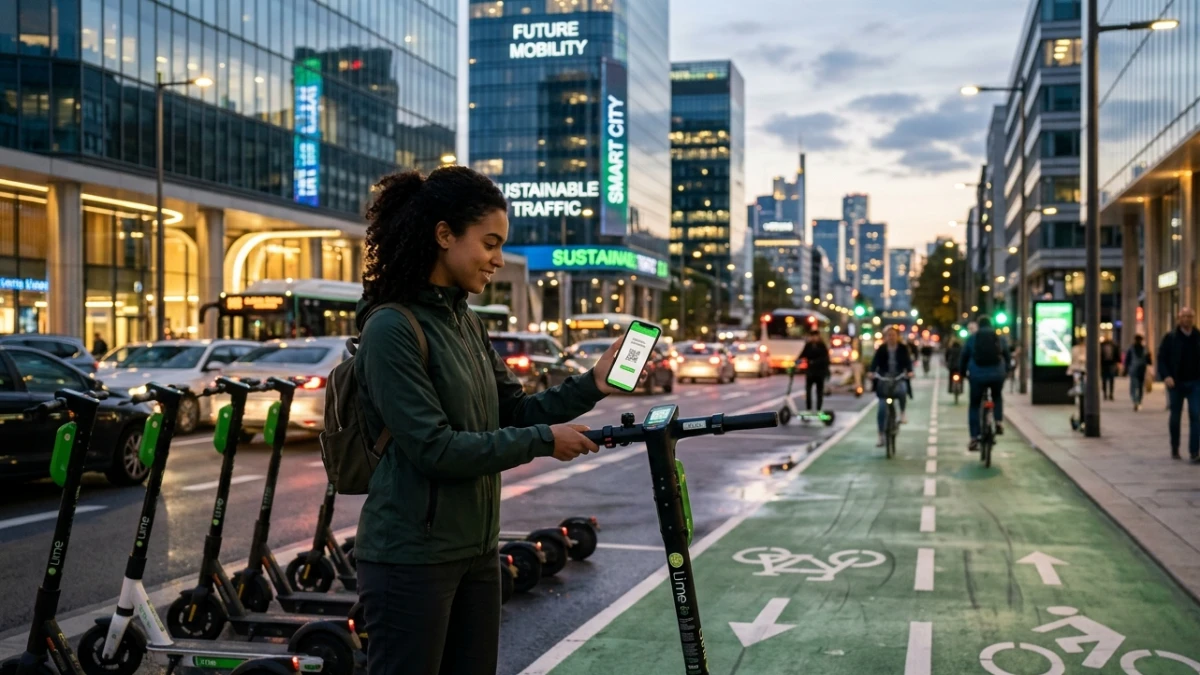
Electric scooter sharing is transforming urban mobility in 2025, offering a fast, affordable, and eco-friendlier alternative to short car trips. With major platforms like Lime, Bird, and Spin expanding globally, riders can cover last-mile journeys for just a few dollars. Improved safety features, longer-lasting scooters, and lower emissions make shared e-scooters a practical transportation solution for commuters, tourists, and students alike.
What Is Electric Scooter Sharing – and Is It Worth It?
Picture this: you step off the subway, and your office is still a mile away. The rideshare surge price is eye-watering, the bus is six minutes out, and walking means you’ll show up sweaty. Then you spot a Lime scooter on the corner.
Thirty seconds later, you’re gliding down the bike lane, breeze in your face, and arriving in five minutes flat for about $2.
That’s the promise of electric scooter sharing—and in 2025, it’s being delivered in cities across the world at a scale that’s hard to overstate. Whether you’re a daily commuter, a tourist exploring a new city, or just someone tired of circling the block for parking, shared e-scooters have quietly become one of the most practical transportation tools of our time. This guide covers everything you need to know: how it works, what it costs, which platforms lead the pack, the real environmental impact, and how to ride smarter.
How Electric Scooter Sharing Actually Works
If you’ve never tried it, the process is surprisingly painless—and you’ll likely wonder why you didn’t try it sooner.
The Basics: Download, Unlock, Ride, Park
Every shared e-scooter service runs through a smartphone app. The most popular platforms in the U.S. and globally include Lime, Bird, and Spin. Here’s the standard flow:
- Download the app (iOS or Android) and create an account with a payment method on file.
- Find a nearby scooter using the app’s map—scooters appear as icons, and you can see their battery level before walking over.
- Unlock it by scanning the QR code on the handlebar or tapping “Unlock” in the app when you’re close enough.
- Ride. Push off with one foot, then press the throttle on the handlebar to engage the electric motor. Most scooters top out around 15–20 mph.
- End your ride by parking in a designated zone, taking a photo through the app to confirm proper parking (both Bird and Lime require this), and tapping “End Ride.”
That’s genuinely it. No gas, no keys, no hunting for a parking spot. The app handles payment automatically.
Pricing: What You’ll Actually Pay
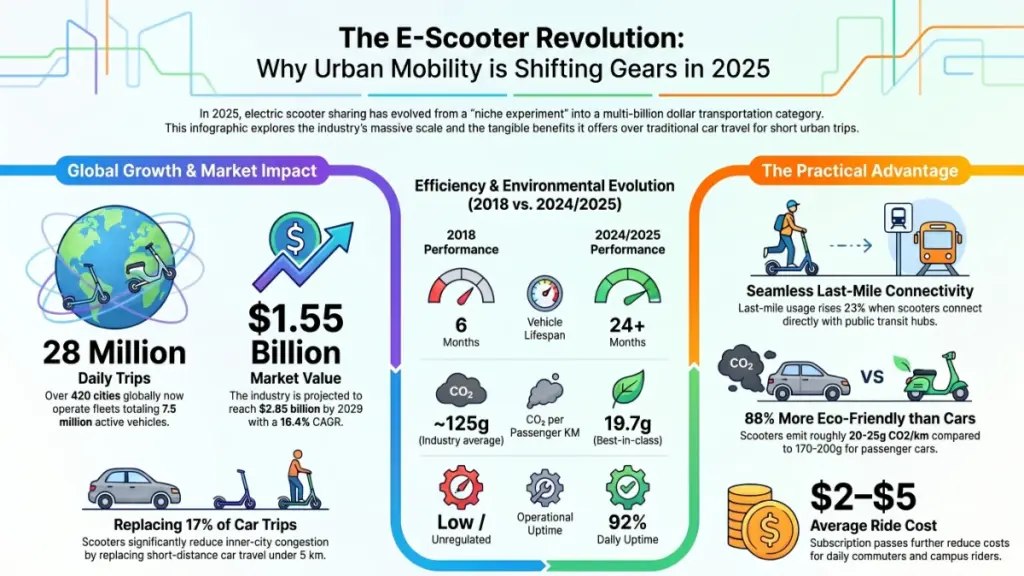
Most services charge a small unlock fee—typically $0.50 to $1.00—plus a per-minute rate that usually lands between $0.15 and $0.39 depending on the city and platform. A typical 10-minute ride costs roughly $2–$5.
Many platforms now offer subscription passes for frequent riders. Lime’s monthly pass, for example, can significantly reduce per-ride costs if you’re commuting daily. It’s worth checking your local app for whatever deals are active in your area.
The State of the Market: Bigger Than You Might Think
Here’s a number that might surprise you: over 420 cities globally now operate shared electric scooter fleets, with more than 7.5 million active vehicles in circulation. Daily ride volumes exceed 28 million trips, with average ride distances ranging from 1.4 km to 2.8 km in dense urban zones.
That’s not a niche experiment—that’s a full-blown transportation category.
The e-scooter sharing market is projected to grow from $1.33 billion in 2024 to $1.55 billion in 2025, and is expected to reach $2.85 billion by 2029 at a CAGR of around 16.4%. The growth is being driven by straightforward demand: people in cities want faster, cheaper, more flexible ways to cover short distances, and shared e-scooters deliver exactly that.
Shared e-scooters replace approximately 17% of short-distance car trips under 5 km, reducing inner-city vehicle congestion by 8–12%. That’s not nothing. In dense urban cores where every car removed from the road helps, those numbers add up fast.
Hardware has improved dramatically too. Vehicle lifespan improved from 6 months in 2018 to over 24 months in 2024, and battery swap cycles dropped from 48 hours to 12 hours, enabling 92% daily operational uptime across major operators. Early shared scooters were notoriously fragile. Today’s fleet hardware is built tough enough to withstand thousands of rides in rain, heat, and everything in between.
The Top Platforms: Lime, Bird, Spin, and Beyond
Not all e-scooter apps are created equal, and availability varies by city. Here’s a quick breakdown of the major players:
| Platform | Best Known For | Notable Availability |
|---|---|---|
| Lime | Widest global footprint, safety focus | U.S., Europe, Australia, Latin America |
| Bird | Strong safety education in-app | U.S. cities, select international |
| Spin | Campus and mid-size city deployments | 60+ U.S. cities, university campuses |
| TIER | Europe-dominant, helmet integration | Germany, France, UK, Nordics |
| Voi | Scandinavia and UK focus | Northern and Central Europe |
| Bolt | Budget pricing in emerging markets | Eastern Europe, Africa, Asia |
If you’re in a major U.S. metro, Lime and Bird are your most likely options. Traveling in Europe? TIER and Voi dominate many cities there. The best move is simply to check which apps operate in your specific city before you travel.
Top e-scooter companies are making safety a priority with features like in-app education, guided tutorials, and proper parking confirmation. TIER includes helmets, and Bird offers excellent safety education within the app. That’s a meaningful evolution from the early days, when scooters appeared overnight with zero infrastructure or guidance.
The Environmental Reality: Greener Than a Car, but It’s Complicated
I want to be straight with you here, because this is where a lot of e-scooter coverage gets it wrong in both directions.
The marketing pitch—”zero emissions!”—isn’t quite accurate for shared scooters. The full lifecycle includes manufacturing, logistics, charging, and fleet operations, all of which consume energy and resources. Research across 32 cities in Europe and North America found that free-floating shared e-scooters don’t inherently provide net environmental benefits—achieving net greenhouse gas reductions depends heavily on operational factors like charging methods and vehicle lifespan.
That said, the industry has made enormous strides. A lifecycle analysis of Lime’s Gen4 e-scooter found the company’s lowest carbon impact yet—just 19.7g CO₂ per passenger kilometer in Paris—and Lime has achieved an 84% reduction in CO₂ per passenger km traveled over five years of operations.
For context, a typical passenger car in the U.S. emits roughly 170–200g CO₂ per kilometer. Even accounting for manufacturing and charging, a modern shared e-scooter at 20–25g CO₂/km is dramatically cleaner.
The practical takeaway: if you’re using a shared scooter to replace a car trip—especially a short one under 3 miles—you’re almost certainly coming out ahead environmentally. Charging e-scooters with electricity from renewable sources further slashes their carbon output, and as grids transition to cleaner energy, the environmental benefits of e-scooters will only increase.
The real environmental win isn’t the scooter in isolation. It’s the scooter replacing the car.
Practical Tips for a Better Ride
Whether you’re a first-timer or a seasoned scooter commuter, a few simple habits make the experience smoother and safer.
Before you ride:
- Check the battery level in the app before walking to the scooter. Nothing’s more frustrating than unlocking a nearly-dead unit.
- Spend 30 seconds familiarizing yourself with the throttle, brakes, and kickstand before pushing off.
- Wear a helmet. Some platforms provide them, but bringing your own is always smarter.
While riding:
- Use bike lanes whenever available. Most cities legally require it.
- Ride predictably—signal turns with your hand, and don’t weave between pedestrians.
- Slow down at intersections even if you have the right of way. You’re more maneuverable than you look, but other drivers may not see you.
- In icy or snowy conditions, brake slowly rather than suddenly, avoid sharp turns, and steer clear of bridges and shaded areas that freeze first and melt last.
When you park:
- End your ride in a designated parking zone, not blocking a sidewalk or doorway.
- Take the in-app photo seriously—it’s how companies enforce proper parking and it protects you from being charged for someone else moving the scooter after you leave.
- Never park near fire hydrants, ramps, or transit entrances.
Save money:
- Check for monthly or weekly passes if you ride more than a few times a week.
- Avoid peak surge pricing windows when possible (typically morning and evening rush hours in some markets).
- Refer friends—most apps offer credits for referrals.
Who’s Using Shared Scooters—and Why It Makes Sense for You
The beauty of shared e-scooters is how many different use cases they actually serve.
The last-mile commuter is probably the most common user. You take transit most of the way, but the gap between the station and your office kills the time advantage. A 5-minute scooter ride closes that gap efficiently and cheaply. Multi-modal integration allows e-scooters to connect with public transit in 44% of cities, where last-mile usage rises by 23%.
The urban tourist uses scooters to cover more ground without the expense or hassle of a rental car. It’s a genuinely fun way to explore—you’re moving fast enough to cover a neighborhood in 20 minutes, but slow enough to actually notice things.
The campus rider has particularly good options. University-focused deployments have increased to 36% of new city launches, where ride density reaches 5.8 trips per scooter per day. Many platforms offer student discounts, and campus geography—spread-out buildings, limited parking, short distances—is nearly ideal for e-scooters.
The occasional errand-runner might grab a scooter for a quick trip to a coffee shop, pharmacy, or lunch spot rather than dealing with parking. For trips under 2 miles, it often beats every other option on pure time efficiency.
The Road Ahead: What’s Coming Next
The shared e-scooter industry in 2025 is meaningfully different from the Wild West rollout of 2018, and the next few years look even more promising.
Battery swapping is gaining serious momentum. Battery-swapping models are cutting vehicle downtime from 6–8 hours to under 5 minutes per swap, quietly transforming fleet operations and enabling higher daily utilization. Instead of waiting hours for a scooter to charge, operators can swap depleted batteries for fresh ones in minutes.
Smarter hardware is also raising the bar. New vehicle engineering includes IPX6 water resistance in 81% of new models, suspension systems in 67%, and anti-theft IoT modules in 92%. These aren’t just convenience improvements—they extend vehicle lifespan, reduce costs, and make the ride more comfortable.
Regulation is maturing. Cities that initially banned or restricted scooters have mostly come around to regulated co-existence, with permitted operating zones, speed limits, and parking rules that make the service work better for everyone. Major operators like Bird, Lime, Spin, and others have collaborated with city transportation officials to develop best practices for integrating shared e-bikes and scooters into urban transportation networks.
Carbon-neutral operations are becoming a competitive differentiator. Carbon-neutral operational models have expanded to 29% of operators, supported by electric service vans and solar charging hubs.
The trajectory is clear: shared e-scooters are becoming a permanent, regulated, increasingly reliable fixture of urban mobility.
Key Takeaways
If you’ve made it this far, here’s what I want you to walk away knowing:
- Electric scooter sharing is fast, cheap, and genuinely useful for short urban trips—especially the last mile between transit and your destination.
- The major platforms (Lime, Bird, Spin in the U.S.; TIER, Voi in Europe) have matured significantly since the chaotic early days. Hardware is better, apps are smoother, and parking rules are clearer.
- Typical cost is $2–$5 for a 10-minute ride, with subscription passes available for frequent riders.
- The environmental picture is nuanced—shared scooters aren’t zero-emission in a lifecycle sense, but they’re dramatically cleaner than cars, and the best operators have cut their carbon footprint by over 80% in just a few years.
- Safety comes down to simple habits: helmet, bike lane, no sidewalk riding, proper parking.
The next time you’re stuck in that annoying gap between transit and your destination, pull up the app. You might be surprised how well it solves a problem you’ve been tolerating for years.