Have you ever found yourself in a heated debate about whether electric vehicles are actually better for the environment? You’re not alone. The carbon footprint of EVs has become one of the most discussed—and misunderstood—topics in automotive sustainability.
Here’s the straightforward answer: Yes, electric vehicles have a lower lifetime carbon footprint than gas-powered cars, but the complete picture is more nuanced than you might think. The manufacturing process is more carbon-intensive, but EVs make up for it through cleaner operation—and the gap widens every year as electricity grids get cleaner.
In this article, we’ll break down the real numbers behind EV emissions, examine every stage of their lifecycle, and help you understand what the latest 2025 research tells us about their environmental impact. Whether you’re considering an EV purchase or just curious about the facts, you’ll walk away with a clear, honest understanding of where electric vehicles stand today.
Understanding the Complete Lifecycle: It’s Not Just About Tailpipe Emissions
When we talk about a vehicle’s carbon footprint, we need to look at the entire lifecycle—not just what comes out of the exhaust pipe (or lack thereof). This comprehensive approach is called a Life Cycle Assessment (LCA), and it’s the only way to get the full environmental picture.
The lifecycle of any vehicle breaks down into three main phases:
Manufacturing Phase: This includes mining raw materials, producing components, and assembling the vehicle. For EVs, battery production is the major carbon contributor here.
Use Phase: This covers all the emissions from actually driving the vehicle over its lifetime—whether that’s gasoline combustion or electricity generation.
End-of-Life Phase: This involves recycling, disposal, and material recovery when the vehicle reaches the end of its useful life.
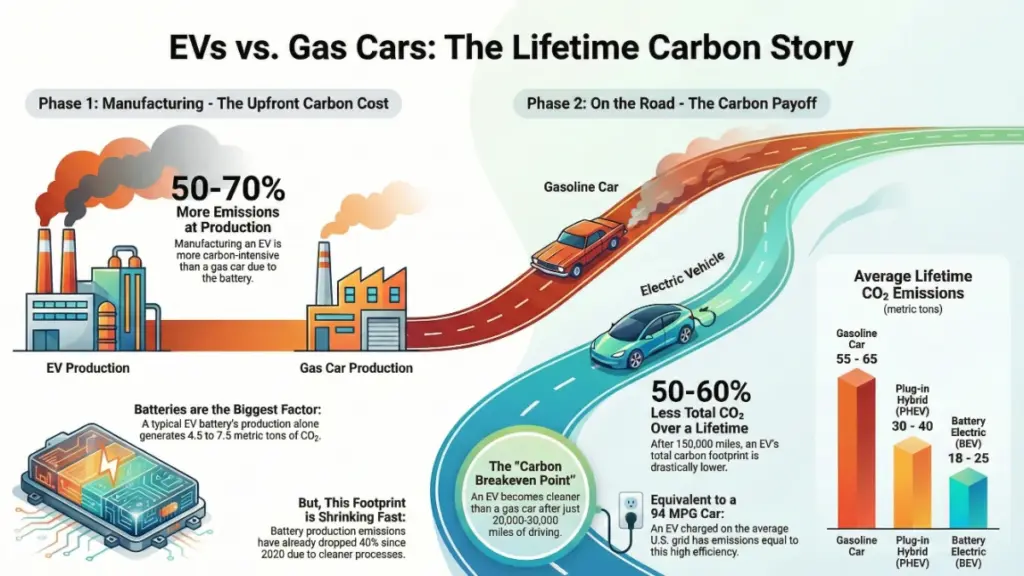
Here’s what surprises most people: an electric vehicle actually starts its life with a larger carbon debt than a comparable gas car. According to 2024 research from the International Energy Agency, manufacturing an EV produces roughly 50-70% more emissions than making a conventional vehicle, primarily due to battery production. A typical EV battery manufacturing process generates about 60-100 kg of CO2 per kilowatt-hour of battery capacity.
But here’s the critical part—that initial deficit gets erased as you drive. Think of it like buying energy-efficient appliances: higher upfront cost (or in this case, carbon cost), but significant savings over time.
The Battery Question: Manufacturing’s Carbon Challenge
Let’s address the elephant in the room: EV battery production is carbon-intensive. The process involves mining lithium, cobalt, nickel, and other materials, refining them, and then manufacturing the battery cells—all energy-hungry processes.
For a mid-sized EV with a 75 kWh battery (like a Tesla Model Y or Ford Mustang Mach-E), battery manufacturing alone generates approximately 4.5 to 7.5 metric tons of CO2. To put that in perspective, that’s equivalent to driving a gas-powered sedan about 15,000-20,000 miles.
However, this picture is improving rapidly:
- Battery production emissions have dropped 40% since 2020 as manufacturers adopt cleaner production methods
- Companies like Tesla and LG Energy Solution are increasingly using renewable energy in their battery factories
- New battery chemistries, including lithium-iron-phosphate (LFP) batteries, require less cobalt and have lower manufacturing footprints
- Recycling programs are beginning to reduce the need for virgin materials—though we’re still in early stages here
The 2025 outlook is even more promising. A study from MIT’s Climate Portal indicates that battery production emissions could fall another 30-50% by 2030 as manufacturing processes become more efficient and renewable energy powers more facilities.
The Breakeven Point: When Do EVs Actually Become Greener?
This is the question everyone wants answered: How long does it take for an EV to “pay back” its higher manufacturing emissions?
The answer depends primarily on two factors: how clean your electricity grid is and how much you drive. Let’s break this down with current 2025 data.
In the United States (Average Grid Mix)
With the current U.S. electricity grid (which is about 40% renewable/nuclear and 60% fossil fuels), the typical EV reaches carbon parity with a comparable gas vehicle after approximately 20,000-30,000 miles of driving. For most American drivers covering 12,000-15,000 miles annually, that’s roughly 1.5 to 2.5 years.
Regional Variations Matter Enormously
- California or Pacific Northwest (clean grids): EVs break even in as little as 10,000-15,000 miles (under 1.5 years)
- Coal-heavy states (West Virginia, Wyoming): The breakeven point extends to 40,000-50,000 miles (3-4 years)
- Texas (mixed grid improving rapidly): Around 25,000-35,000 miles (2-3 years)
Here’s a practical example: If you’re driving a Chevrolet Bolt in Seattle, where hydroelectric power dominates, you’re offsetting that manufacturing carbon debt much faster than someone driving the same car in Kentucky, where coal still powers a significant portion of the grid.
After reaching breakeven, the environmental benefits compound. Over a typical 150,000-mile vehicle lifetime, an EV in the U.S. produces roughly 50-60% less total carbon than a comparable gasoline vehicle—even accounting for the manufacturing difference.
Electricity Source: The Single Biggest Variable
You’ve probably heard someone say, “EVs just move emissions from the tailpipe to the power plant.” There’s a kernel of truth there, but it misses the bigger picture.
Why EVs Are Cleaner Even on Fossil Fuel Grids:
First, power plants are significantly more efficient at converting fuel to energy than car engines. A modern natural gas power plant operates at 50-60% efficiency, while gasoline engines average just 20-30% efficiency. Even when you account for transmission losses and charging inefficiencies, EVs convert energy more effectively.
Second—and this is crucial—the grid is getting cleaner every year. In 2025, renewables make up the fastest-growing segment of electricity generation globally. In the U.S., renewable electricity generation increased by over 30% from 2020 to 2024, and this trend is accelerating.
What This Means for Your EV:
- Every year you own an EV, its carbon footprint automatically improves as the grid gets cleaner
- A gasoline car’s emissions remain constant (or worsen as it ages and loses efficiency)
- This creates a widening gap in environmental impact over time
According to the Union of Concerned Scientists’ 2024 analysis, an EV charged on today’s U.S. grid produces global warming emissions equivalent to a gasoline car getting 94 MPG. No conventional gas car comes close to that.
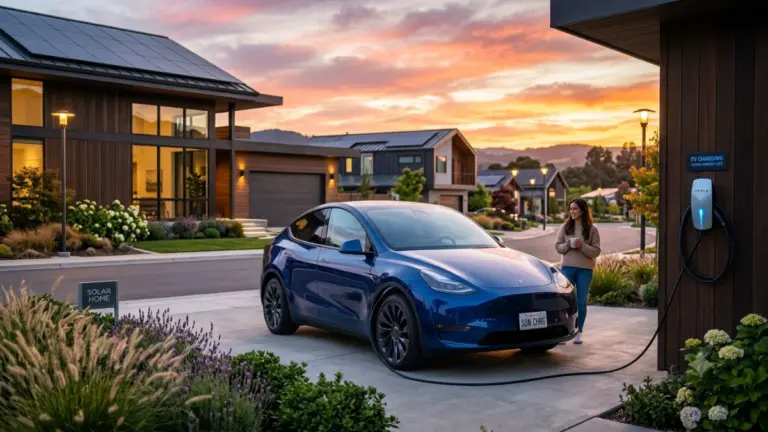
If you charge primarily at home with rooftop solar, your EV’s operational emissions drop to nearly zero. I’ve spoken with several EV owners who’ve made this transition—they describe it as “driving on sunshine,” and the numbers back up their enthusiasm.
Comparing EV Types: Not All Electric Vehicles Are Equal
The carbon footprint varies significantly depending on which type of EV you choose:
Battery Electric Vehicles (BEVs)
- Lifetime emissions: ~18-25 metric tons CO2 (U.S. average grid)
- Manufacturing emissions: ~8-12 metric tons CO2
- Best overall lifecycle footprint
Plug-in Hybrids (PHEVs)
- Lifetime emissions: ~30-40 metric tons CO2
- Manufacturing emissions: ~7-9 metric tons CO2
- Better than conventional cars, but depend heavily on charging habits
- Real-world performance varies wildly—some drivers rarely plug in, negating most benefits
Conventional Gasoline Vehicles
- Lifetime emissions: ~55-65 metric tons CO2
- Manufacturing emissions: ~5-7 metric tons CO2
- Highest operational emissions
Important caveat about PHEVs: Studies show that company-car PHEVs in Europe often produce more emissions than advertised because drivers don’t charge them regularly. If you’re considering a PHEV, be honest with yourself about whether you’ll actually plug in daily.
The Rare Earth Metals Concern: Separating Fact from Fiction
One persistent myth about EVs involves rare earth elements. Let’s clarify what’s actually true:
Fact: EV batteries use lithium, cobalt, nickel, and manganese—not technically “rare earth” elements, but materials that do require mining.
Fiction: This mining is worse than oil extraction.
The reality? Over a vehicle’s lifetime, an EV requires mining about 500 pounds of battery materials—a one-time extraction. A gasoline car, by contrast, burns through approximately 30,000-40,000 pounds of petroleum over its lifetime, requiring continuous extraction, refining, and transportation.
The mining impact is real but improving:
- Major automakers have committed to responsible sourcing standards
- Battery recycling is ramping up—Redwood Materials and Li-Cycle are recovering up to 95% of battery materials
- New chemistries are reducing or eliminating controversial materials like cobalt
- Direct lithium extraction methods use 90% less water than traditional mining
The 2024 International Energy Agency report notes that with robust recycling programs, we could meet up to 40% of lithium and cobalt demand from recycled batteries by 2040.
Longer Vehicle Life = Lower Footprint
Here’s something that doesn’t get discussed enough: how long your vehicle lasts dramatically affects its lifecycle emissions.
EVs have several advantages that could extend their useful life:
- Fewer moving parts mean less mechanical wear (no transmission, no exhaust system, no oil changes)
- Battery longevity is exceeding expectations—Tesla data shows Model S batteries retaining 90% capacity after 200,000 miles
- Over-the-air updates keep the vehicle technologically current longer
- Electric motors can last 500,000+ miles with minimal degradation
If an EV lasts 200,000 miles instead of 150,000, that amortizes the manufacturing emissions over more miles, further improving the lifecycle footprint. Early data from high-mileage EVs suggests this is increasingly realistic.
The 2025 Reality: Improvement Accelerates
The carbon footprint story keeps getting better. Here’s what’s changed just in the last few years:
Manufacturing Improvements:
- Tesla’s Gigafactory in Nevada runs on 100% renewable energy
- CATL (world’s largest battery maker) reduced production emissions by 35% since 2022
- Ford’s BlueOval City will be carbon-neutral from day one when it opens in 2025
Grid Decarbonization:
- U.S. coal power generation dropped to below 17% in 2024 (from 50% in 2008)
- Wind and solar capacity additions broke records in 2024
- Battery storage is enabling higher renewable penetration
Battery Technology:
- Solid-state batteries (coming in 2026-2027) promise 40% lower production emissions
- Sodium-ion batteries eliminate cobalt and nickel entirely
- LFP batteries are becoming mainstream for smaller EVs
A comprehensive 2024 study from the European Environment Agency found that EVs in Europe now produce 70% less CO2 over their lifetime compared to diesel vehicles—up from 60% just three years ago.
What You Can Do to Minimize Your EV’s Footprint
If you’re already driving an EV—or planning to—here are practical ways to maximize your environmental impact:
1. Charge Smart
- Use time-of-use rates to charge when renewable generation is highest (midday for solar, overnight for wind in many regions)
- Apps like ChargePoint and Optiwatt can optimize charging times automatically
2. Drive Efficiently
- Maximize regenerative braking—it’s like a mini power plant
- Precondition the battery while plugged in to avoid energy waste
- Smooth acceleration uses less energy than jackrabbit starts
3. Keep Your Battery Healthy
- Avoid frequent charging to 100% (80% is usually sufficient)
- Minimize DC fast charging when possible—slower charging is gentler
- Park in moderate temperatures when feasible
4. Consider Your Grid
- If available, choose a green energy plan from your utility
- Installing home solar creates the cleanest possible charging scenario
- Community solar programs offer an alternative if rooftop panels aren’t feasible
5. Plan for the Long Haul
- The longer you keep your EV, the better its lifecycle footprint becomes
- Proper maintenance ensures maximum lifespan (though EVs need far less than gas cars)
Addressing the Skeptics: Common Counterarguments
Let’s tackle some frequent criticisms head-on:
“What about battery disposal?” Modern EV batteries are 90-95% recyclable, and the industry is building out recycling infrastructure rapidly. Old batteries also get second lives in stationary energy storage before recycling. The pollution from battery disposal is minimal compared to the continuous emissions from burning gasoline.
“The grid can’t handle mass EV adoption” Studies from MIT and the National Renewable Energy Laboratory show the current U.S. grid could support 80% EV adoption with modest upgrades—primarily because most charging happens overnight during off-peak hours. In fact, EVs can actually help stabilize grids through vehicle-to-grid technology.
“Hydrogen is cleaner” Currently, 95% of hydrogen comes from natural gas (not clean). Green hydrogen from electrolysis is extremely energy-intensive—using that same electricity to charge batteries is 2-3 times more efficient. Hydrogen may have a role in heavy transport, but for passenger cars, batteries win on efficiency and emissions.
The Bottom Line: What the Data Tells Us
After examining manufacturing, operation, grid mix, and end-of-life impacts, here’s what we can confidently say about EV carbon footprints in 2025:
Key Takeaways:
EVs have lower lifetime emissions than gas cars in virtually every scenario—even in regions with coal-heavy grids
The breakeven point keeps getting shorter as battery production becomes cleaner and grids decarbonize
By 150,000 miles, an EV produces 50-60% less CO2 than a comparable gasoline vehicle (U.S. average)
The emissions gap widens every year as the grid gets cleaner—your EV automatically becomes greener over time
Battery production emissions are dropping rapidly through cleaner manufacturing and emerging recycling programs
Regional variation matters, but even in the worst-case scenarios (coal-heavy grids), EVs break even within the vehicle’s lifetime
The honest assessment? If you’re concerned about climate impact and drive a typical amount, switching to an EV is one of the most significant carbon reductions you can make in personal transportation. It’s not perfect—no technology is—but the data overwhelmingly supports EVs as the cleaner choice.
The environmental case for electric vehicles isn’t based on hope or greenwashing; it’s grounded in comprehensive lifecycle analyses from credible institutions worldwide. And unlike the static emissions of a gasoline car, an EV’s environmental performance improves year after year as our energy systems continue their transition toward renewable sources.
Ready to dive deeper? Check out the EPA’s Beyond Tailpipe Emissions Calculator or the Argonne National Laboratory’s GREET model to see specific numbers for your region and driving patterns. The more you understand the real data, the clearer the picture becomes: electric vehicles represent a measurable, meaningful step toward cleaner transportation.