Are electric vehicles really cheaper than gas cars when you add everything up? This question keeps potential EV buyers up at night—and for good reason. While the sticker price might make your eyes water, the total cost of ownership tells a surprisingly different story.
Here’s the truth: electric vehicles can save you thousands of dollars over their lifetime, but understanding exactly how and when those savings materialize is crucial for making an informed decision. Whether you’re a budget-conscious commuter, a business fleet manager, or simply curious about the economics driving the EV revolution, this article breaks down the real financial picture of electric vehicle ownership in 2025.
You’ll learn about upfront costs versus long-term savings, federal and state incentives that can slash your purchase price, the dramatic difference in fuel and maintenance expenses, and how EVs are reshaping entire economies—from job creation to grid infrastructure. By the end, you’ll have the financial clarity you need to determine whether an EV makes economic sense for your situation.
Lower Fuel Costs: The Everyday Savings Add Up Fast
Let’s start with the most obvious benefit: you’ll never visit a gas station again. But how much does that actually save you?
The Math is Compelling
According to the U.S. Department of Energy, charging an EV costs about $0.04 to $0.05 per mile compared to $0.12 to $0.15 per mile for gasoline vehicles (based on average 2025 electricity and gas prices). Consequently, for the average American driver covering 12,000 miles annually, that translates to roughly $500 to $1,320 in annual savings.
Over a typical 10-year ownership period, you’re looking at $5,000 to $13,200 in fuel savings alone. That’s a significant chunk of the purchase price difference right there.
Real-World Example: Meet Sarah, a Denver-based sales rep who drives about 15,000 miles yearly. She switched from a Honda Accord to a Tesla Model 3 in 2023. Her previous gas bill averaged $2,250 per year. Now? She spends approximately $675 annually charging at home during off-peak hours. As a result, that’s $1,575 saved every single year—money she’s redirected toward paying down her car loan faster.
Home Charging vs. Public Charging
The savings equation changes based on where you charge. Therefore, it’s important to understand the different charging cost structures:
- Home charging (overnight, off-peak rates): $0.03-$0.05 per mile
- Home charging (standard rates): $0.05-$0.07 per mile
- Public Level 2 charging: $0.08-$0.12 per mile
- DC fast charging: $0.10-$0.18 per mile
Most EV owners do 80-90% of their charging at home, maximizing those savings. Furthermore, if you have access to workplace charging or time-of-use electricity rates (which many utilities now offer specifically for EV owners), your costs drop even further.
Fuel Price Volatility Protection
Here’s something gas car owners can’t claim: predictable energy costs. Gasoline prices swing wildly based on geopolitical tensions, seasonal demand, and refinery capacity. In contrast, electricity rates, while they do fluctuate, are far more stable and regulated.
Moreover, you can budget with confidence, knowing your “fuel” costs won’t suddenly spike 40% because of events halfway around the world. This stability provides peace of mind that’s difficult to quantify but economically valuable nonetheless.
Dramatically Reduced Maintenance Expenses
Electric vehicles have fewer moving parts—about 20 components in an EV drivetrain versus 2,000+ in a traditional internal combustion engine. This simplicity translates directly into maintenance savings that compound year after year.
What You’ll Never Pay For Again
When you drive an EV, these routine expenses simply vanish:
- Oil changes (every 3,000-7,500 miles): $40-$75 each
- Transmission service: $150-$250 every 30,000-60,000 miles
- Spark plug replacement: $100-$300 every 30,000-100,000 miles
- Timing belt replacement: $500-$1,000 every 60,000-100,000 miles
- Exhaust system repairs: $150-$2,000 depending on issue
- Fuel filter replacement: $50-$150 periodically
AAA estimates that maintenance costs for EVs average $0.06 per mile compared to $0.10 per mile for gas vehicles. Consequently, over 200,000 miles, that’s a difference of $8,000—and that’s a conservative estimate that doesn’t account for major repairs like engine rebuilds or transmission replacements that simply can’t happen in an EV.
What Maintenance Do EVs Actually Need?
Your EV maintenance schedule looks refreshingly simple. In fact, you’ll only need to handle these basic tasks:
- Tire rotations (same as any vehicle)
- Brake fluid changes (less frequent due to regenerative braking)
- Cabin air filter replacement
- Windshield washer fluid refills
- Battery coolant checks (varies by manufacturer)
The Regenerative Braking Advantage
Here’s a maintenance benefit that surprises many new EV owners: your brake pads last significantly longer. Regenerative braking uses the electric motor to slow the vehicle, capturing that energy to recharge the battery. As a result, your traditional friction brakes do far less work.
Many EV owners report their original brake pads lasting 100,000+ miles—sometimes the entire life of the vehicle. In comparison, typical brake pads on conventional vehicles last only 30,000-70,000 miles. Therefore, you’re saving several hundred dollars in brake service over the car’s lifetime.
Warranty Coverage Peace of Mind
Most EV manufacturers offer robust battery and powertrain warranties—typically 8 years or 100,000 miles, with some extending to 10 years or 150,000 miles. This means your most expensive component is protected far longer than a conventional engine warranty (usually 5 years/60,000 miles for powertrain). Consequently, you have additional financial protection during the critical early ownership years.
Federal and State Incentives: Immediate Savings at Purchase
The upfront cost barrier is real, but government incentives in 2025 can dramatically reduce your actual purchase price—sometimes by $10,000 or more when you combine federal, state, and local programs.
Federal Tax Credit (Updated for 2025)
The Inflation Reduction Act provides a federal tax credit of up to $7,500 for new qualifying EVs. Here’s what you need to know:
- Income limits apply: $150,000 for single filers, $300,000 for joint filers
- Price caps: $80,000 for SUVs/trucks, $55,000 for other vehicles
- North American assembly requirement: Vehicle must be assembled in North America
- Battery component requirements: Increasing percentage of battery components and minerals must be sourced from North America or free trade partners
As of 2025, popular models like the Tesla Model 3, Chevrolet Equinox EV, Ford F-150 Lightning, and Volkswagen ID.4 qualify for the full credit. Additionally, the IRS maintains an updated list of qualifying vehicles on their website.
Important: Starting in 2024, this credit can be applied at the point of sale as a down payment, meaning you don’t have to wait until tax season to benefit. This is a game-changer for buyers who couldn’t previously afford to front the full cost and wait for their tax refund.
Used EV Tax Credit
Don’t overlook the $4,000 tax credit for used EVs (up to 30% of the purchase price). Requirements include:
- Vehicle must be at least 2 years old
- Price cap of $25,000
- Income limits: $75,000 (single) or $150,000 (joint)
- Must be purchased from a licensed dealer
This makes certified pre-owned EVs incredibly attractive for budget-conscious buyers.
State and Local Incentives
Many states offer additional incentives that stack with federal credits. Therefore, checking your state’s programs is essential:
- California: Up to $7,500 (Clean Vehicle Rebate Project), plus potential utility rebates
- Colorado: $5,000 for new EVs, $2,500 for used
- New York: Up to $2,000 under the Drive Clean Rebate
- New Jersey: $4,000 for EVs under $55,000
- Massachusetts: Up to $3,500 (MOR-EV program)
Furthermore, some municipalities add their own incentives. For example, certain California counties offer additional rebates, and some cities provide free parking for EVs or access to HOV lanes regardless of passenger count (a time-savings that translates to economic value for commuters).
Utility Company Rebates and Programs
Many electric utilities offer incentives for EV adoption. As a result, you can access:
- Rebates on home charging equipment: $250-$1,000
- Reduced electricity rates for EV charging: Time-of-use plans that cut charging costs by 30-50%
- Managed charging incentives: Get paid to charge during off-peak hours
Check with your local utility—these programs are expanding rapidly as utilities recognize EVs as beneficial load management tools.
Total Incentive Example
Let’s say you’re buying a $45,000 Hyundai Ioniq 5 in California. Here’s how the incentives stack up:
- Federal tax credit: -$7,500
- California CVRP rebate: -$2,000
- Local utility charger rebate: -$500
- Effective price: $35,000
That’s a 22% reduction from the sticker price before you even factor in fuel and maintenance savings.
Lower Total Cost of Ownership: The 5 and 10-Year Picture
When you zoom out and analyze the complete financial picture over your ownership period, EVs increasingly come out ahead—even when starting at a higher purchase price.
Breaking Down Total Cost of Ownership (TCO)
TCO includes several important factors. Specifically, you need to consider:
- Purchase price (minus incentives)
- Financing costs
- Fuel expenses
- Maintenance and repairs
- Insurance
- Registration fees
- Depreciation
Real-World TCO Comparison (2025)
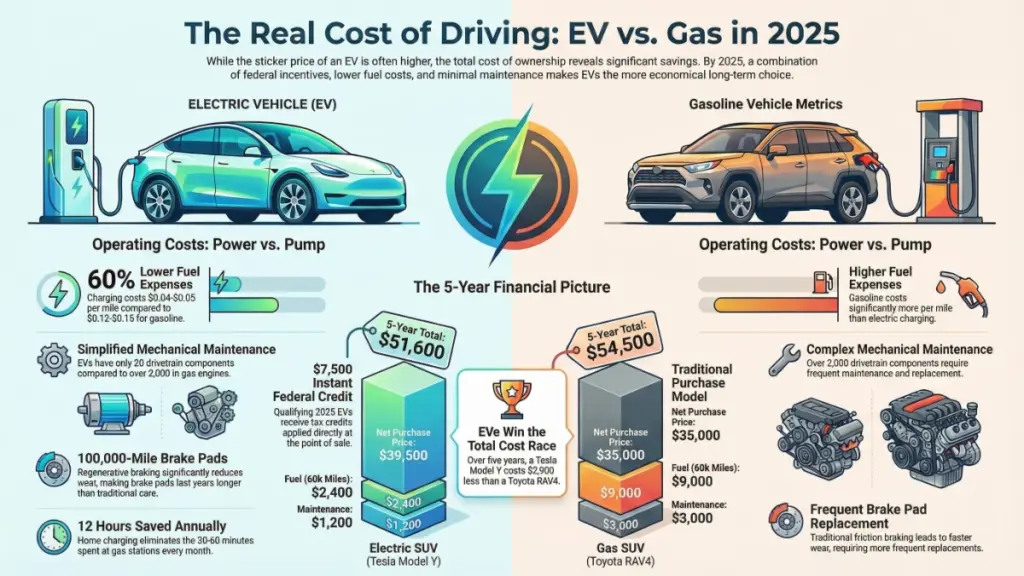
Let’s compare two popular mid-size SUVs over 5 years (60,000 miles):
| Expense Category | Toyota RAV4 (Gas) | Tesla Model Y |
|---|---|---|
| Purchase Price | $35,000 | $47,000 |
| Federal Incentive | $0 | -$7,500 |
| Net Purchase | $35,000 | $39,500 |
| Fuel (60,000 miles) | $9,000 | $2,400 |
| Maintenance | $3,000 | $1,200 |
| Insurance (annual avg) | $7,500 | $8,500 |
| 5-Year Total | $54,500 | $51,600 |
The Model Y actually costs $2,900 less over five years despite the higher upfront cost. Moreover, extend this to 10 years and 120,000 miles, and the gap widens to approximately $8,000-$10,000 in the EV’s favor.
Factors That Improve EV Economics
Your personal TCO equation improves further if you meet certain conditions. Specifically, the economics work better when you:
- Drive more than average annual miles (fuel savings accelerate)
- Keep vehicles longer (spreading purchase premium over more years)
- Have access to home charging (avoiding public charging premiums)
- Live in states with high gas prices or generous EV incentives
- Qualify for workplace charging
- Take advantage of time-of-use electricity rates
The Depreciation Question
Early EVs suffered from steeper depreciation, but this trend is reversing. Several factors now work in EVs’ favor:
- Longer battery life than initially predicted: Modern EV batteries retain 80-90% capacity after 200,000 miles
- Demand for used EVs is rising: As gas prices remain volatile and charging infrastructure expands
- Software updates add value: Unlike gas cars that become obsolete, EVs can receive over-the-air improvements
- Federal used EV tax credit: Creates strong demand in the certified pre-owned market
In addition, 2024-2025 data shows that popular models like the Tesla Model 3, Chevrolet Bolt, and Nissan Leaf are holding value comparably to similar gas vehicles, especially when the used EV tax credit is factored in.
Insurance Considerations: A Mixed Bag
Let’s be honest: EV insurance can be 10-20% higher than comparable gas vehicles. However, the story is more nuanced than it first appears.
Why EV Insurance Costs More
Several factors contribute to higher insurance premiums. Primarily, insurers cite these reasons:
- Higher vehicle values: EVs often cost more to purchase
- Expensive battery repairs: If damaged, battery replacement is costly (though rare)
- Specialized repair shops: Fewer certified EV technicians currently available
- Advanced technology: More sensors, cameras, and electronics to replace
Why This Gap is Narrowing
Nevertheless, several positive trends are reducing this insurance premium gap:
- Insurance companies gaining experience: Better risk assessment as more EVs hit the roads
- Improved battery durability: Fewer claims than initially projected
- Expanding repair networks: More shops becoming EV-certified
- Safety ratings: EVs consistently earn top safety scores, which reduces claim severity
Cost-Saving Strategies
Fortunately, you can minimize insurance costs through several approaches:
- Shop around aggressively: Rates vary dramatically between insurers
- Consider EV-specific insurers: Companies like Tesla Insurance, USAA, and Progressive offer competitive EV rates
- Bundle policies: Multi-car or home+auto discounts often offset EV premiums
- Lower coverage on older EVs: As your vehicle depreciates, adjust comprehensive coverage
- Take advantage of EV discounts: Some insurers offer green vehicle discounts
The Insurance Bottom Line
The Big Picture: Yes, you might pay $200-$400 more annually for insurance, but remember you’re saving $500-$1,500 on fuel and $300-$600 on maintenance. Therefore, the net equation still favors the EV significantly.
Economic Benefits Beyond Personal Savings
The economic advantages of EVs extend far beyond your personal bank account. Indeed, the shift to electric transportation is creating measurable economic benefits at the community, regional, and national levels.
Job Creation and Economic Growth
The EV revolution is a major job creator across multiple sectors. In particular, new employment opportunities are emerging in:
- Manufacturing jobs: EV and battery production facilities across the U.S. (e.g., Tesla Gigafactories, Ford’s BlueOval City, GM’s Ultium plants)
- Charging infrastructure: Installation, maintenance, and operation of charging networks
- Grid modernization: Utility upgrades and smart grid technology deployment
- Maintenance and service: New roles for EV-certified technicians (even if fewer overall service hours are needed)
The U.S. Department of Energy estimates that the EV sector will create over 3 million jobs by 2030 across manufacturing, infrastructure, and supporting industries. Furthermore, these tend to be higher-skilled, better-paying positions compared to traditional automotive jobs.
Energy Independence and Trade Balance
Every gallon of gasoline not burned is a gallon not imported. Consequently, this has significant macroeconomic implications. The U.S. still imports significant petroleum despite increased domestic production, sending billions abroad annually.
Electric vehicles powered by domestic electricity—whether from natural gas, renewables, or nuclear—keep energy dollars circulating within the U.S. economy. Moreover, the International Energy Agency estimates that widespread EV adoption could reduce global oil demand by 5 million barrels per day by 2030, strengthening energy security for adopting nations.
Reduced Healthcare Costs
Air pollution from vehicle emissions costs the U.S. economy an estimated $200 billion annually in healthcare expenses and lost productivity. In contrast, EVs produce zero tailpipe emissions, improving air quality particularly in urban areas.
Studies show that replacing gas vehicles with EVs in major metropolitan areas could reduce:
- Asthma and respiratory illnesses
- Cardiovascular disease
- Premature deaths from air pollution
- Emergency room visits
These health improvements translate directly into reduced healthcare costs and increased economic productivity—benefits that accrue to society even if you never buy an EV yourself.
Grid Flexibility and Vehicle-to-Grid (V2G) Potential
Here’s an emerging economic benefit most people don’t yet appreciate: your EV can become a grid asset. Specifically, Vehicle-to-Grid (V2G) technology allows EVs to send stored energy back to the power grid during peak demand periods.
Early pilot programs are already paying EV owners for this service. As a result, participants can:
- Stabilize the grid: Reduce need for expensive “peaker” power plants
- Earn passive income: Get paid for providing grid services (programs offering $500-$2,000 annually in some markets)
- Lower electricity costs for everyone: Distributed energy storage reduces infrastructure costs
Furthermore, as this technology matures, your EV essentially becomes a mobile power bank that can earn money while parked—a completely novel economic benefit impossible with gas vehicles.
Commercial and Fleet Economics
For businesses, EV economics are even more compelling. Specifically, companies benefit from:
- Lower operating costs: Fleet fuel and maintenance savings multiply across dozens or hundreds of vehicles
- Tax advantages: Accelerated depreciation under Section 179 for commercial EVs
- Corporate sustainability goals: Meeting ESG commitments increasingly important for investors and customers
- Employee recruitment: Offering EV company cars or charging as a perk attracts talent
Companies like Amazon (100,000 electric delivery vans on order), UPS, FedEx, and DHL are electrifying fleets specifically because the ROI is superior to diesel alternatives when analyzing total cost over vehicle lifespan.
Resale Value and Market Trends
As EV adoption accelerates, we’re seeing interesting market dynamics. In particular, several trends are emerging:
- Strong used EV demand: The federal used EV tax credit creates artificial demand floor
- Battery degradation slower than feared: Real-world data showing 90%+ capacity after 10 years improves resale confidence
- Software updates preserve value: Tesla vehicles from 2017 have received dozens of feature improvements, unlike static gas cars
- Gas vehicle depreciation risk: As EV infrastructure expands and gas stations become less convenient, ICE vehicles may face accelerated depreciation
Interestingly, early adopters who bought EVs in 2020-2022 are finding resale values holding better than initially projected—a positive economic surprise.
Workplace and Commercial Incentives
If you own a business or have influence over company vehicle policy, EV economics become even more attractive with commercial incentives.
Section 179 Deduction
Businesses can deduct up to $28,900 (2025 limit) for qualifying EVs placed in service during the tax year. Moreover, this is in addition to the $7,500 federal tax credit, potentially reducing your business’s EV cost by over $36,000 in the first year.
Commercial EV Tax Credit
The Inflation Reduction Act also includes a 30% tax credit for commercial clean vehicles (up to $7,500 for vehicles under 14,000 lbs, $40,000 for heavier vehicles). This applies to businesses purchasing EVs for company use.
Charging Infrastructure Deduction
Additionally, businesses can claim a 30% tax credit (up to $100,000 per site) for installing EV charging equipment. This makes workplace charging economically viable and can be an employee perk that aids recruitment.
Total Business Savings Example
Let’s examine a real-world scenario. A small business purchasing a Ford E-Transit van ($50,000) for deliveries:
- Commercial EV tax credit: -$7,500
- Section 179 deduction (30% tax bracket): -$8,670 (tax savings on $28,900 deduction)
- Charging infrastructure credit (installing 2 chargers at $8,000): -$2,400
- Total first-year tax benefits: $18,570
- Effective vehicle cost: $31,430
Add in fuel savings of $3,000-$4,000 annually and maintenance savings of $1,000+ yearly, and the business case becomes overwhelming.
Time Savings: The Hidden Economic Benefit
Not all economic benefits show up on a spreadsheet. In fact, time is money, and EVs can save you significant time depending on your situation.
No More Gas Station Trips
The average person spends 30-60 minutes per month at gas stations. That’s 6-12 hours annually. However, if you charge at home overnight, this time evaporates. You start every morning with a “full tank” without ever thinking about it.
For business owners or high-earning professionals where time literally equals money, this is a measurable economic benefit. Indeed, at $100/hour billing rate, that’s $600-$1,200 in recovered time value each year.
HOV Lane Access
Many states grant EV owners access to High Occupancy Vehicle (HOV) or carpool lanes regardless of passenger count. Consequently, in congested metro areas like Los Angeles, San Francisco, Washington D.C., or Atlanta, this can save 30-60 minutes daily on commutes.
If your time is valuable and you commute in traffic-heavy areas, this single benefit can justify EV ownership purely on time savings.
Reduced Maintenance Appointments
Fewer oil changes, transmission services, and repair visits mean fewer trips to the shop and less scheduling hassle. While harder to quantify, this convenience factor contributes to the overall economic value proposition.
Environmental Benefits That Create Economic Value
Let’s connect the environmental advantages to tangible economic outcomes—because going green increasingly means saving green.
Carbon Credits and Offset Programs
Some jurisdictions and companies are creating markets where environmental benefits translate to direct payments. Specifically:
- California’s LCFS program: Generates revenue for charging networks, some of which flows back to consumers as reduced charging costs
- Carbon offset markets: While not directly available to individual EV owners yet, corporate fleets can monetize emission reductions
- Green financing incentives: Some lenders offer lower interest rates for EV purchases as part of green loan programs
Property Value Increases
Homes with EV charging infrastructure are showing modest appreciation premiums (1-3%) in markets with high EV adoption. Therefore, installing a Level 2 charger (cost: $500-$2,000) can increase your home’s appeal to a growing pool of EV-owning buyers.
Future-Proofing Against Policy Changes
As governments implement stricter emission standards, congestion pricing, or urban vehicle access restrictions, EV owners gain economic protection. In particular:
- Avoid future congestion charges: Cities like London, Stockholm, and potentially U.S. cities may charge ICE vehicles for city center access
- Exemption from low-emission zones: Some European cities already ban older gas vehicles; expect similar policies spreading
- Protected from gas tax increases: As governments shift from gas taxes to road usage fees, early policy frameworks often favor EVs
These aren’t immediate savings, but they’re economic insurance against likely future scenarios.
Addressing the Economic Concerns: Being Realistic
Let’s tackle the legitimate financial concerns about EVs head-on, because honest analysis requires acknowledging both advantages and challenges.
Higher Upfront Costs (Narrowing but Real)
Yes, EVs typically cost $5,000-$15,000 more than comparable gas vehicles before incentives. This represents a real barrier for buyers without access to financing or who can’t wait for tax credits.
The reality: Nevertheless, this gap is shrinking. Models like the Chevrolet Equinox EV (starting under $35,000) and Nissan Leaf are approaching price parity with gas equivalents even before incentives. Furthermore, industry projections suggest EVs reach price parity with ICE vehicles by 2027-2028 as battery costs continue declining.
Charging Infrastructure Availability
If you can’t charge at home and rely entirely on public charging, your economics change significantly. Specifically:
- Public charging costs 2-3x more than home charging
- Time spent at charging stations reduces convenience savings
- Lack of nearby fast charging can limit vehicle utility
The reality: Home charging availability is the #1 factor determining EV economic viability. Therefore, if you’re a renter without guaranteed parking or live in an area with sparse charging infrastructure, wait for your situation to improve or choose a plug-in hybrid as a bridge technology.
Battery Replacement Anxiety
Battery replacement costs ($5,000-$20,000 depending on model) loom large in potential buyers’ minds.
The reality: However, real-world data shows this fear is largely unfounded. Modern EV batteries are lasting 200,000+ miles with 80-90% capacity retention. Additionally, warranties cover batteries for 8-10 years or 100,000-150,000 miles. The percentage of EVs requiring battery replacement outside of warranty is extremely low (under 5% based on current data).
In comparison, you’re more likely to need an engine rebuild or transmission replacement in a gas car than a battery replacement in an EV during typical ownership periods.
Electricity Rate Volatility
While more stable than gas, electricity rates can and do increase.
The reality: Nevertheless, even with rate increases, electricity remains significantly cheaper than gasoline per mile. Additionally, you can partially insulate yourself by installing home solar panels, creating your own fuel source at locked-in costs (net metering in most states).
The Future Economic Outlook: Where Are We Heading?
Understanding the trajectory of EV economics helps you time your purchase and set realistic expectations.
Battery Costs Continuing to Plummet
Battery pack costs have fallen 89% since 2010 (from ~$1,200/kWh to ~$130/kWh in 2024). Moreover, industry experts project costs reaching $80-$100/kWh by 2027, the threshold where EVs achieve purchase price parity with gas vehicles without subsidies.
This means:
- Lower EV purchase prices across the board
- Longer range becoming standard
- Better resale values as battery longevity improves
Charging Infrastructure Expansion
The U.S. is investing $7.5 billion in federal funding (Infrastructure Investment and Jobs Act) to build a national network of 500,000 public chargers by 2030. Furthermore, private investment adds tens of billions more.
Economic impact:
- Increased charging convenience reduces “range anxiety” barrier
- Competition drives down public charging costs
- Apartment dwellers and renters gain access (Level 2 chargers in parking structures)
Grid Integration Benefits
As utilities implement smart charging programs and V2G technology matures, EV owners will increasingly monetize their vehicles as grid assets. In fact, early pilot programs suggest earning potential of $500-$2,000 annually by participating in demand response programs.
Used EV Market Maturation
The federal used EV tax credit ($4,000) creates strong demand for pre-owned EVs. As more first-generation EVs enter the used market (2018-2022 models), we’ll see several positive developments. Specifically:
- More affordable entry points for budget-conscious buyers
- Better data on long-term battery performance (building confidence)
- Certified pre-owned programs from manufacturers
- Lower total cost of ownership for used EV buyers than used gas vehicles
Software-Defined Vehicles
Unlike gas cars that become technologically obsolete, EVs receive over-the-air software updates that add features, improve performance, and extend vehicle relevance. This is a fundamentally different ownership experience with economic implications:
- Your vehicle improves over time rather than declining
- Resale value preservation through ongoing enhancements
- Reduced need to upgrade for new features
Making the Economic Decision: Is an EV Right for You?
With all this information, how do you determine if an EV makes financial sense for your specific situation?
You’re an Excellent EV Candidate If:
✅ You have home charging access (garage, driveway, dedicated parking spot) ✅ You drive more than 10,000 miles annually ✅ Your daily driving is within the vehicle’s range (most modern EVs: 250-350 miles) ✅ You qualify for federal and state incentives ✅ You keep vehicles for 5+ years ✅ You live in an area with developed charging infrastructure ✅ Electricity costs in your area are reasonable ($0.10-$0.15/kWh)
You Might Want to Wait If:
❌ You rent without guaranteed charging access ❌ You frequently drive long distances beyond EV range ❌ You live in extreme cold climates (range reduction concerns) and lack home charging ❌ You need to sell vehicles quickly (short ownership periods) ❌ Your annual mileage is very low (<5,000 miles) making fuel savings negligible ❌ You don’t qualify for tax incentives and cash flow is tight
The Hybrid Alternative
If you’re on the fence, plug-in hybrids (PHEVs) offer a middle ground. Specifically, they provide:
- Electric range for daily commuting (25-50 miles)
- Gas engine for road trips (eliminates range anxiety)
- Federal tax credit eligibility ($3,750-$7,500 depending on battery size)
- Lower purchase price than full EVs
Models like the Toyota RAV4 Prime, Jeep Wrangler 4xe, or Ford Escape PHEV can deliver 60-80% of EV economics while eliminating charging infrastructure concerns.
Conclusion: The Economic Case Strengthens Year by Year
The question isn’t whether electric vehicles make economic sense—it’s when they make sense for you specifically.
Here’s What We Know for Certain in 2025
First and foremost, lower operating costs are real and substantial: $500-$1,500 in annual fuel savings plus $300-$800 in maintenance savings add up to thousands over ownership periods.
Second, incentives are generous but time-limited: Federal and state programs can reduce purchase prices by $10,000+ but may phase down as adoption grows.
Third, total cost of ownership increasingly favors EVs: Especially for high-mileage drivers keeping vehicles long-term.
Fourth, broader economic benefits extend beyond personal savings: Job creation, energy independence, and health improvements create societal value.
Finally, the trajectory is clear: Prices falling, range improving, infrastructure expanding—EV economics will only get better.
My Recommendation
If you’re considering an EV, run your personal numbers. Calculate your specific annual mileage, local fuel and electricity costs, available incentives, and ownership timeline. The break-even analysis varies by individual circumstances, but for a growing majority of Americans, the math now favors electric.
Don’t just take the industry’s word for it—talk to actual EV owners. You’ll find most report that the economic benefits exceeded their expectations, and many say they’ll never go back to gas vehicles.
The electric vehicle revolution isn’t just about saving the planet—it’s increasingly about saving money too. And in 2025, those two goals are finally, definitively aligned.
Ready to run your own numbers? Start by checking which federal and state incentives you qualify for at fueleconomy.gov and explore the EV models that fit your budget and driving needs. Your financial future might just be electric.