Are you ready to make the switch to electric, but overwhelmed by the sheer number of options hitting showrooms in 2025? You’re not alone. In fact, with over 50 new and updated EV models launched this year alone, finding the right electric car feels like navigating a maze.
Here’s the good news: the 2025 EV market has matured dramatically. Moreover, we’re finally seeing vehicles that don’t just promise the world on paper but actually deliver in real-world driving conditions. After analyzing the latest models, owner feedback, and independent testing data, I’ve identified the electric cars that genuinely stand out this year—not just for their spec sheets, but for how they perform when you’re actually behind the wheel.
In this guide, you’ll discover the best electric cars across different categories: overall value, luxury performance, family-friendly SUVs, budget-conscious options, and innovative newcomers. Whether you’re commuting 20 miles daily or planning cross-country road trips, there’s an EV here that fits your lifestyle.
What Makes an Electric Car “Best” in 2025?
Before diving into specific models, let’s establish what truly matters when evaluating electric vehicles today. Importantly, the game has changed significantly from even two years ago.
Beyond Range: The New Priorities
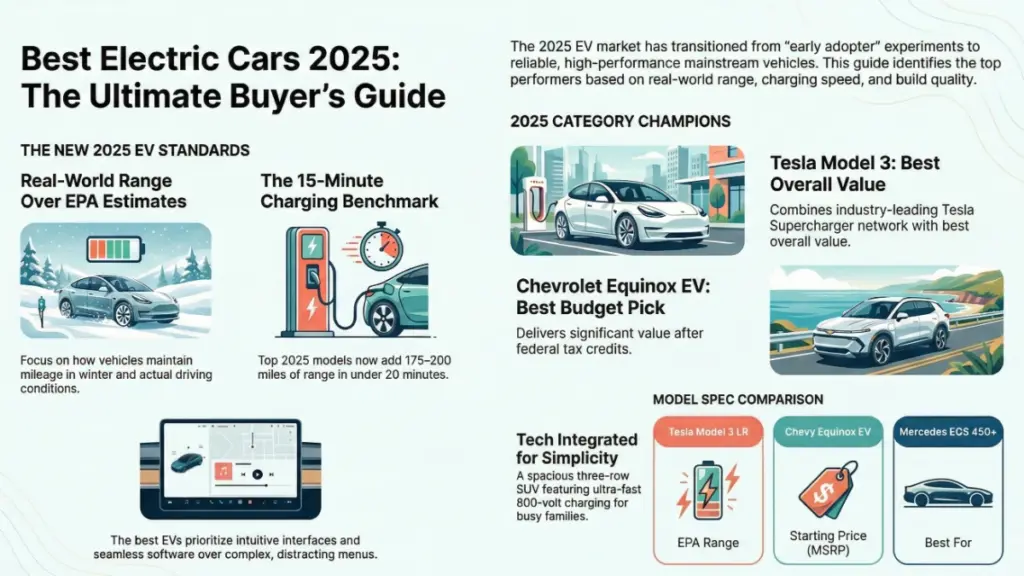
Range is no longer the only metric that counts. Yes, you want sufficient range for your needs, but in 2025, charging speed, efficiency, and real-world performance in various weather conditions matter just as much. Furthermore, a car with 250 miles of range that charges quickly and maintains that range in winter can be more practical than one claiming 350 miles that underperforms in cold weather.
Build quality and reliability have become critical differentiators. Consequently, the early EV days of “acceptable quirks” are over. Today’s best electric cars match or exceed traditional automotive standards for fit, finish, and dependability. In addition, we’re seeing this in J.D. Power’s 2025 quality studies, where several EVs now rank among the top vehicles overall.
User Experience and Technology Integration
Technology integration should enhance, not complicate, your driving experience. The best EVs in 2025 feature intuitive interfaces, seamless software updates, and driver-assistance systems that actually work consistently. After all, nobody wants to attend a training course just to adjust their climate control.
Here’s what I prioritize when evaluating electric cars:
- Real-world range (EPA estimates vs. actual owner reports)
- Charging speed and network compatibility (particularly with Tesla Supercharger access via NACS)
- Total cost of ownership (purchase price, incentives, maintenance, depreciation)
- Driving dynamics (how it actually feels to drive daily)
- Interior quality and technology (you’ll spend a lot of time here)
- Safety ratings and reliability data
Overall Best Electric Car: Tesla Model 3 Long Range
The Tesla Model 3 Long Range continues to set the benchmark for what an electric car should be in 2025, and for good reason. Starting at $47,740 (before the $7,500 federal tax credit), it offers an unmatched combination of range, performance, charging infrastructure, and technology.
Performance and Range Excellence
What makes it stand out: The latest Model 3 delivers 341 miles of EPA-rated range with the efficiency to back it up—we’re talking about 131 MPGe combined. However, the real advantage? Access to Tesla’s Supercharger network, still the gold standard for road-tripping. As a result, you can add 175 miles of range in just 15 minutes at a V3 Supercharger, making this the most practical EV for long-distance travel.
The refreshed 2025 model addresses previous criticisms with improved build quality, a more refined interior featuring sustainable materials, and a redesigned center console. Additionally, Tesla also added physical turn signal buttons back (finally listening to feedback), and the ride quality has noticeably improved with updated suspension tuning.
Real-World Performance and Considerations
Real-world performance: Owners consistently report achieving 90-95% of EPA range in normal conditions. Moreover, even in winter temperatures, the Model 3 typically maintains 70-75% of its range—better than most competitors. Meanwhile, the dual-motor all-wheel-drive system provides confident handling in all conditions, with 0-60 mph in 4.2 seconds when you want it.
The drawbacks? The minimalist interior isn’t for everyone—if you prefer traditional stalks and buttons, you’ll need to adapt. Furthermore, some drivers find the ride firm, particularly on rougher roads. And while Tesla’s Autopilot is impressive, it still requires constant attention despite marketing that sometimes suggests otherwise.
Best for: Tech enthusiasts, frequent road-trippers, and anyone prioritizing charging convenience and efficiency over traditional luxury.
Key Specs:
- Range: 341 miles (EPA)
- Charging: 15 minutes for 175 miles (Supercharger V3)
- 0-60 mph: 4.2 seconds
- Starting Price: $47,740 ($40,240 after federal credit)
- Efficiency: 131 MPGe combined
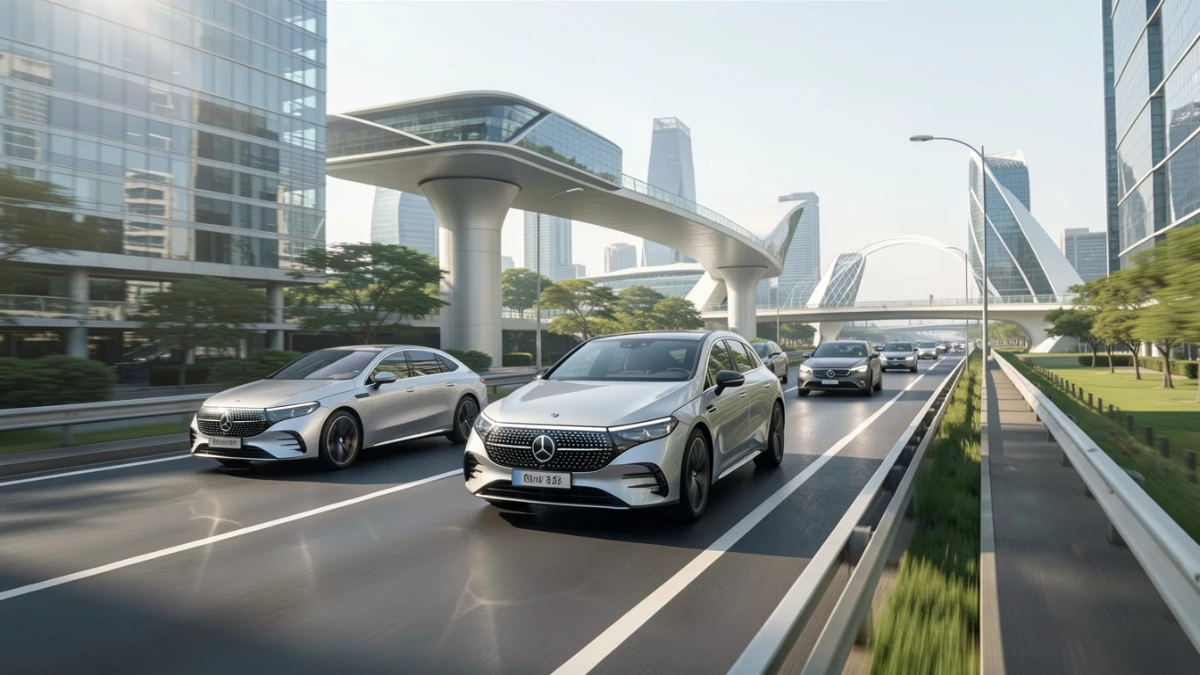
Best Luxury Electric Car: Mercedes-Benz EQS 450+
If you’re stepping up from a traditional luxury sedan and refuse to compromise on comfort, the Mercedes EQS 450+ represents the pinnacle of electric luxury in 2025. Starting at $104,400, it’s expensive—but it delivers an experience that justifies the price for buyers seeking the ultimate in refinement.
Luxury Redefined in Electric Form
What sets it apart: The EQS feels like a Mercedes should—whisper-quiet, impeccably built, and loaded with comfort features. Notably, the 2025 model year brings improved battery chemistry, extending range to 453 miles on a single charge. That’s not just impressive on paper; in fact, owners regularly report 400+ miles in real-world conditions, making range anxiety a distant memory.
The interior is where the EQS truly shines. The MBUX Hyperscreen—a 56-inch curved glass display spanning the entire dashboard—is either the future of automotive design or overwhelming depending on your perspective. Nevertheless, what’s undeniable is the craftsmanship: Nappa leather, genuine wood trim, and seat comfort that rivals first-class airline seating. Similarly, the available Executive Rear Seat package transforms the back into a mobile office with massage functions, heated armrests, and tablet integration.
Performance Meets Efficiency
Performance and efficiency: Don’t mistake luxury for sluggishness. Instead, the EQS 450+ sprints to 60 mph in 5.5 seconds while maintaining remarkable efficiency at 97 MPGe. Furthermore, the air suspension provides what I’d call “magic carpet” ride quality—it simply glides over imperfections. In addition, active rear-axle steering (up to 10 degrees) makes this large sedan surprisingly maneuverable in tight spaces.
Charging and Practical Considerations
Charging capabilities: The 400-volt architecture charges at up to 200 kW, adding 186 miles in 15 minutes under ideal conditions. While not the fastest charging EV, the massive battery means you’ll charge less frequently anyway. Moreover, the vehicle also comes with complimentary access to the Mercedes me Charge network, simplifying public charging access across multiple providers.
The considerations: At over 17 feet long and 5,300 pounds, the EQS is undeniably large. Therefore, parking requires planning. The technology-heavy interface has a learning curve—expect to spend time with the owner’s manual. Additionally, some drivers find the light, almost video-game-like steering feel disconnected, particularly compared to Mercedes’ traditional sedans.
Best for: Luxury sedan buyers prioritizing comfort, range, and cutting-edge technology. Ideal for executives, frequent long-distance travelers, and those transitioning from S-Class or 7-Series vehicles.
Key Specs:
- Range: 453 miles (EPA)
- Charging: 186 miles in 15 minutes (peak conditions)
- 0-60 mph: 5.5 seconds
- Starting Price: $104,400
- Efficiency: 97 MPGe combined
Best Family Electric SUV: Kia EV9 GT-Line
The three-row electric SUV segment exploded in 2025, but the Kia EV9 GT-Line emerges as the clear family favorite. Priced from $73,900, it delivers space, versatility, technology, and surprising driving dynamics in a package that actually makes sense for families with multiple children and all their cargo.
Space and Versatility for Active Families
Why families love it: The EV9 comfortably seats seven adults (or six with the available second-row captain’s chairs), with genuine usable space in the third row—not just emergency seating for small children. Furthermore, when you fold down the second and third rows, you get 81.7 cubic feet of cargo space, rivaling traditional full-size SUVs. Essentially, we’re talking about room for sports equipment, camping gear, and Costco runs without compromises.
Importantly, the 2025 GT-Line model includes Kia’s excellent suite of driver-assistance features as standard: Highway Driving Assist 2, blind-spot monitoring, rear cross-traffic alert, and parking assist. These aren’t just checkboxes—they work reliably and reduce stress during school pickups, soccer practice shuttles, and highway family road trips.
Range and Charging for Real-World Family Use
Range and charging for real families: The dual-motor AWD version delivers 270 miles of range, which honestly matters less than you’d think for typical family use. After all, most families charge overnight at home, waking up to a “full tank” daily. However, for road trips, the 800-volt architecture enables 10-80% charging in just 24 minutes on compatible 350 kW chargers. That’s perfect for bathroom breaks and quick meals—you’ll likely be ready before the kids are.
What impressed me most? The EV9 maintains usable range even when loaded with passengers and cargo. Specifically, real-world testing shows it achieves about 85% of EPA range with five passengers and luggage—better than several competitors that see significant range drops when fully loaded.
Technology and Comfort Features
Tech and comfort features: The available Relaxation Seats (first and second rows) recline nearly flat, while the panoramic sunroof spans all three rows, and the premium Meridian sound system actually delivers concert-quality audio. Additionally, the dual 12.3-inch displays are intuitive, Apple CarPlay and Android Auto work wirelessly, and there are enough USB-C ports that your teenagers won’t fight over charging cables.
The trade-offs: The EV9 isn’t cheap, especially when optioned up to the GT-Line with desirable packages. Moreover, some buyers report the ride quality is slightly firm over rough pavement. And while 270 miles is adequate for most families, those regularly taking 300+ mile road trips may find themselves charging more frequently than with longer-range alternatives.
Best for: Families needing three rows, buyers prioritizing space and versatility, and those wanting modern technology without the luxury price premium.
Key Specs:
- Range: 270 miles (EPA, AWD)
- Seating: 6 or 7 passengers
- Charging: 10-80% in 24 minutes (350 kW charger)
- Cargo Space: 81.7 cu ft (seats folded)
- Starting Price: $73,900 (GT-Line AWD)
- Warranty: 10 years/100,000 miles battery
Best Budget Electric Car: Chevrolet Equinox EV
Electric vehicles have finally reached the affordable mainstream with the 2025 Chevrolet Equinox EV. Starting at just $34,995 for the base 1LT trim—and potentially $27,495 after the federal tax credit—this compact SUV proves you don’t need a six-figure budget to go electric.
Exceptional Value Proposition
The value proposition: The Equinox EV delivers 319 miles of range in its extended-range configuration, which is remarkable at this price point. Indeed, just three years ago, getting 300+ miles meant spending $60,000 or more. Subsequently, GM’s Ultium battery platform enables this combination of affordability and range, finally making EVs accessible to average American families.
You’re not sacrificing essential features for the lower price, either. In fact, even the base 1LT includes a 17.7-inch touchscreen, wireless Apple CarPlay and Android Auto, automatic emergency braking, lane-keeping assist, and adaptive cruise control. Moreover, the interior quality exceeds expectations with soft-touch materials, comfortable cloth seats (or available leather), and thoughtful storage solutions throughout.
Practical Performance for Everyday Driving
Practical everyday performance: The single-motor front-wheel-drive version produces 210 horsepower—adequate for daily driving without feeling underpowered. Similarly, acceleration is smooth and responsive in typical around-town situations. Meanwhile, the dual-motor AWD option (adding $3,000) bumps power to 288 hp and provides confident winter driving capability.
Charging occurs at up to 150 kW on DC fast chargers, adding 70 miles in about 10 minutes. While not the fastest-charging EV available, it’s perfectly practical for the occasional road trip. Additionally, the long range means you’ll charge less frequently anyway. For most buyers charging at home overnight, the charging speed barely matters.
Owner Appreciation and Limitations
What owners appreciate: The Equinox EV is genuinely practical. Specifically, rear seat space is generous, the cargo area holds 57.2 cubic feet with rear seats folded, and there’s a useful front trunk (frunk) for additional storage. Furthermore, the turning radius is tight for easy city maneuvering. And GM’s Super Cruise (optional on higher trims) provides hands-free highway driving on mapped roads—technology previously reserved for luxury vehicles.
The honest limitations: Build quality, while decent, doesn’t match premium rivals. Consequently, some interior plastics feel economy-grade, and cabin noise is more noticeable at highway speeds compared to pricier EVs. Additionally, the base model lacks heated seats and a heat pump (important for cold-weather efficiency), forcing buyers to step up to at least the 2LT trim for these features. Finally, GM’s charging network partnerships aren’t as extensive as Tesla’s Supercharger access, though this gap is closing throughout 2025.
Best for: First-time EV buyers, budget-conscious families, commuters wanting long range without premium prices, and anyone who’s been waiting for electric vehicles to become truly affordable.
Key Specs:
- Range: 319 miles (EPA, extended-range FWD)
- Charging: 70 miles in 10 minutes (DC fast charging)
- 0-60 mph: 6.5 seconds (AWD)
- Cargo Space: 57.2 cu ft (rear seats folded)
- Starting Price: $34,995 ($27,495 after federal credit)
- Warranty: 8 years/100,000 miles battery
Best Performance Electric Car: Porsche Taycan Turbo S
For driving enthusiasts who refuse to compromise on emotion and engagement, the 2025 Porsche Taycan Turbo S remains the performance EV benchmark. Starting at $185,000, it’s absurdly expensive—but it delivers a driving experience unlike any other electric vehicle.
Unmatched Performance Credentials
What makes it special: The Taycan Turbo S produces 938 horsepower with Launch Control engaged, rocketing to 60 mph in 2.4 seconds. Those are hypercar numbers. However, raw acceleration is just the beginning. This Porsche handles, steers, and brakes with the precision and feedback that made the brand legendary. Moreover, the two-speed transmission on the rear axle (unique among EVs) provides stronger acceleration at higher speeds and contributes to the engaging powertrain character.
The 2025 refresh brings meaningful improvements: notably, a larger 105 kWh battery extends range to 343 miles (EPA), addressing the previous model’s main weakness. Furthermore, Porsche also improved charging efficiency, now reaching up to 320 kW peak charging speeds on the latest 800-volt infrastructure—adding 200 miles in roughly 18 minutes.
The Engaging Driving Experience
The driving experience: Where other EVs feel fast but numb, the Taycan feels alive. Specifically, the steering communicates road texture and grip levels. Similarly, the chassis balance allows you to precisely place the car in corners. Meanwhile, the ceramic composite brakes (standard on the Turbo S) provide fade-free stopping power with excellent pedal feel. Additionally, the active suspension adapts brilliantly between comfortable cruising and track-ready stiffness.
This is the electric car for drivers who thought EVs couldn’t deliver emotional engagement. Undoubtedly, Porsche proves them wrong.
Luxury Interior and Real-World Considerations
Luxury and technology: The interior blends traditional Porsche sport-sedan aesthetics with modern EV technology. Notably, the curved digital display is driver-focused rather than overwhelming. Materials quality is exceptional—genuine leather, brushed aluminum, carbon fiber options. Furthermore, the available 21-speaker Burmester sound system is audiophile-grade. And yes, you can option it into six-figure territory with Porsche’s extensive customization program.
Real-world considerations: The Taycan Turbo S isn’t practical as your only vehicle unless you have considerable financial flexibility. For instance, the firm sport suspension isn’t ideal for damaged roads. Additionally, rear seat space is tighter than traditional sedans. The low-slung design makes entry/exit less graceful. And achieving the EPA range requires disciplined driving—spirited acceleration drops efficiency considerably.
Porsche’s charging network partnerships are improving, but you don’t get the seamless experience of Tesla’s integrated Supercharger network. Therefore, plan routes carefully for long trips.
Best for: Driving enthusiasts with substantial budgets, Porsche loyalists going electric, track-day participants, and anyone who believes performance cars should provide joy beyond straight-line acceleration.
Key Specs:
- Range: 343 miles (EPA)
- Charging: 200 miles in ~18 minutes (320 kW peak)
- 0-60 mph: 2.4 seconds (with Launch Control)
- Power: 938 hp (overboost with Launch Control)
- Starting Price: $185,000
- Top Speed: 162 mph (optional Sport Chrono package)
Best Innovative Newcomer: Hyundai Ioniq 6 Limited
The Hyundai Ioniq 6 proves that being different can be better. This streamlined sedan—which Hyundai boldly calls an “Electrified Streamliner”—achieves the best efficiency of any non-Tesla EV in 2025 while offering 361 miles of range and genuinely engaging styling. Priced from $51,200 for the well-equipped Limited trim, it represents exceptional value in the mid-size electric sedan segment.
Industry-Leading Efficiency
Standout efficiency: The Ioniq 6’s swoopy, aerodynamic design isn’t just for looks—it achieves a remarkable 0.21 drag coefficient, among the slipperiest production cars ever made. Consequently, this translates to 140 MPGe combined, meaning your electricity costs are minimal. In fact, in real-world testing, drivers regularly exceed EPA range estimates, sometimes by 10-15%—practically unheard of in the EV world where most vehicles underperform their ratings.
The secret? Hyundai optimized everything for efficiency without sacrificing performance. Specifically, the heat pump (standard on Limited trim) maintains range in cold weather better than most rivals. Furthermore, the regenerative braking system offers adjustable levels via steering wheel paddles, allowing one-pedal driving that maximizes energy recovery.
Advanced Charging Technology
Advanced 800-volt architecture: Like the Kia EV9, the Ioniq 6 uses 800-volt technology enabling ultra-fast charging. Therefore, on a 350 kW charger, you’ll add 10-80% charge in just 18 minutes—that’s 221 miles added in the time it takes to grab coffee and use the restroom. Importantly, this charging speed combined with the long range makes the Ioniq 6 exceptionally practical for road trips despite its modest size.
Design and Interior Quality
Design and interior quality: The exterior styling is polarizing—you’ll either love the retro-futuristic look or find it too unconventional. Personally, I appreciate automotive design that takes risks. Meanwhile, the interior feels upscale with ambient lighting, sustainable materials, and comfortable seating with excellent support. Additionally, the dual 12.3-inch displays are crisp and responsive, and Hyundai’s infotainment is among the most intuitive in the industry.
Rear seat space surprises given the sloped roofline—adults fit comfortably, though headroom is tighter than in traditional sedans. Nevertheless, the trunk offers 11.2 cubic feet, adequate for sedan purposes but not class-leading.
Advanced Features and Compromises
Technology and features: The Limited trim includes Highway Driving Assist 2, remote smart parking assist (you can park the car via key fob), a heads-up display, and Hyundai’s excellent safety suite. Moreover, the Relaxation Comfort Seats in front recline with extendable leg supports—perfect for charging stops. And the available solar roof panel provides supplemental charging, adding an estimated 2-3 miles of range daily in sunny climates.
The compromises: The Ioniq 6’s unique styling won’t appeal to everyone, potentially affecting resale value. Furthermore, the single-motor RWD version (most efficient) lacks all-wheel-drive capability for snow-belt buyers. And while Hyundai’s charging network access has improved with partnerships, it’s still not quite as seamless as Tesla’s integrated experience.
Best for: Efficiency enthusiasts, design-forward buyers, commuters wanting minimal charging costs, and anyone seeking an electric sedan that doesn’t look like everything else on the road.
Key Specs:
- Range: 361 miles (EPA, SE Long Range RWD)
- Efficiency: 140 MPGe combined
- Charging: 10-80% in 18 minutes (350 kW charger)
- 0-60 mph: 4.7 seconds (AWD version)
- Starting Price: $41,600 (SE), $51,200 (Limited)
- Warranty: 10 years/100,000 miles battery
What About Tesla’s Competitors? Other Notable EVs in 2025
While the vehicles above represent my top picks, several other electric cars deserve consideration depending on your specific priorities. Let me walk you through some excellent alternatives worth exploring.
Capable Trucks and Adventure SUVs
Ford F-150 Lightning – The electric truck that’s genuinely practical for truck buyers, starting at $49,995. With 320 miles of range (extended-range battery), the ability to power your home during outages, and genuine F-150 capability, it’s ideal for truck loyalists going electric. However, the compromise? It’s expensive once optioned up, and charging infrastructure for large vehicles remains challenging on some routes.
Rivian R1S – The adventure-ready electric SUV with legitimate off-road capability, quad-motor performance, and clever storage solutions. At $78,000, it’s pricey but delivers genuine versatility for outdoor enthusiasts. Fortunately, the expanding charging network and improved reliability in 2025 models address earlier concerns.
European and Mainstream Alternatives
BMW iX xDrive50 – For luxury buyers wanting traditional BMW driving dynamics in electric form, the iX delivers with 380 miles of range, sumptuous interior quality, and the handling prowess BMW is known for. Starting at $87,250, it splits the difference between the EQS and more affordable options. Nevertheless, the controversial exterior styling remains divisive.
Nissan Ariya – A solid, conventional electric SUV starting at $39,590 with 304 miles of range. It lacks the wow factor of competitors but delivers dependable, straightforward EV ownership. Consequently, it’s best for buyers wanting familiar ergonomics and proven Nissan reliability.
Volkswagen ID.4 – The affordable European alternative to the Equinox EV, offering 275 miles of range starting at $38,995. Strong incentives and Volkswagen’s reputation for build quality make it worth considering, though the infotainment system frustrates some owners.
How to Choose the Right Electric Car for You
With so many excellent options, selecting your ideal EV comes down to matching capabilities with your specific needs and priorities. Here’s a practical framework to guide your decision.
Assessing Your Range Needs
Start with your realistic daily range requirements. Most drivers cover fewer than 40 miles daily, meaning even a 250-mile EV provides 5-6 days between charges. However, if you road trip frequently, prioritize longer range (300+ miles) and fast charging capability. On the other hand, if you rarely drive beyond your city, focus on other factors instead.
Evaluating Charging Infrastructure
Consider your charging situation seriously. Home charging access fundamentally changes EV ownership. For instance, if you can install a Level 2 charger (240V) at home, even a 200-mile EV works beautifully for daily use. Conversely, without home charging, you’ll need excellent public charging nearby or an exceptionally long-range vehicle to avoid constant charging stops.
Matching Vehicle Size to Actual Usage
Match size to your actual needs, not wants. That three-row SUV seems appealing, but if you rarely carry more than four people, you’re paying for space you don’t use while sacrificing efficiency. Instead, smaller EVs often provide better range, lower costs, and easier parking.
The Importance of Test Driving
Test drive multiple options in realistic conditions. Drive them on highways, in city traffic, and on rough roads. Similarly, test the infotainment systems. Sit in the back seats. Load cargo. Many “perfect on paper” EVs reveal compromises during actual use.
Financial Considerations
Calculate total cost of ownership, not just purchase price. Factor in available incentives, electricity costs, reduced maintenance, and potential resale value. Surprisingly, a $50,000 EV might cost less over five years than a $40,000 gas vehicle when considering fuel savings and maintenance.
Research charging networks in your area and along your common routes. Use apps like PlugShare to map available chargers. Importantly, if you frequently drive specific corridors, verify adequate fast-charging coverage exists. This matters more than range numbers for road-tripping.
Federal Tax Credits and Incentives (2025 Update)
The federal EV tax credit structure remains in effect for 2025, though eligibility requirements continue to tighten around domestic assembly and battery sourcing. Here’s what you need to know to maximize your savings.
Federal Tax Credit Eligibility
Up to $7,500 federal tax credit is available for qualifying new electric vehicles that meet specific criteria:
- Final assembly in North America
- Battery components and critical minerals sourcing requirements
- MSRP caps: $80,000 for vans, SUVs, and trucks; $55,000 for other vehicles
- Income limits: $300,000 (married filing jointly), $225,000 (head of household), $150,000 (single)
Point-of-sale credits are now standard, meaning you receive the discount immediately at purchase rather than waiting to file taxes—a significant improvement.
Verifying Eligibility and Additional Incentives
Many vehicles in this guide qualify for the full $7,500 credit, though always verify current eligibility on fueleconomy.gov, as requirements and qualifying vehicles change. In fact, some manufacturers have restructured supply chains specifically to maintain eligibility.
State and local incentives vary dramatically by location. For example, California, Colorado, New Jersey, and several other states offer additional rebates ranging from $1,000 to $5,000. Additionally, some utilities provide rebates for home charger installation or discounted electricity rates for EV charging. Research your specific location’s offerings—combined incentives can dramatically reduce purchase prices.
The Charging Infrastructure Reality in 2025
One of the biggest questions potential EV buyers have: “Will I find charging when I need it?” The honest answer in 2025 is: mostly yes, but with caveats. Let me break down what you can realistically expect.
Home Charging: The Foundation
Home charging remains the foundation of EV ownership. Installing a Level 2 (240V) charger at home costs $500-$2,000 depending on your electrical panel and installation complexity. Consequently, this lets you add 25-30 miles of range per hour—you’ll wake to a full battery daily. Therefore, if you can charge at home, public charging becomes occasional rather than necessary.
Public Charging Network Status
Public charging has improved dramatically but remains inconsistent. Tesla’s Supercharger network—which now supports non-Tesla vehicles via NACS adapters—offers the most reliable fast-charging experience with 45,000+ stalls nationwide. Importantly, major routes are well-covered.
Similarly, Electrify America, EVgo, and ChargePoint have expanded significantly, with most interstate corridors now featuring DC fast chargers every 50-75 miles. Urban areas typically have abundant options. However, rural areas and certain regions remain challenging.
Real-World Charging Practicality
The 2025 charging reality: You can road trip in any modern EV if you plan routes using apps like A Better Route Planner or PlugShare. Yes, it requires more planning than gas stops. No, you won’t find chargers as universally as gas stations—yet. Nevertheless, for 95% of driving, it’s a non-issue if you charge at home.
Fortunately, the upcoming NACS (North American Charging Standard) adoption by most manufacturers will dramatically improve the charging experience by 2026, giving non-Tesla EVs access to the Supercharger network.
Final Recommendations: Which EV Is Right for You?
After evaluating all these excellent options, here are my targeted recommendations based on different buyer profiles and priorities.
Recommendations by Use Case
For most buyers, I recommend:
- Daily commuters with home charging: Chevrolet Equinox EV (best value)
- Tech enthusiasts and road-trippers: Tesla Model 3 Long Range (best all-around)
- Families needing space: Kia EV9 GT-Line (best three-row)
- Luxury sedan buyers: Mercedes-Benz EQS 450+ (best comfort and range)
- Driving enthusiasts: Porsche Taycan Turbo S (best performance)
- Efficiency-focused buyers: Hyundai Ioniq 6 Limited (best efficiency and value)
Guidance for Different Experience Levels
First-time EV buyers should prioritize: Reliability, proven service networks, and conventional ergonomics. Therefore, the Equinox EV, Hyundai Ioniq 6, and Ford F-150 Lightning (for truck buyers) offer the smoothest transitions.
Experienced EV owners upgrading should consider: Advanced features like 800-volt charging, heat pumps, and improved winter range. Consequently, the Kia EV9, Ioniq 6, and updated Model 3 deliver meaningful improvements.
Luxury buyers shouldn’t compromise on: Build quality, dealer service experience, and comfort features. Thus, the Mercedes EQS, BMW iX, and Porsche Taycan represent electric vehicles that truly match traditional luxury standards.
Conclusion: The Electric Future Is Here—And It’s Excellent
The 2025 electric vehicle market represents a turning point. Indeed, we’ve moved beyond the early adopter phase into genuine mainstream viability. These vehicles aren’t compromises—they’re often superior to gas alternatives in performance, technology, and operating costs.
Key Takeaways
The key takeaways from this year’s best EVs:
Range anxiety is largely solved. With vehicles routinely delivering 300+ miles and charging infrastructure expanding rapidly, electric cars now work for the vast majority of drivers. Moreover, you’ll adapt to charging routines faster than you expect.
Quality has caught up. The best 2025 EVs match or exceed traditional vehicles in build quality, reliability, and refinement. Therefore, you’re no longer accepting quirks to go electric.
Costs are becoming competitive. With federal incentives, improving efficiency, and minimal maintenance, EVs increasingly make financial sense even before considering environmental benefits.
Choice is abundant. Whether you need a budget commuter, luxury sedan, family hauler, or performance machine, there’s an excellent electric option.
Taking the Next Step
My advice? Test drive several vehicles from this list. Experience the instant torque, the quiet cabins, and the different approaches manufacturers take. Ultimately, the right EV for you depends on your specific situation, but I’m confident there’s a vehicle here that will exceed your expectations.
The transition to electric is happening—these are the vehicles leading the way.