You’ve probably heard the debates raging online: “Electric cars are just coal-powered vehicles in disguise!” versus “EVs will save the planet!” Like most passionate discussions, the truth lies somewhere in the nuanced middle. As someone who’s spent years diving deep into electric vehicle technology and environmental science, I can tell you that understanding the real environmental impact of electric cars requires looking at the complete picture – from the moment raw materials are extracted from the earth to the day your EV reaches the end of its useful life.
Think of it like judging a person’s entire life story rather than just a single photograph. Today, we’re going to take that comprehensive journey together, examining every stage of an electric car’s environmental footprint. You might be surprised by what we discover along the way.
The Manufacturing Reality Check: It’s Not All Sunshine and Rainbows
Let’s start with some honesty that might make EV enthusiasts uncomfortable: building electric cars currently has a higher environmental impact than manufacturing traditional gasoline vehicles. The culprit? Those massive battery packs that make our electric dreams possible.
Manufacturing a typical EV battery produces roughly 3 to 4 tons of CO2 emissions – that’s like burning about 1,500 gallons of gasoline before your car ever touches the road. The process involves mining lithium in South America’s salt flats, extracting cobalt from Democratic Republic of Congo mines, and processing nickel in facilities powered by various energy sources worldwide.
But here’s where it gets interesting: this upfront environmental “debt” isn’t permanent. Think of it as an investment that pays environmental dividends over time. A 2022 study from the International Council on Clean Transportation found that despite this manufacturing burden, EVs in Europe become environmentally superior to gasoline cars after just 13,500 miles of driving. In the U.S., with our current energy mix, that breakeven point extends to about 21,300 miles – still well within the first two years of ownership for most drivers.
I recently spoke with Sarah Chen, a Tesla Model 3 owner from California, who put this in perspective: “When I bought my car, I wasn’t naive about the manufacturing impact. But I drive 15,000 miles a year, so I knew I’d be making a positive environmental difference by year two. Now, three years later, I’m definitely in the green.”
The Energy Source Equation: Your Zip Code Matters More Than You Think
Here’s where things get really fascinating – and where your local electric grid becomes the star of the show. The environmental impact of your daily driving depends entirely on how your local utility generates electricity.
If you’re lucky enough to live in Washington State, where hydroelectric power dominates, your EV produces virtually zero emissions during operation. Drive that same car in West Virginia, where coal still powers much of the grid, and your environmental footprint looks quite different – though still better than a gasoline car.
The numbers are eye-opening: in the cleanest U.S. regions, driving an EV produces emissions equivalent to a hypothetical gasoline car getting 100+ MPG. Even in the coal-heavy regions, EVs still perform like a 50-60 MPG vehicle – significantly better than the average new car’s 25 MPG.
But here’s the beautiful part about this equation: it’s constantly improving in your favor. While your gasoline car’s emissions stay fixed throughout its lifetime, your EV automatically gets cleaner as your local grid adds more renewable energy. It’s like having a car that becomes more environmentally friendly while sitting in your garage.
Consider this: the U.S. electric grid has reduced its carbon intensity by 40% since 2010, and that trend is accelerating. Your 2024 EV will have a smaller environmental footprint in 2030 than it does today, without any modifications.
The Battery Lifecycle: From Cradle to Second Life to Grave
Let’s address the elephant in the room: what happens to those massive batteries when they’re no longer suitable for your car? This question keeps many environmentally conscious consumers awake at night, but the reality is more promising than you might expect.
EV batteries don’t suddenly die one day like your old smartphone. Instead, they gradually lose capacity over many years. When a battery degrades to about 70-80% of its original capacity – typically after 10-15 years or 150,000+ miles – it’s no longer ideal for automotive use, but it’s far from dead.
This is where the concept of “second life” becomes exciting. Companies like BMW and Nissan are already using retired EV batteries for stationary energy storage, helping stabilize electrical grids and store renewable energy. These batteries can serve effectively in this role for another 10-20 years.
When batteries finally reach true end-of-life, recycling technology is rapidly advancing. Current processes can recover about 95% of valuable materials like lithium, cobalt, and nickel. Companies like Redwood Materials, founded by former Tesla executives, are building recycling facilities that will process hundreds of thousands of battery packs annually.
The recycling landscape is evolving so quickly that by the time your current EV’s battery needs replacement, the recycling infrastructure will be far more mature than today. It’s like buying a smartphone in 2007 and having today’s repair ecosystem available when you need it.
Comparing Apples to Apples: EVs Versus Traditional Cars
When we look at the complete lifecycle – manufacturing, operation, and end-of-life – how do electric cars really stack up against their gasoline counterparts?
The most comprehensive studies consistently show that EVs produce 40-70% fewer lifetime emissions than comparable gasoline vehicles, depending on your location and driving patterns. In renewable energy-rich areas, that advantage extends to 80% or more.
But the gap is widening in EVs’ favor. While gasoline car efficiency improvements have plateaued, electric vehicles are simultaneously getting more efficient (newer models go farther per kWh) and cleaner (thanks to grid improvements and better battery technology).
Here’s a concrete example: a 2024 Tesla Model 3 in California produces about 1.2 tons of CO2 equivalent per year for an average driver. A comparable BMW 3 Series produces about 4.8 tons annually. Over a 10-year lifespan, that’s a difference of 36 tons of CO2 – equivalent to taking a gasoline car off the road for almost two years.
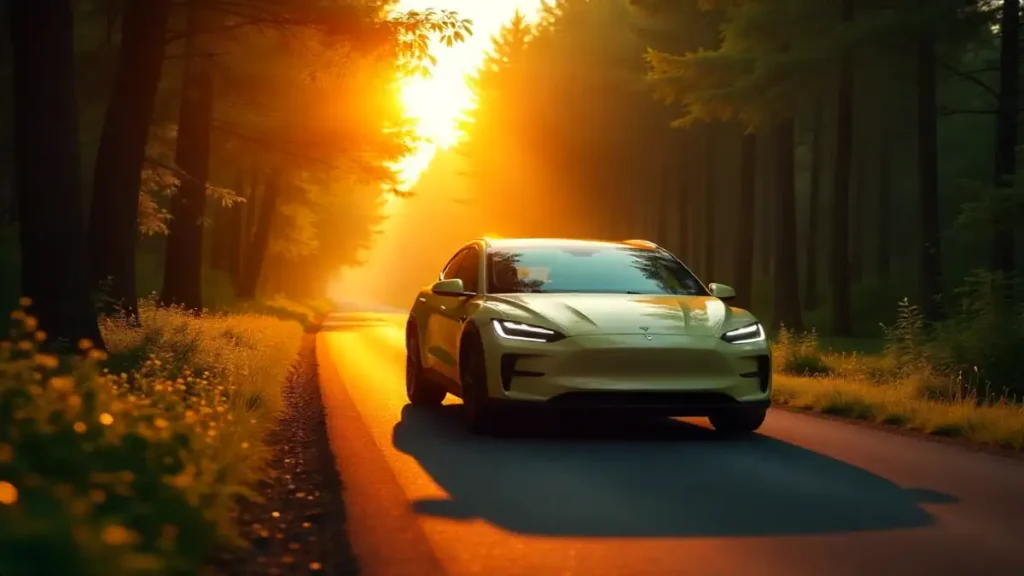
The Road Ahead: Continuous Improvement in Real Time
What excites me most about electric vehicle environmental impact isn’t where we are today – it’s the trajectory we’re on. Unlike gasoline technology, which faces fundamental thermodynamic limits, electric vehicle systems are improving on multiple fronts simultaneously.
Battery energy density is increasing by about 7-8% annually while costs drop and environmental impact decreases. New battery chemistries like lithium iron phosphate (LFP) eliminate cobalt entirely while lasting even longer. Solid-state batteries, coming within the next 5-7 years, promise even greater improvements.
Manufacturing is also getting cleaner. Tesla’s Gigafactory in Nevada aims for carbon neutrality, powered entirely by renewable energy. Other manufacturers are following suit, recognizing that clean manufacturing isn’t just good for the environment – it’s becoming a competitive necessity as consumers demand transparency.
The charging infrastructure is increasingly powered by renewable energy too. Electrify America commits to sourcing 100% renewable energy for its charging network. Companies like EVgo are installing solar canopies over charging stations, creating local clean energy generation.
Making Sense of It All: Your Personal Environmental Impact
So, what does all this mean for you as a potential EV buyer concerned about environmental impact? The answer depends on your specific situation, but for most Americans, the environmental case for EVs is compelling and getting stronger every month.
If you drive more than 10,000 miles annually and plan to keep your car for several years, an EV will almost certainly have a lower lifetime environmental impact than a comparable gasoline vehicle, regardless of where you live in the U.S. If you drive less or live in an area still heavily dependent on coal power, the environmental advantage is smaller but still present.
The key insight is that environmental impact isn’t binary – it’s not about perfect versus imperfect, but about better versus worse. Electric cars aren’t environmentally neutral (no technology is), but they represent a significant step forward from our current transportation system.
As renewable energy continues expanding, battery technology improves, and recycling infrastructure develops, that environmental advantage will only grow larger. You’re not just buying a car; you’re investing in a technology platform that becomes cleaner over time.
The environmental impact of electric cars tells a story of imperfect but rapid progress. Yes, there are challenges around manufacturing emissions and battery disposal. Yes, the benefits vary by location and usage patterns. But when you examine the complete lifecycle honestly and objectively, electric vehicles emerge as a crucial tool for reducing transportation emissions – and their environmental advantage is growing stronger every year.
The question isn’t whether EVs are perfect environmental solutions. The question is whether they’re better than our alternatives and moving in the right direction. On both counts, the evidence is clear: they are, and they’re improving faster than many of us dared hope just a few years ago.