Are you considering an electric vehicle but worried about the upfront cost? You’re not alone—and here’s the good news: federal, state, and local governments are offering substantial financial incentives that can slash thousands of dollars off your EV purchase price. In fact, with the right combination of incentives, some buyers are saving $15,000 or more on their electric vehicle investment.
The landscape of EV incentives has evolved significantly in recent years, with new rules, expanded credits, and additional programs emerging to make electric vehicles more accessible to everyday drivers. Whether you’re eyeing a brand-new Tesla Model 3, a used Nissan Leaf, or even an electric truck for your business, understanding which incentives you qualify for can make the difference between “too expensive” and “surprisingly affordable.”
In this comprehensive guide, I’ll walk you through everything you need to know about government incentives for electric vehicles in 2025—from the federal tax credit’s latest requirements to state-specific rebates, utility company programs, and little-known local incentives that could put even more money back in your pocket. By the end, you’ll know exactly how to maximize your savings and make your EV purchase as cost-effective as possible.
Understanding the Federal EV Tax Credit: Your Biggest Savings Opportunity
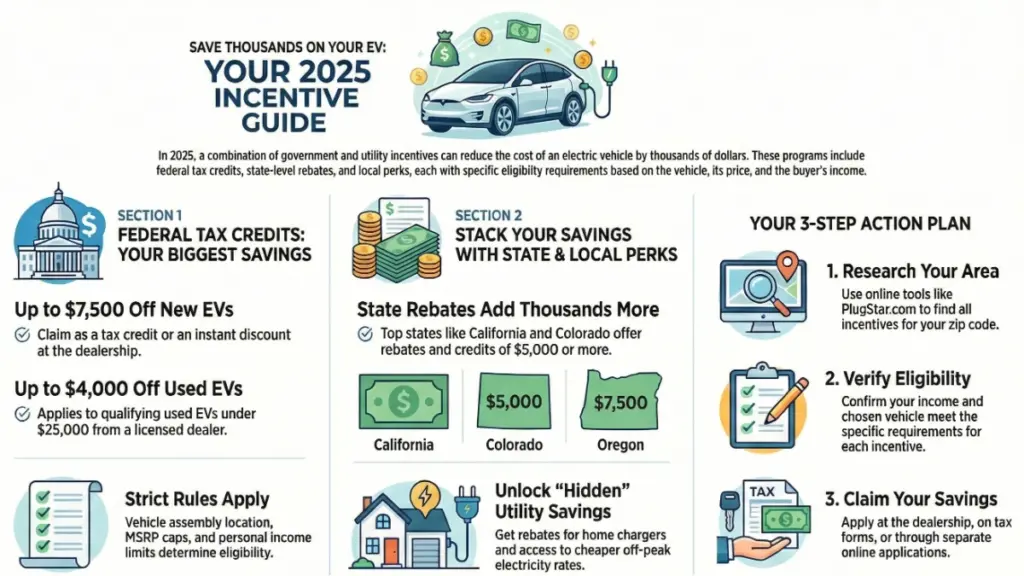
The federal electric vehicle tax credit remains the most substantial incentive available to most American buyers, offering up to $7,500 for new EVs and $4,000 for used electric vehicles. However, the rules changed significantly under the Inflation Reduction Act, and understanding these requirements is crucial to ensuring you actually qualify for the credit.
New EV Tax Credit Requirements (2025)
To qualify for the full $7,500 federal tax credit on a new EV, your vehicle must meet several criteria:
Vehicle Assembly and Price Caps
- The EV must be assembled in North America (United States, Canada, or Mexico)
- Maximum MSRP of $80,000 for vans, SUVs, and trucks
- Maximum MSRP of $55,000 for sedans and other vehicles
- The vehicle must be new (not used) and purchased for personal use
Battery Component Requirements Starting in 2025, the tax credit is actually split into two $3,750 components:
- $3,750 for meeting critical minerals requirements (a percentage of battery minerals must be extracted or processed in the US or free trade agreement countries)
- $3,750 for meeting battery component requirements (a percentage of battery components must be manufactured or assembled in North America)
These percentages increase each year, making compliance more challenging for some manufacturers. As of 2025, many popular models still qualify for the full $7,500, but it’s essential to check the IRS’s updated qualified vehicle list before making your purchase.
Income Limitations Not everyone qualifies, regardless of the vehicle they choose. Your modified adjusted gross income (MAGI) must fall below these thresholds:
- $300,000 for joint filers
- $225,000 for heads of household
- $150,000 for single filers
Here’s what many buyers don’t realize: these income limits are based on the year you take delivery of the vehicle, not when you ordered it. If you’re close to the threshold, timing your purchase strategically could make a significant difference.
The Game-Changing Point-of-Sale Credit
Perhaps the most exciting development for 2025 is the expansion of the point-of-sale option for the federal tax credit. Instead of waiting until you file your taxes to claim the $7,500 credit, you can now assign it directly to the dealer at the time of purchase, receiving an immediate discount on your vehicle’s price.
Why does this matter? Let’s say you’re buying a $45,000 electric vehicle. With the point-of-sale credit, you effectively pay $37,500 upfront—no need to wait months for your tax refund. This makes EVs dramatically more competitive with gas-powered vehicles on day one, and it means you don’t need to have $7,500 in tax liability to benefit from the full credit amount.
Important caveat: You’ll need to register with the IRS Energy Credits Online portal before taking delivery, and the dealer must be registered with the system. Most major dealers are now set up for this, but it’s worth confirming before you finalize your purchase.
Used EV Tax Credit: Making Pre-Owned EVs Even More Affordable
Here’s an incentive that doesn’t get enough attention: the federal government now offers a $4,000 tax credit (or 30% of the sale price, whichever is less) for qualifying used electric vehicles. This program opened up EV ownership to a much broader audience, particularly first-time buyers and those on tighter budgets.
Used EV Credit Requirements:
- Vehicle must be at least 2 years old
- Sale price cannot exceed $25,000
- Must be purchased from a licensed dealer (not a private party)
- Vehicle must have a battery capacity of at least 7 kilowatt-hours
- Income limits: $150,000 (joint), $112,500 (head of household), $75,000 (single)
This credit is particularly appealing because it opens up a world of affordable options. A three-year-old Chevrolet Bolt EV selling for $18,000 effectively costs $14,000 after the credit—potentially cheaper than many used gas-powered vehicles with similar features and far lower operating costs.
State-Level EV Incentives: Where You Live Matters
While the federal tax credit gets most of the attention, state-level incentives can be equally impressive—and in some cases, they’re even easier to claim. The catch? Incentive availability and generosity vary wildly depending on where you live.
Top States for EV Incentives in 2025
California: The Gold Standard California continues to lead the nation in EV incentives through its Clean Vehicle Rebate Project (CVRP) and additional local programs:
- Up to $7,500 rebate for new EVs (income-qualified buyers)
- Additional rebates for low-income households
- Carpool lane access (a huge perk in traffic-heavy areas)
- Utility company rebates and special EV electricity rates
What sets California apart is the combination of state rebates with local air quality management district incentives. In some regions, buyers can stack multiple programs for savings exceeding $10,000 beyond the federal credit.
Colorado: Mountain State Savings Colorado offers one of the most straightforward and generous programs:
- Up to $5,000 state tax credit for new EVs
- Additional $2,500 for low and moderate-income buyers
- Used EV credit of up to $2,500
- No complex application process—claim it on your state tax return
New York: Drive Clean Rebate
- $2,000 rebate for most qualifying EVs
- No income restrictions for the base rebate
- Additional incentives for low-income New Yorkers through other programs
- Instant rebate at point of sale (no waiting for tax season)
Other Notable State Programs:
- New Jersey: Up to $4,000 through Charge Up New Jersey
- Massachusetts: Up to $3,500 through MOR-EV program
- Maryland: Up to $3,000 in tax credits
- Oregon: Up to $7,500 for standard rebate, more for lower-income households
- Connecticut: Up to $3,000 through CHEAPR program
States with No EV Incentives
It’s worth noting that not every state offers additional incentives. States like Alabama, Alaska, Mississippi, and Wyoming currently don’t have statewide EV purchase incentives. However, even in these states, you can still benefit from the federal tax credit and may find local utility or municipal programs.
Pro tip: Some states without direct purchase incentives offer other benefits like reduced registration fees, emissions testing exemptions, or HOV lane access that provide ongoing value beyond the initial purchase.
Local and Utility Company Incentives: Hidden Savings Most People Miss
While federal and state programs grab headlines, local incentives and utility company rebates often fly under the radar—despite offering substantial savings and ongoing benefits that can add up to thousands over your EV’s lifetime.
Utility Company EV Programs
Many electric utilities offer incentives to encourage EV adoption, recognizing that electric vehicles create new demand for electricity while helping meet clean energy goals. These programs typically fall into several categories:
Rebates on Home Charging Equipment Your local utility might offer $500-$1,000 toward the purchase and installation of a Level 2 home charging station. For example:
- Southern California Edison offers up to $1,000 for charger rebates
- Pacific Gas & Electric provides various incentive tiers based on location and income
- Many Midwestern utilities offer $500-750 rebates through coordinated programs
Special EV Electricity Rates This is where you can save serious money over time. Many utilities offer time-of-use rates specifically designed for EV owners, with super-cheap electricity during off-peak hours (typically overnight when most people charge).
For instance, you might pay just $0.05-0.08 per kilowatt-hour during overnight hours instead of the standard $0.15-0.20. Charging a 60 kWh battery pack at these rates could cost you $3-5 instead of $9-12—savings that compound significantly over years of ownership.
Demand Response Programs Some utilities will pay you to let them slightly delay or adjust your charging during peak demand periods. These programs typically offer $50-200 annually in bill credits just for enrolling your vehicle, with no noticeable impact on your charging experience.
Municipal and Regional Programs
Beyond utilities, many cities, counties, and regional air quality districts offer additional incentives:
Bay Area Air Quality Management District (California): Up to $3,000 in additional rebates for income-qualified residents, stacking with state and federal programs
Austin Energy (Texas): Rebates up to $1,200 for home charging equipment plus discounted electricity rates—particularly valuable in a state without broader EV incentives
South Coast Air Quality Management District (Southern California): Up to $5,000 for qualifying low-income residents to replace older vehicles with EVs
City of Denver: Additional $500-$1,000 in rebates beyond Colorado’s state program, plus free parking at city meters for EVs
These local programs often have less stringent requirements than state or federal incentives and can be easier to claim. The challenge? Finding them. Your best bet is to search “[your city/county name] electric vehicle incentives” or check the Department of Energy’s Alternative Fuels Data Center, which maintains a comprehensive database.
EV Incentives for Businesses: Commercial and Fleet Benefits
If you’re a business owner considering electric vehicles for your company, you’re in luck—the incentive landscape for commercial EVs is even more generous than for personal vehicles, with programs specifically designed to accelerate fleet electrification.
Commercial EV Tax Deductions and Credits
Section 179 Deduction Business owners can deduct up to $30,800 of the cost of qualifying commercial EVs in the year of purchase under Section 179. This is particularly advantageous for small businesses looking to reduce their taxable income while upgrading to electric vehicles.
For vehicles over 6,000 pounds (like electric vans or trucks), you may qualify for even larger deductions. Many businesses combine this with the federal EV tax credit to maximize first-year tax benefits.
Business Federal EV Tax Credit Commercial vehicles may qualify for the standard $7,500 credit, but the rules differ slightly from consumer purchases:
- No income limitations for business purchasers
- Different vehicle weight and type classifications may apply
- Vehicles used exclusively for business purposes qualify without some consumer restrictions
State Business EV Incentives
Many states offer enhanced incentives for commercial EV adoption:
California’s Hybrid and Zero-Emission Truck and Bus Voucher Incentive Project (HVIP): Offers vouchers up to $240,000 for heavy-duty electric trucks and buses, making fleet electrification dramatically more affordable for trucking companies and transit agencies.
New York Truck Voucher Program: Up to $185,000 for heavy-duty electric trucks, with lower amounts for lighter commercial vehicles.
Several states also offer grants, low-interest loans, or accelerated depreciation for business EV purchases, recognizing that commercial adoption drives broader infrastructure development and market growth.
Fleet Electrification Programs
For businesses operating multiple vehicles, specialized fleet electrification programs can provide:
- Bulk purchase discounts negotiated with manufacturers
- Infrastructure development grants to install charging equipment
- Consulting services to optimize fleet transition strategies
- Reduced electricity rates for commercial charging
Example: A delivery company replacing 10 gasoline vans with electric versions might receive federal tax credits totaling $75,000, state incentives of $30,000-50,000, utility rebates for charging infrastructure of $20,000, and benefit from significantly reduced fuel and maintenance costs—potentially recovering the vehicle price premium in 2-3 years.
How to Find and Claim EV Incentives: Your Step-by-Step Action Plan
With incentives varying by federal, state, local, and utility programs—not to mention changing annually—how do you actually figure out what you qualify for and successfully claim these benefits? Here’s your practical roadmap.
Step 1: Research Available Incentives in Your Area
Start with these comprehensive resources:
PlugStar.com/incentives: One of the most user-friendly tools, allowing you to enter your zip code and see all federal, state, local, and utility incentives available to you. The site is regularly updated and includes incentive amounts, eligibility requirements, and application links.
U.S. Department of Energy Alternative Fuels Data Center: The government’s official database (afdc.energy.gov/laws) includes every incentive program nationwide, searchable by location and vehicle type.
Manufacturer Websites: Many EV manufacturers maintain updated incentive calculators showing total savings for specific models in your area. These tools can be helpful for comparing real-world costs across different vehicles.
Your Electric Utility’s Website: Check the residential programs or electric vehicle section—many utilities don’t heavily advertise their EV programs, but the savings are real.
Step 2: Verify Vehicle Eligibility
Before falling in love with a specific EV, confirm it qualifies for the incentives you’re counting on:
For Federal Tax Credit: Check the IRS’s official list of qualified vehicles at fueleconomy.gov/feg/tax2023.shtml (updated regularly). This list specifies which vehicles qualify for the full $7,500, which receive partial credits, and which don’t qualify at all due to assembly location or battery sourcing requirements.
For State and Local Programs: Requirements vary widely. Some states exclude vehicles over certain MSRPs, while others have minimum electric range requirements. Read the fine print before you buy.
Step 3: Understand Income and Other Eligibility Requirements
Compile your financial information early in the car-buying process:
- Modified adjusted gross income (MAGI) from your most recent tax return
- Projected income for the purchase year if you’re close to thresholds
- Household size (some programs use this for income qualification)
Remember: The income limits apply to the year you take delivery, so strategic timing can matter if you’re near the threshold.
Step 4: Claim Federal Incentives
For the Federal Tax Credit (traditional method):
- Complete IRS Form 8936 when filing your federal tax return
- You’ll need the vehicle’s VIN and purchase date
- The credit reduces your tax liability dollar-for-dollar (it’s nonrefundable, so you need sufficient tax liability to claim the full amount)
For Point-of-Sale Credit (2025 option):
- Register at the IRS Energy Credits Online portal before purchase
- Provide information to the dealer at time of sale
- Dealer applies the credit as an immediate discount
- You’ll still file Form 8936, but the credit is already accounted for in your purchase price
Step 5: Apply for State and Local Rebates
Unlike the federal credit (which you claim on taxes), most state programs require separate applications:
Immediate Rebate Programs (like New York’s Drive Clean): The rebate is processed at the dealership at the time of purchase, similar to the federal point-of-sale credit.
Post-Purchase Rebate Programs (like California’s CVRP): You’ll need to:
- Complete an online application within a specified timeframe (often 6 months to 2 years)
- Upload proof of purchase and vehicle registration
- Provide income documentation if required
- Wait 2-12 weeks for rebate check or direct deposit
Tax Credit Programs (like Colorado’s): Claim the credit on your state income tax return using the appropriate forms—no separate application needed.
Step 6: Claim Utility and Local Incentives
For Utility Rebates:
- Contact your electric utility company before or immediately after vehicle purchase
- Many offer rebates for both the vehicle and home charging equipment
- Some require enrollment in special EV electricity rate plans
- Installation of smart charging equipment may unlock additional incentives
For Local Programs:
- Check with your city, county, or air quality management district
- Application processes vary widely—some are streamlined online applications, others require more documentation
- Many local programs are first-come, first-served with limited annual funding, so apply early
Common Mistakes to Avoid
Missing Application Deadlines: Some programs have strict application windows. Mark your calendar immediately after purchase.
Assuming Automatic Eligibility: Even if your vehicle qualifies, you personally might not due to income limits, residency requirements, or other factors.
Not Saving Documentation: Keep copies of everything—purchase agreements, proof of payment, registration documents, and VIN information. You’ll need these for applications and tax filing.
Overlooking Combined Benefits: Many buyers claim the federal credit but miss out on thousands more from state, local, and utility programs. Do comprehensive research before and after your purchase.
Leasing Complications: When you lease an EV, the leasing company typically claims the federal tax credit, not you (though they may pass some savings through lower payments). However, you may still qualify for state and local rebates—check specific program rules.
The Future of EV Incentives: What’s Coming in 2025 and Beyond
As we move through 2025, the landscape of EV incentives continues to evolve. Understanding where these programs are headed can help you make smarter timing decisions about your EV purchase.
Anticipated Changes and Trends
Tightening Battery Requirements: The federal tax credit’s battery component and critical minerals requirements become more stringent each year. Some vehicles that qualify for the full $7,500 in 2025 may only receive partial credits by 2026-2027. If you’re considering a model that barely meets current requirements, purchasing sooner rather than later might maximize your savings.
Shifting State Priorities: Several states are transitioning from upfront purchase incentives toward charging infrastructure development and lower-income assistance programs. California, for instance, has been gradually reducing universal rebates while expanding income-qualified incentives. This doesn’t mean incentives are disappearing—they’re being targeted more specifically.
Used EV Market Growth: As the used EV market matures, expect expanded state-level programs supporting used EV purchases. The federal used EV credit is relatively new (introduced in 2023), and many states are developing complementary programs to make pre-owned EVs more accessible.
Commercial and Fleet Focus: Government at all levels is increasingly prioritizing commercial vehicle electrification. Expect growing incentives for electric vans, trucks, and fleet vehicles, with particular emphasis on last-mile delivery vehicles and medium-duty trucks.
Political Considerations
It’s impossible to discuss EV incentives without acknowledging their political dimension. The Inflation Reduction Act that established current federal incentive structures has faced ongoing debate, with some lawmakers proposing modifications or phase-outs while others advocate for expansion.
While the federal tax credit is currently authorized through 2032, the specific rules—particularly around battery sourcing requirements—could change with new legislation. Most experts believe the core incentive will remain in some form, given the bipartisan infrastructure investments and climate commitments, but the details may shift.
What this means for buyers: If you’re ready to purchase an EV and currently qualify for incentives, there’s value in acting rather than waiting for potentially “better” programs in the future. The current combination of federal, state, and local incentives represents historically unprecedented support for EV adoption.
Real-World Example: Calculating Your Total Savings
Let’s walk through a concrete example to see how these incentives stack up in real life.
Scenario: You’re a single filer earning $120,000 annually living in Colorado, considering a 2025 Hyundai Ioniq 5 SEL with an MSRP of $46,000.
Federal Incentives:
- Federal EV tax credit: $7,500 (vehicle qualifies for full credit, you’re under the $150,000 income limit)
State Incentives:
- Colorado state tax credit: $5,000 (you’re under the income threshold for the full credit)
Local Incentives:
- Xcel Energy (Colorado’s largest utility) home charger rebate: $1,300
- Xcel Energy special EV electricity rate: Estimated $200-300 annual savings compared to standard rates
Total First-Year Value: $14,100 in immediate incentives, plus ongoing electricity savings
Your $46,000 vehicle effectively costs $31,900 after incentives—making it competitive with similarly equipped gas-powered SUVs, but with dramatically lower fuel and maintenance costs going forward.
Over five years of ownership, when you factor in approximately $1,000-1,500 in annual fuel savings and reduced maintenance costs, your total cost of ownership could be $10,000-15,000 less than a comparable gasoline vehicle—even before accounting for the incentives.
Key Takeaways: Maximizing Your EV Incentive Benefits
As you navigate the world of electric vehicle incentives, keep these essential points in mind:
Do Your Homework Early: Research available incentives before you start shopping, not after you’ve already signed the paperwork. Understanding what you qualify for will help you budget accurately and possibly influence which vehicle you choose.
Stack Everything You Can: Don’t stop at the federal tax credit. The real savings come from combining federal, state, local, and utility incentives. In the right markets, total incentives can exceed $15,000-20,000.
Verify Before You Buy: Confirm your chosen vehicle qualifies for the specific incentives you’re counting on. Assembly location, battery sourcing, vehicle price, and your income all matter. One oversight could cost you thousands.
Act Promptly on Applications: Many state and local programs operate on first-come, first-served basis with annual funding limits. Apply for rebates as soon as you’re eligible, and keep copies of all documentation.
Consider Total Cost of Ownership: Even without incentives, EVs often cost less over their lifetime due to lower fuel and maintenance expenses. The incentives are icing on the cake, accelerating your payback period dramatically.
Stay Informed About Changes: Incentive programs evolve. Sign up for updates from your state energy office and check the Department of Energy’s Alternative Fuels Data Center before making your purchase to ensure you have current information.
The bottom line? Government incentives for electric vehicles in 2025 are more generous and accessible than ever before. With federal tax credits, state rebates, local programs, and utility incentives all potentially available to you, the upfront cost premium of EVs has largely disappeared for many buyers. Combined with lower operating costs and rapidly improving technology, there’s never been a better time to make the switch to electric.
Ready to start your EV journey? Begin by researching incentives in your area today—those savings are waiting for you to claim them.