TL;DR: Check EV coolant every 12 months or 15,000 miles (whichever comes first), though some systems go 2-3 years.
Top off only when cold using manufacturer-specific coolant (never generic). Watch for warning lights, slow charging, or reduced range. Budget $50-150/year for maintenance to protect $15,000+ battery. Professional flush needed every 50k-100k miles ($200-400). Skip checks = 30-40% faster battery degradation.
If you’re driving an electric vehicle, you might assume coolant checks are a thing of the past—no engine, no problem, right? Not quite. While EVs have ditched the traditional combustion engine, they still rely on sophisticated cooling systems to keep batteries, motors, and electronics running safely. So how often should you actually check your EV’s coolant?
The short answer: Most EV manufacturers recommend checking coolant levels every 12 months or 15,000 miles, whichever comes first, though some systems can go 2-3 years between checks. However, the frequency depends on your specific EV model, driving conditions, and the type of cooling system your vehicle uses.
In this guide, you’ll learn exactly when to check your EV’s coolant, what makes electric vehicle cooling systems unique, how to identify potential problems early, and practical tips to keep your battery and motor running at peak performance for years to come.
Why Electric Vehicles Need Coolant in the First Place
You might be wondering why an EV even needs coolant when there’s no hot engine block to worry about. Here’s the thing: modern electric vehicles generate significant heat in three critical areas that require precise temperature management.
Your EV’s battery pack is the biggest heat generator. When you’re accelerating hard or fast-charging at a DC station, those lithium-ion cells can heat up quickly. Too hot, and you risk permanent battery degradation. Too cold, and charging slows to a crawl while range plummets. The cooling system maintains that Goldilocks zone—typically between 68-86°F (20-30°C)—where your battery performs optimally.
The electric motor also needs temperature control, especially during spirited driving or towing. Unlike gas engines that waste most of their energy as heat, electric motors are remarkably efficient, but they still generate warmth that needs managing. Some EVs use a single cooling loop for both battery and motor, while others employ separate systems.
Power electronics—the inverters and converters that manage electricity flow—represent the third heat source. These components work hard converting DC battery power to AC for the motor and back again during regenerative braking. Keep them cool, and they’ll deliver consistent performance for the life of your vehicle.
Understanding Your EV’s Cooling System Type
Not all electric vehicles cool themselves the same way, and understanding your system type directly affects your maintenance schedule.
Liquid cooling systems are the most common in modern EVs. Tesla, Chevrolet Bolt, Ford Mustang Mach-E, Hyundai Ioniq 5, and most premium EVs use liquid coolant (typically a 50/50 mix of glycol and water) circulated through channels in the battery pack and motor. These systems offer precise temperature control and generally require checking every 12-24 months.
Air cooling systems, found in earlier Nissan Leafs and some budget EVs, use fans to move air across the battery. While simpler, they’re less effective at temperature regulation and don’t require coolant checks—though you should ensure cooling fans operate properly.
Hybrid systems combine both approaches, using liquid cooling for the battery and air cooling for motors or vice versa. Your owner’s manual will specify exactly what your vehicle uses.
Want to know which system your EV has? Check your owner’s manual under “cooling system” or “thermal management,” or look for a coolant reservoir under the hood—if you see one, you’ve got a liquid-cooled system that needs periodic attention.
Manufacturer-Recommended Coolant Check Intervals
Different automakers have varying recommendations based on their specific cooling system designs and coolant formulations. Here’s what major EV manufacturers suggest as of 2025:
Tesla Models
- Model 3/Y: Check every 2 years, replace every 4 years
- Model S/X: Check every 2 years, replace every 4 years or 50,000 miles
- Cybertruck: Check annually, replace every 5 years
General Motors EVs
- Chevrolet Bolt EV/EUV: Inspect every 150,000 miles or 12 years (newer coolant formulation)
- GMC Hummer EV: Check every 150,000 miles
- Cadillac Lyriq: Check every 150,000 miles
Ford Electric Vehicles
- Mustang Mach-E: Inspect at 100,000 miles, then every 50,000 miles
- F-150 Lightning: Check at 100,000 miles or 10 years
Hyundai/Kia EVs
- Ioniq 5/6, EV6, Niro EV: Check every 2 years or 30,000 miles
- Replace every 4 years or 60,000 miles
Nissan
- Ariya: Check every 15,000 miles or 12 months
- Leaf (with liquid cooling): Check every 30,000 miles or 2 years
Volkswagen ID Series
- ID.4, ID. Buzz: Inspect every 2 years regardless of mileage
Rivian
- R1T/R1S: Check annually or every 15,000 miles
These intervals assume normal driving conditions. If you frequently tow, drive in extreme temperatures, or regularly fast-charge, consider checking more often.
When to Check More Frequently Than Recommended
While manufacturer schedules provide a baseline, certain driving patterns and conditions warrant more frequent coolant inspections. Think of these as red flags that your cooling system is working overtime.
Heavy towing or hauling puts enormous stress on your EV’s battery and motor. If you’re using your F-150 Lightning to tow a boat every weekend or your Rivian R1T to haul construction materials, check coolant levels every 6 months. The additional load generates more heat, potentially causing coolant to evaporate or degrade faster.
Frequent DC fast charging is convenient but generates significant battery heat. If you’re road-tripping regularly or relying on 150+ kW chargers several times weekly, inspect coolant every 6-12 months. Watch for coolant level drops that might indicate your system is working harder than designed.
Extreme climate driving accelerates coolant degradation. Live in Arizona where summer temperatures routinely exceed 110°F? Or in Minnesota where winter brings sustained sub-zero conditions? Your cooling system cycles more aggressively, breaking down coolant additives faster. Quarterly checks aren’t overkill in these environments.
High-mileage EVs (over 75,000 miles) deserve closer attention. Hoses age, connections can weaken, and seals may develop minor leaks. If your EV has substantial mileage, transitioning to twice-yearly inspections helps catch small issues before they become expensive problems.
You should also check immediately if you notice any warning lights on your dash, reduced range, slower charging speeds, or unusual sounds from the motor compartment—all potential indicators of cooling system issues.
How to Check Your EV’s Coolant: A Step-by-Step Guide
Checking your EV’s coolant is simpler than you might think, though the process differs slightly from traditional vehicles. Here’s how to do it safely and effectively.
Step 1: Park on level ground and ensure the vehicle is off. Unlike gas cars where you might check fluids with the engine running, EVs should always be powered down completely during coolant checks. Wait at least 30 minutes after driving to allow the system to cool—hot coolant can cause burns.
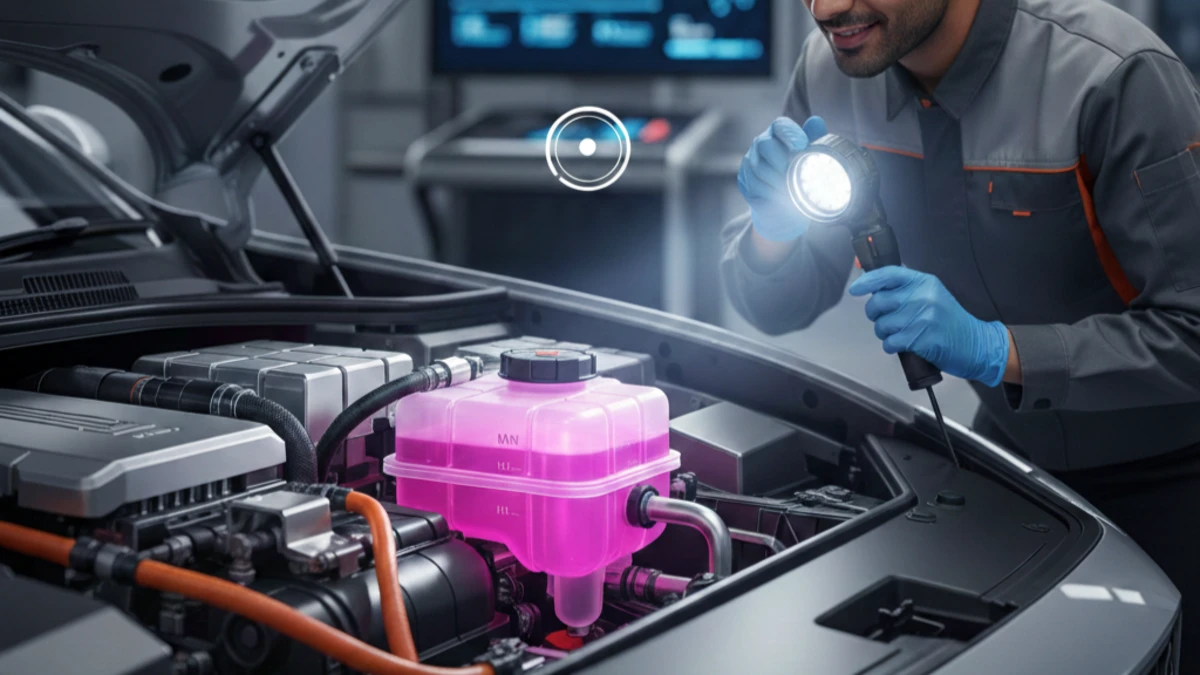
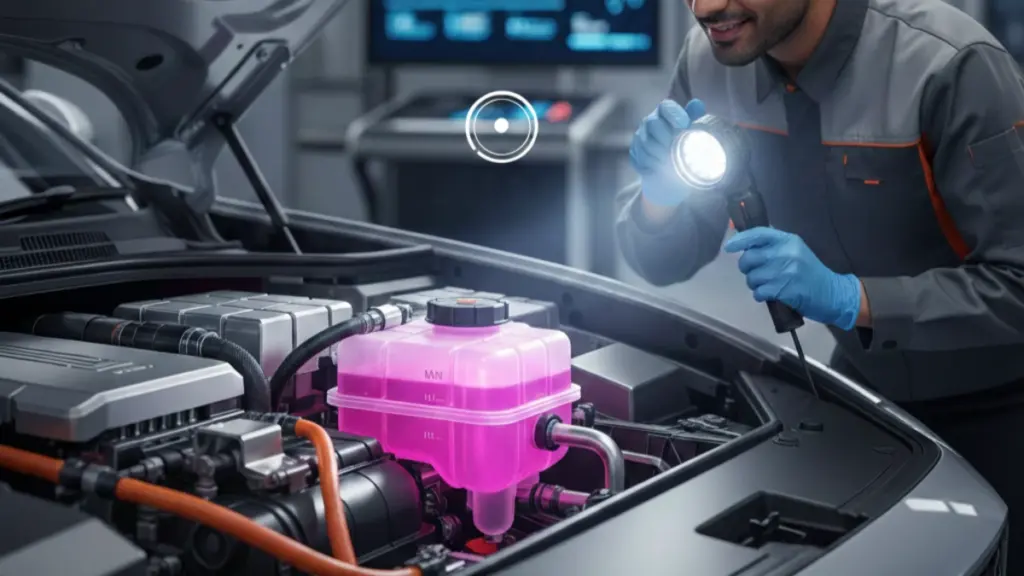
Step 2: Locate the coolant reservoir. Pop your hood and look for a translucent plastic tank, usually near the front or side of the motor compartment. It’s often marked with a snowflake symbol or temperature gauge icon. Some EVs have multiple reservoirs for separate cooling loops—your manual will identify each one.
Step 3: Check the level indicators. Most reservoirs have “MIN” and “MAX” fill lines etched into the plastic. Your coolant should sit between these marks when cold. If it’s at or below the minimum line, you’ll need to add coolant.
Step 4: Inspect the coolant condition. Look through the reservoir walls. Healthy coolant appears bright in color (usually pink, orange, or green depending on formulation) and relatively clear. Dark, murky, or rust-colored coolant indicates contamination and needs replacement, not just topping off.
Step 5: Check for leaks. While you’re under the hood, examine hoses, connections, and the ground beneath your vehicle for coolant puddles or stains. A sweet smell might indicate a small leak you can’t see.
Important: Never open the coolant reservoir cap on a hot system. Unlike checking oil, you don’t need to remove the cap during a basic inspection. Only add coolant when the system is completely cool and you’ve confirmed the correct type for your vehicle.
If you’re uncomfortable performing this check yourself, most EV service centers or even general mechanics can inspect your coolant in minutes, often during routine tire rotations.
Warning Signs Your EV’s Cooling System Needs Attention
Your electric vehicle will usually tell you something’s wrong before a cooling system fails completely. Learning to recognize these early warnings can save you thousands in battery or motor damage.
Dashboard warning lights are the most obvious indicator. A battery temperature warning (often displayed as a thermometer icon) means your cooling system isn’t maintaining proper temperature. Some EVs show specific coolant level warnings. Never ignore these—pull over safely and contact service.
Reduced charging speed often points to cooling issues. If your EV suddenly takes much longer to charge, especially at fast chargers, the battery might be limiting current intake to prevent overheating due to inadequate cooling. A Tesla that normally charges at 250 kW but maxes out at 50 kW has a problem.
Decreased driving range on a full charge can indicate thermal management problems. When batteries run too hot or cold, they deliver less power efficiently. If your Hyundai Ioniq 5’s range drops from 300 miles to 220 miles without explanation, suspect cooling issues.
Unusual sounds from under the hood—gurgling, bubbling, or excessive fan noise—might signal air in the cooling system or a failing pump. Electric vehicles should run nearly silent, so new sounds warrant investigation.
Visible coolant leaks appear as brightly colored puddles under your parked vehicle. Even small drips matter—a few ounces of lost coolant can disrupt the entire system’s efficiency. Check your garage floor or parking spot regularly.
Overheating messages during normal driving or charging indicate immediate problems. If your EV tells you to reduce speed or stop charging due to temperature, you’ve got a cooling emergency requiring professional service.
Performance limitations might activate automatically. Some EVs enter “reduced power mode” when temperatures exceed safe limits. If your acceleration suddenly feels sluggish or top speed drops, thermal protection systems may have engaged.
Don’t wait for multiple symptoms to appear. Even one of these signs deserves a quick inspection or service appointment. Modern EVs are sophisticated enough to detect problems early—take advantage of that early warning system.
The Right Coolant Type Matters More Than You Think
Here’s something many EV owners don’t realize: using the wrong coolant in your electric vehicle can cause serious, expensive damage. EV coolants aren’t interchangeable with traditional automotive antifreeze, and even different EV models often require specific formulations.
EV-specific coolants are engineered for electrical conductivity properties that traditional coolants don’t address. Your battery pack has high-voltage components running through the cooling system, so the coolant must be non-conductive or have very low electrical conductivity to prevent short circuits or corrosion.
Most manufacturers use glycol-based coolants, but with special additives designed for EV applications. Tesla uses a proprietary G-48 coolant (similar to Volkswagen/Audi formulations). General Motors EVs use Dex-Cool with specific electrical properties. Nissan specifies their own “Long Life Coolant Blue.” These aren’t marketing gimmicks—they’re engineered for different electrical environments.
Never assume generic “universal” coolant is safe for your EV. That $10 jug at the auto parts store might work fine in a Honda Civic, but it could damage your EV’s battery cooling channels or corrode sensors. Always use the manufacturer-specified coolant listed in your owner’s manual.
If you need to top off coolant, many automakers recommend using only their branded product or an approved equivalent. For example:
- Tesla: Use only Tesla High-Efficiency G-48 coolant
- Rivian: Requires Genuine Rivian coolant or Havoline XLC equivalent
- Ford EVs: Motorcraft Orange Prediluted Antifreeze/Coolant (VC-13-G)
- Hyundai/Kia: Crown LLC (EV) or equivalent meeting MS591-08 specification
When in doubt, order from your dealership or authorized service center. Yes, it costs more than generic coolant, but replacing a damaged battery pack costs tens of thousands of dollars—not worth the savings.
DIY vs. Professional Coolant Service: What You Should Know
Checking your coolant level is straightforward enough for any EV owner, but should you handle more extensive coolant service yourself? The answer depends on your mechanical confidence and your vehicle’s specific design.
What you can safely do yourself:
- Visual coolant level checks through the reservoir
- Inspecting for obvious leaks or damaged hoses
- Adding small amounts of the correct coolant when levels are low
- Monitoring for warning lights and symptoms
- Documenting coolant condition with photos for your service records
What requires professional service:
- Complete coolant system flushes and replacements
- Bleeding air from the cooling system
- Diagnosing cooling system failures or leaks
- Replacing pumps, valves, or cooling system components
- Any work involving the battery pack cooling channels
Here’s why professional service matters for major coolant work: EV cooling systems are pressurized and contain multiple loops that must be bled properly to remove air pockets. Air in the system reduces cooling efficiency and can cause localized hot spots that damage batteries. Specialized equipment ensures coolant flows correctly through all channels.
Additionally, working around high-voltage components requires specific training and safety equipment. While coolant reservoirs are accessible, the cooling lines run directly through battery packs carrying hundreds of volts. A DIYer accidentally puncturing a cooling line near the battery could face serious electrical hazards.
Cost expectations for professional service:
- Coolant level check and top-off: $30-$60
- Complete coolant flush and replacement: $150-$400
- Cooling system leak diagnosis: $100-$200
- Component replacement (pump, valve, etc.): $400-$1,200+
Many EV service centers include coolant inspection in routine maintenance packages. If you’re already bringing your vehicle in for tire rotation or brake service, ask them to check coolant at the same time—usually no additional charge.
For owners comfortable with car maintenance, checking levels yourself between professional service intervals makes perfect sense. Just leave the complex work to certified technicians who have the right tools and training.
Coolant Maintenance Costs Over Your EV’s Lifetime
Let’s talk dollars and cents. How much should you budget for coolant maintenance over your EV ownership?
Initial years (0-50,000 miles): Many new EVs include complimentary maintenance during the warranty period, which may cover coolant checks. Even if you’re paying out of pocket, expect minimal costs—maybe $50-$100 for periodic inspections if you’re not doing them yourself.
Mid-life service (50,000-100,000 miles): This is when most EVs need their first major coolant replacement. Budget $200-$400 for a complete system flush and refill with fresh coolant. Some vehicles with long-life coolant formulations might not need replacement until 100,000+ miles.
Later years (100,000+ miles): Higher-mileage EVs might need more frequent attention. Plan for coolant service every 3-5 years or 50,000 miles, plus occasional top-offs between services. Annual costs might average $100-$150.
Total 10-year/150,000-mile ownership: Expect to spend roughly $500-$800 on coolant-related maintenance over a decade of typical driving. That’s significantly less than the $2,000-$3,000 you’d spend on oil changes alone for a comparable gas vehicle.
Compare this to battery replacement costs ($5,000-$15,000+) or motor repairs ($3,000-$8,000), and the value of preventive coolant maintenance becomes crystal clear. Spending a few hundred dollars on proper cooling system care protects tens of thousands in potential battery damage.
Money-saving tip: Many extended warranties and prepaid maintenance plans cover coolant service. If you’re purchasing a new EV, compare plans that include thermal system maintenance—they often pay for themselves if you keep the vehicle long-term.
What Happens If You Neglect Coolant Maintenance?
Skip coolant checks at your own financial peril. Here’s what actually happens when EV cooling systems don’t receive proper attention.
Battery degradation accelerates dramatically. Lithium-ion batteries hate temperature extremes. Running consistently 10-15°F hotter than optimal can reduce battery lifespan by 30-40%. A battery that should last 200,000 miles might need replacement at 120,000 miles—a $12,000-$15,000 consequence of ignored coolant maintenance.
Charging speeds become frustratingly slow. Low coolant levels or degraded coolant reduce heat transfer efficiency. Your EV’s thermal management system detects this and limits charging current to prevent overheating. That 30-minute fast charge becomes a 90-minute ordeal because your cooling system can’t keep up.
Range decreases noticeably. Poor thermal management forces your battery to work harder, consuming more energy to deliver the same performance. Owners report losing 15-25% of rated range when cooling systems fail—turning a 300-mile EV into a 225-mile vehicle.
Component failures cascade. An overheated battery can damage the motor, inverter, and other expensive electrical components. What starts as a $200 coolant service becomes a $5,000+ repair bill when multiple systems fail from heat damage.
Warranty claims get denied. Here’s the painful part: many manufacturers void battery warranties if they determine cooling system neglect contributed to failure. Your maintenance records (or lack thereof) become evidence. That “free” warranty replacement suddenly costs $15,000 out of pocket.
Safety risks increase. In extreme cases, overheated batteries can enter thermal runaway—a dangerous condition where heat generation becomes self-sustaining. While rare, it’s a genuine safety hazard that proper coolant maintenance helps prevent.
Real-world example: A 2019 Chevy Bolt owner on online forums reported ignoring a coolant warning light for several months. The resulting battery damage cost $9,800 to repair, and GM denied warranty coverage because service records showed missed coolant inspections. All for want of a $150 coolant service.
Future-Proofing: How EV Cooling Technology Is Evolving
The coolant check intervals I’ve outlined above apply to current 2024-2025 EVs, but cooling technology is advancing rapidly. Here’s what’s coming that might change maintenance requirements.
Immersion cooling systems are being developed where battery cells sit directly in non-conductive liquid coolant rather than having coolant flow through channels. Companies like XING Mobility and some racing EV applications already use this technology. These systems might require less frequent maintenance but different service procedures entirely.
Solid-state batteries, expected in production vehicles by 2026-2027, generate less heat and may need simpler cooling systems—or possibly none at all for smaller packs. Toyota and QuantumScape are leading this development. Future EVs with solid-state technology might eliminate coolant checks entirely.
Heat pump systems that transfer waste heat to cabin heating are becoming standard in newer models like the 2025 Hyundai Ioniq 6 and VW ID.7. These sophisticated systems improve efficiency but add complexity that might require specialized maintenance.
AI-driven thermal management is emerging, where machine learning algorithms predict temperature needs based on driving patterns and weather forecasts. Tesla’s latest updates include predictive battery conditioning. These systems might alert you to coolant issues before problems develop, reducing the need for manual checks.
Extended-life coolants are in development that promise 200,000+ mile service intervals. GM’s Ultium platform already uses advanced formulations rated for 150,000 miles. As these become widespread, coolant maintenance might become a once-per-decade task.
For now, though, stick with your manufacturer’s current recommendations. As your EV receives software updates or if you trade up to a newer model, maintenance requirements will likely evolve. Stay informed through official manufacturer communications about any updated service schedules.
Key Takeaways: Your EV Coolant Maintenance Action Plan
Let’s bring this all together with clear, actionable steps you can implement immediately.
Follow your specific manufacturer’s schedule as the baseline—recommendations range from annually to every 2-3 years depending on your EV model and coolant formulation. Check your owner’s manual or service booklet for exact intervals.
Perform visual inspections yourself every few months. Pop the hood, check the coolant reservoir level, look for leaks, and note the coolant’s color and clarity. This takes 2 minutes and catches problems early.
Adjust check frequency based on your driving. Heavy towing, frequent fast charging, extreme climates, or high mileage all warrant more frequent inspections—shift to twice-yearly checks under these conditions.
Never ignore warning lights or symptoms like reduced range, slow charging, or temperature alerts. These are your EV telling you something’s wrong—address them immediately to prevent expensive damage.
Use only manufacturer-specified coolant types when topping off or replacing. Generic coolants can damage EV-specific electrical components. The extra cost is insurance against battery pack replacement.
Budget approximately $50-$150 annually for coolant-related maintenance over your ownership period—a small price for protecting a $15,000+ battery investment.
Leave major service to professionals while handling basic visual checks yourself. Coolant flushes, system bleeding, and component replacement require specialized knowledge and tools.
The bottom line? Think of coolant maintenance as health insurance for your EV’s most expensive component. A little preventive care goes a long way toward maximizing your battery’s lifespan, maintaining optimal range and charging speeds, and protecting your investment for the long haul.