TL;DR:
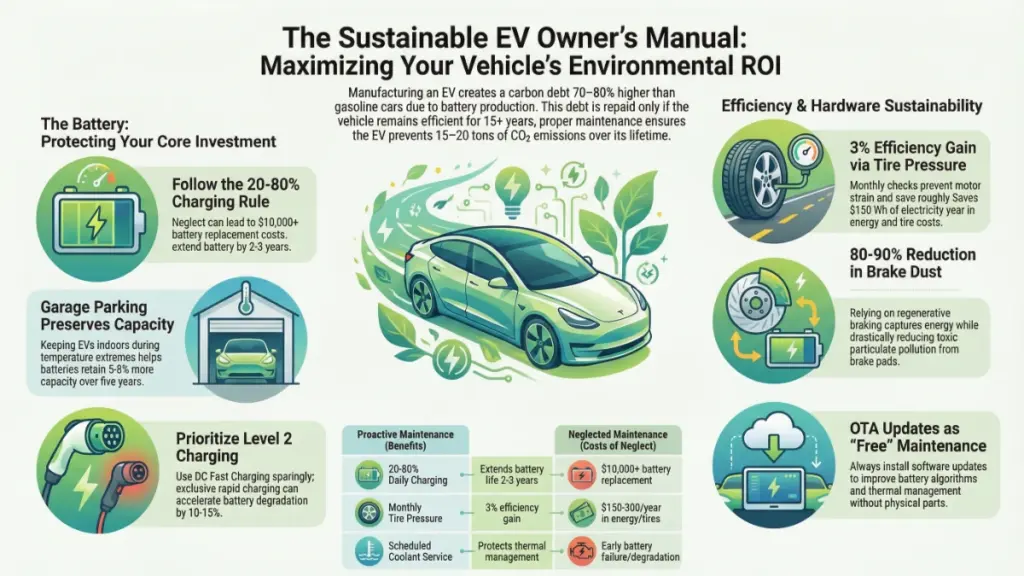
The Big Idea: Your EV’s environmental impact depends more on how you maintain it than how you drive it. Manufacturing creates a carbon debt that only pays off if your battery lasts 15+ years.
Do This:
- Charge 20-80% daily (not 0-100%) to double battery lifespan
- Check tire pressure monthly — saves 3% energy and extends tire life
- Update software — free efficiency improvements
- Service coolant & brake fluid on schedule, even if brakes look fine
- Avoid extreme temps — garage park when possible
Skip This:
- DC fast charging as your daily habit
- Letting battery sit at 100% or 0% for long periods
- Ignoring tire rotation (EVs are heavy)
- Skipping “unnecessary” fluid changes
The Win: A well-maintained EV prevents 15-20 tons of CO2 vs. gasoline cars. The greenest EV is the one you already own — kept running efficiently for 200,000+ miles.
Bottom Line: Treat your battery like a smartphone (gentle charging, temperature-aware), your tires like they’re carrying extra weight (they are), and your software like it’s part of the engine (it is).
Your EV Journey Doesn’t End at the Dealership
Congratulations on switching to an electric vehicle—you’ve made one of the most impactful environmental decisions available to consumers today. But here’s what most new EV owners don’t realize: sustainable EV ownership begins after you drive off the lot.
How you maintain your electric car directly amplifies—or diminishes—its environmental benefits. Smart electric vehicle maintenance reduces resource consumption, extends component lifespans, and ensures your EV offsets its manufacturing carbon footprint many times over. In fact, a well-maintained electric vehicle can prevent 15-20 tons of CO2 emissions over its lifetime compared to a gasoline equivalent, but only if it remains efficient for 15+ years.
This comprehensive guide covers everything you need to know about sustainable EV maintenance in 2025. From EV battery care best practices to tire management, software optimization, and emerging sustainability technologies, you’ll learn how to reduce your lifetime carbon footprint while protecting your investment. Whether you’re a new Tesla owner, a Rivian adventurer, or a three-year EV veteran, these strategies will help you maximize both performance and planetary impact.
Why EV Maintenance Is an Environmental Imperative
The Hidden Carbon Cost of Manufacturing
Here’s a perspective shift that changed how I approach electric vehicle sustainability: the most environmentally expensive part of your EV is already built.
Manufacturing an electric vehicle—particularly its lithium-ion battery pack—creates a significant upfront carbon debt. According to the International Energy Agency (IEA), producing a mid-size EV generates approximately 70–80% more emissions than manufacturing a comparable internal combustion engine vehicle, almost entirely due to battery production. A typical 75 kWh battery pack alone represents 8-10 tons of CO2 equivalent before you drive a single mile.
That carbon debt gets repaid through clean, emissions-free driving. But the math only works if your vehicle lasts long enough to offset those manufacturing emissions. The longer your EV runs efficiently, the better its lifetime environmental performance becomes.
The break-even point: Most EVs need to travel 15,000-20,000 miles to offset their manufacturing emissions compared to gasoline cars. After that, every mile driven is a net win for the environment—but only if your battery and components remain healthy.
Maintenance as Sustainability Strategy
Every preventable battery replacement, prematurely worn tire, or failed component carries ecological consequences. When you maintain your EV properly, you’re not just saving money—you’re:
- Reducing demand for resource-intensive manufacturing (lithium mining alone consumes 500,000 gallons of water per ton)
- Minimizing hazardous waste from discarded components
- Maximizing the environmental return on your initial investment
- Supporting circular economy principles through extended product lifecycles
The greenest choice after buying an EV? Keeping it in peak condition for as long as possible.
EV Battery Maintenance: The Foundation of Sustainable Ownership
Your battery pack represents the single most valuable—and environmentally costly—component in your vehicle, typically comprising 30-40% of total manufacturing emissions. These EV battery care strategies will help you maximize its 10-20 year potential lifespan.
Understanding Battery Degradation: Chemistry Meets Reality
Lithium-ion batteries degrade through several mechanisms:
- Calendar aging: Natural degradation over time regardless of use
- Cycle aging: Degradation from charge/discharge cycles
- Thermal degradation: Accelerated aging from temperature extremes
- High-voltage stress: Damage from sustained high charge states
The good news: Modern EV batteries are engineered for longevity. Tesla’s 2023 impact report showed their batteries retain 90% capacity after 200,000 miles on average. But your habits significantly influence whether your battery achieves—or exceeds—these benchmarks.
Optimal EV Charging Habits: The 20-80% Rule
Stop treating your battery like a gas tank. One of the most common electric car battery mistakes is running levels low, then charging to 100%. Lithium-ion batteries degrade faster with extreme state-of-charge cycles.
Best practice for daily EV charging: Keep your battery between 20% and 80% capacity. Major manufacturers including Tesla, Rivian, Ford, Hyundai, and BMW explicitly recommend this range for routine use. Reserve 100% charges for long road trips when you need maximum range.
Why this matters: Charging to 100% or letting your battery drain to near-zero creates chemical stress inside cells, accelerating capacity fade. Research from the Journal of Power Sources suggests maintaining moderate charge levels can extend battery life by 2-3 years and preserve 10-15% more capacity at the 10-year mark.
Action step: Configure your EV’s built-in charge limit settings. Nearly all modern electric vehicles allow you to set maximum charge levels—set yours to 80% for daily driving and forget about it. For vehicles without native limiting (early Nissan Leafs, some Chevy Bolts), use charging timers to estimate 80% completion.
Temperature Management for Battery Longevity
Extreme temperatures are lithium-ion batteries’ biggest enemy. Chronic exposure to heat and cold accelerates long-term capacity loss beyond the temporary range reduction you notice on winter mornings.
The science: Battery chemistry operates optimally between 60-80°F (15-26°C). Every 10°F above 85°F can double the rate of calendar aging. Cold temperatures below 20°F increase internal resistance, causing lithium plating that permanently reduces capacity.
Proven strategies for EV battery temperature management:
- Garage parking: Whenever possible, park indoors during summer heat waves and deep winter freezes. This simple habit significantly reduces thermal stress. Studies show garage-kept EVs retain 5-8% more capacity after 5 years than those parked outdoors.
- Battery preconditioning: Use your EV’s scheduled departure feature before cold-weather driving. This warms the battery while still plugged in, using grid power rather than battery reserves—protecting both your range and long-term cell health. Preconditioning can improve cold-weather efficiency by 15-20%.
- Avoid high-heat + high-charge combinations: Never leave your EV in direct sunlight for extended periods with the battery at 90%+ charge. This combination creates maximum chemical stress and can trigger battery management systems to permanently reduce available capacity as a safety measure.
DC Fast Charging: Strategic Use Protects Your Investment
DC fast charging (Level 3) offers incredible convenience, and modern EVs handle it better than early generations. However, exclusive reliance on rapid charging adds incremental stress that compounds over years.
The mechanism: Rapid charging generates heat within battery cells. While thermal management systems mitigate this, repeated thermal cycling causes electrode stress and electrolyte breakdown. Research indicates exclusive DC fast charging can accelerate degradation by 10-15% compared to Level 2 charging.
Sustainable charging hierarchy:
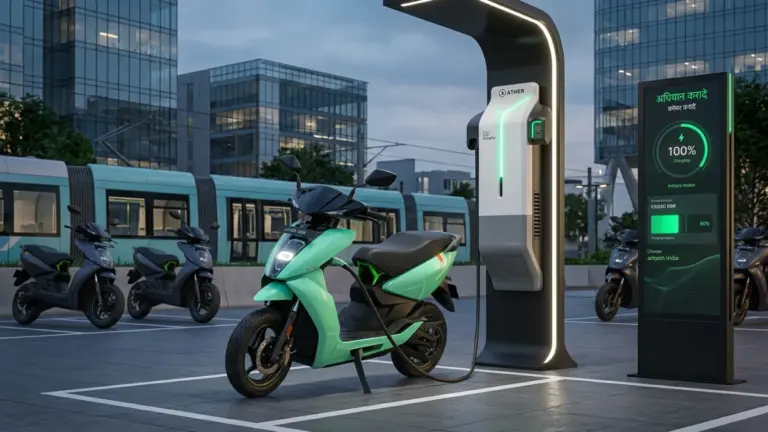
- Level 2 home charging (240V): Primary daily method—gentlest on batteries, most cost-effective
- Level 1 trickle charging (120V): Suitable for overnight top-ups when Level 2 isn’t available—very gentle but slow
- DC fast charging (Level 3): Reserve for road trips and genuine emergencies
The environmental win: A battery lasting 15 years instead of 10 represents a 33% reduction in lifetime manufacturing impact per mile driven. If your EV travels 200,000 miles over 15 years versus needing battery replacement at 120,000 miles, you prevent the manufacturing emissions of an entire additional battery pack.
Electric Vehicle Tire Maintenance: Small Actions, Major Impact
Tires represent one of the most overlooked sustainability factors in EV ownership, yet they significantly influence both environmental impact and operating costs. Electric vehicles typically weigh 10-30% more than gasoline equivalents due to battery mass, creating unique maintenance requirements and accelerated wear patterns.
The Environmental Stakes of EV Tire Care
Tire manufacturing consumes significant petroleum and energy—a single tire requires 7 gallons of oil to produce. Poorly maintained tires don’t just wear faster—they generate microplastic pollution (tires are the second-largest source of ocean microplastics), increase rolling resistance (reducing your EV’s range), and require more frequent disposal.
EV-specific challenges:
- Instant torque: Electric motors deliver maximum torque from 0 RPM, increasing initial tire stress
- Regenerative braking: Changes weight distribution and braking patterns
- Weight distribution: Heavy battery packs create different wear patterns than engine-bay weight
Monthly Tire Pressure Checks: Your Highest-ROI Maintenance Habit
Underinflated tires increase rolling resistance, forcing your electric motor to work harder and drain more battery. Research from the U.S. Department of Energy indicates properly inflated tires improve energy efficiency by up to 3%—translating to meaningful energy savings over 50,000+ miles.
Real-world impact: For a Tesla Model 3 Long Range (358 mile EPA rating), 3% efficiency improvement equals 10+ miles of additional range per charge. Over 100,000 miles, that’s nearly 300 kWh of electricity saved—equivalent to 100+ pounds of CO2 prevented (depending on grid mix).
EV-specific tire pressure tips:
- Check pressure monthly using a reliable digital gauge
- EVs often require higher pressures (40-45 PSI) than gasoline cars—always follow your door jamb sticker, not the tire sidewall
- Check when tires are cold (parked 3+ hours) for accurate readings
- Account for temperature changes: tires lose 1 PSI for every 10°F temperature drop
EV-Specific Tires and Rotation Schedules
Invest in electric vehicle tires designed for your car’s unique demands. Standard tires on EVs wear 20-30% faster due to weight and torque, making EV-optimized tires economically and environmentally superior.
Top EV tire options:
- Michelin e·Primacy: Low rolling resistance, optimized for EV weight distribution
- Bridgestone Turanza EV: Enliten technology reduces rolling resistance by up20%
- Continental EcoContact 6: BlueCompound technology for extended range
- Pirelli P Zero All Season Elect: Designed specifically for electric sports sedans
Key advantages: These tires feature reinforced sidewalls to handle instant EV torque, optimized tread patterns for heavier vehicle weights, and compounds that balance grip with efficiency.
Maintenance schedule: Rotate tires every 5,000–7,500 miles (or per manufacturer guidelines)—more frequently than many gasoline vehicles. Even wear distribution extends tire life significantly, reducing manufacturing demand and waste over your vehicle’s lifetime. Given that EV tires cost $200-400 each, rotation pays for itself quickly.
Regenerative Braking and EV Brake Maintenance
Electric vehicles offer a built-in sustainability advantage through regenerative braking that no gasoline car can match. When you decelerate, your motor acts as a generator, converting kinetic energy back into battery charge while dramatically reducing physical brake use.
How Regenerative Braking Works
When you lift off the accelerator or press the brake pedal lightly, the electric motor reverses function, becoming a generator that:
- Converts vehicle momentum into electrical energy
- Feeds that energy back into the battery
- Slows the vehicle without physical brake engagement
- Captures 60-70% of braking energy that gasoline cars waste as heat
Environmental Benefits of Regenerative Braking
Traditional brake pads shed fine particulate matter containing copper, zinc, and antimony that contaminate waterways and contribute to urban air pollution. EVs using regenerative braking produce significantly less brake dust pollution—a genuine environmental win that’s rarely discussed.
Quantified impact: A typical gasoline car produces 5-10 mg of brake dust per kilometer. For a vehicle driven 12,000 miles annually, that’s 100-200 grams of metal particulates released into the environment yearly. EVs with strong regenerative braking reduce this by 80-90%.
The Hidden Maintenance Risk: Brake Caliper Seizure
The catch: Because physical brakes see minimal use—sometimes only engaging below 5-10 mph or during hard stops—caliper pistons can seize from inactivity. This is particularly problematic in wet, salty climates like the Northeast or coastal regions where corrosion accelerates.
Warning signs:
- Vehicle pulls to one side during braking
- Squealing or grinding when mechanical brakes engage
- Reduced regenerative braking effectiveness
- Uneven brake pad wear
Prevention strategy:
- Periodically use mechanical brakes at low speeds to keep caliper pistons moving—some EVs offer “brake maintenance mode” in settings
- Request annual brake caliper and rotor inspections during service, even if pads appear unused
- Address any sticking or grinding immediately to prevent rotor damage
- Consider annual brake fluid moisture testing in humid climates
Why this matters: Preventive maintenance is far less wasteful than replacing seized calipers ($500-1000+) or damaged rotors. It also ensures your mechanical brakes function properly in emergency situations.
Essential EV Fluid Maintenance (Yes, You Still Need Some)
One of EV ownership’s genuine joys is eliminating oil changes, transmission service, and spark plug replacements. However, “reduced maintenance” doesn’t mean “zero maintenance.” Skipping critical fluid checks leads to premature component failure and unnecessary environmental impact.
Battery Coolant System Maintenance
Your battery pack, inverter, and electric motor generate substantial heat requiring active thermal management. Unlike gasoline engine coolant primarily managing combustion heat, EV coolant systems maintain battery temperatures within narrow optimal windows—typically 60-95°F—regardless of ambient conditions.
Why it matters: Battery thermal management is critical for both performance and longevity. A 2022 study found that degraded coolant reduced battery cooling efficiency by 25%, leading to accelerated degradation during fast charging and hot weather.
Service interval: Typically every 5 years or 150,000 miles (verify your owner’s manual). Some manufacturers like Tesla use “lifetime” coolant, but testing is still recommended at 100,000 miles.
Warning signs of coolant issues:
- Reduced fast charging speeds
- Battery temperature warnings
- Unusual pump noises from front of vehicle
- Sweet smell indicating leak
Neglecting coolant service risks thermal management failures that accelerate battery degradation—a costly mistake given battery replacement’s environmental impact.
Brake Fluid Replacement for EVs
Brake fluid is hygroscopic, meaning it absorbs atmospheric moisture over time. This lowers its boiling point and causes internal corrosion—even in EVs with minimal brake use. Moisture-contaminated brake fluid can boil during hard braking, causing pedal fade and reduced stopping power.
Recommended service: Test and replace brake fluid approximately every 2 years, regardless of mileage. This is more frequent than some manufacturer recommendations but prudent given safety implications.
EV-specific consideration: Because regenerative braking reduces heat generation at the brakes, EV brake fluid typically stays cooler—potentially extending service life. However, the hygroscopic nature means time, not just use, degrades fluid quality.
Cabin Air Filter: Efficiency and Health
A clogged cabin air filter forces your HVAC system to work harder, drawing additional energy from your battery. It also reduces interior air quality, particularly important given EVs’ airtight cabins for noise reduction.
Replacement schedule: Annually or per manufacturer recommendation—typically a simple, inexpensive DIY task that supports both energy efficiency and occupant health. Some premium EVs like Tesla Model S/X have biological weapon defense mode filters requiring more frequent replacement.
Efficiency impact: A severely clogged filter can increase HVAC energy consumption by 15-20%—significant in extreme weather when heating/cooling already reduces range.
Over-the-Air Updates: The Unique EV Maintenance Advantage
Here’s something no gasoline vehicle offers: software updates that improve efficiency and longevity after purchase. This represents a fundamental shift in automotive sustainability—continuous improvement without physical modification.
How OTA Updates Enhance Sustainability
Manufacturers including Tesla, Rivian, Lucid, Ford, GM, and Hyundai regularly deploy over-the-air (OTA) updates enhancing:
- Battery management algorithms: Improved charging curves and thermal management
- Regenerative braking calibration: More energy recovery, less physical brake use
- Thermal control strategies: Better preconditioning and climate efficiency
- Charging efficiency protocols: Reduced energy loss during charging
- Route planning: Optimized navigation considering elevation and charging stops
Critical action: Ensure your EV stays connected to Wi-Fi with automatic updates enabled. These updates cost nothing and can meaningfully extend battery life and improve real-world efficiency.
Real-World Impact Examples
Tesla: 2023 updates improved cold-weather efficiency by 10-15% through better heat pump management and battery preconditioning algorithms.
Ford Mustang Mach-E: 2022 updates increased usable battery capacity by 2-3% through refined state-of-charge calculations, effectively adding range without hardware changes.
Volkswagen ID.4: Software updates have progressively improved charging speeds and thermal management, reducing charging time by 10-15% at DC fast chargers.
The sustainability angle: Software improvements that extend range by 5% reduce charging frequency, saving electricity and grid infrastructure wear. Updates that improve battery longevity by even 6 months prevent premature replacement and associated manufacturing emissions.
Advanced Sustainability Practices for EV Owners
Beyond basic maintenance, several emerging practices can further reduce your EV’s environmental footprint.
Smart Charging and Grid Integration
Time-of-use charging: Charging during off-peak hours (typically 11 PM – 7 AM) reduces strain on electrical grids and often uses cleaner energy mix. Many utilities offer 50-70% lower rates during these periods.
Vehicle-to-grid (V2G) readiness: Some EVs like Ford F-150 Lightning and Nissan Leaf offer bidirectional charging, allowing your vehicle to power your home or feed energy back to the grid. This turns your EV into grid storage, supporting renewable energy integration.
Solar pairing: Charging with rooftop solar creates a true zero-emission transportation loop. Even a modest 5 kW solar array can generate enough annual energy to drive 12,000-15,000 miles.
Eco-Driving Techniques for Maximum Efficiency
Your driving style significantly impacts energy consumption and component wear:
- Gradual acceleration: Rapid acceleration increases battery discharge rates and tire wear
- Anticipatory driving: Looking ahead reduces sudden braking, maximizing regenerative recovery
- Speed optimization: EV efficiency drops significantly above 65-70 mph due to aerodynamic drag
- Climate pre-conditioning: Heating/cooling while plugged in preserves battery range
Impact: Efficient driving can improve real-world range by 15-20%, reducing charging frequency and battery cycle count.
End-of-Life Planning: Sustainable EV Ownership Beyond Your Tenure
Responsible electric vehicle ownership includes planning for eventual sale, trade-in, or recycling. The average EV remains in service for 15-18 years across multiple owners, making end-of-life considerations relevant even for new car buyers.
Extending Vehicle Life Through Multiple Owners
The most sustainable EV is one that serves multiple owners over 20+ years. Maintaining comprehensive service records, keeping software updated, and addressing minor issues promptly preserves resale value and ensures continued efficient operation.
Second-owner considerations: Many EVs see their second life as affordable used vehicles, democratizing clean transportation. A well-maintained 8-year-old EV with 80% battery capacity still offers 150+ miles of range—sufficient for 90% of daily driving needs.
Second-Life Battery Applications
EV battery packs retaining 70-80% of original capacity no longer meet automotive range requirements but remain valuable for stationary energy storage. This “second life” can extend total battery usefulness by 10-15 years before recycling.
Major programs include:
- Nissan-Eaton partnership: Repurposing Leaf batteries for commercial and residential grid storage, with installations powering stadiums and factories
- Volkswagen Group: Developing stationary storage solutions for used EV batteries through their “PowerCo” division
- Tesla: Exploring second-life battery integration into Powerwall ecosystem
- BMW: Using i3 batteries for factory forklift power and grid storage
Action step: Research manufacturer buyback or repurposing programs before your vehicle reaches end-of-life. Extending battery utility delays recycling and reduces mining demand for new materials. Some manufacturers offer $2,000-5,000 for end-of-life battery packs.
Responsible EV Battery Recycling
When batteries truly reach end-of-life—typically after 15-25 years of combined vehicle and stationary use—responsible recycling recovers critical materials.
Closed-loop recycling leaders:
- Redwood Materials (founded by former Tesla CTO JB Straubel): Recovering 95%+ of lithium, cobalt, nickel, and manganese for re-entry into new battery supply chains
- Li-Cycle: Hub-and-spoke model recovering materials with minimal environmental impact
- Umicore: European leader in battery materials recovery
The sustainability win: Recycled lithium requires 80% less energy than virgin mining. Recycled cobalt reduces mining demand from politically unstable regions. By 2030, recycled materials could supply 20% of battery demand, reducing mining pressure.
Avoid: General waste streams or unverified recyclers where materials are lost and chemicals may leach into ecosystems. Always verify recycler certifications and environmental compliance.
Quick Reference: EV Maintenance Impact Summary
| Maintenance Practice | Environmental Benefit | Cost of Neglect | Estimated Savings |
|---|---|---|---|
| Daily 20-80% charging | Extends battery lifespan 2-3+ years | Premature capacity fade, $10,000+ replacement | $200-400/year in avoided degradation |
| Monthly tire pressure checks | 3% efficiency gain, extended tire life | Increased energy use, accelerated tire waste | $150-300/year in energy and tire costs |
| Scheduled coolant service | Protects battery thermal management | Accelerated degradation, early battery failure | $5,000-15,000 in avoided early replacement |
| Annual brake inspections | Prevents caliper seizure, reduces particulate | Premature component replacement | $500-1,000 in avoided repairs |
| OTA software updates | Optimizes efficiency and battery algorithms | Missed range and longevity improvements | 5-10% efficiency gains, free |
| Cabin filter replacement | Reduces HVAC energy load | Higher consumption, reduced air quality | $50-100/year in energy costs |
| Smart charging practices | Uses cleaner grid energy, lower rates | Higher emissions, higher electricity costs | $200-500/year in utility savings |
Conclusion: The Greenest EV Is the One You Maintain Exceptionally Well
When asked about the most sustainable electric vehicle purchase, my answer is consistent: the EV you already own—properly maintained.
The environmental case for electric vehicles strengthens annually as electrical grids incorporate more renewable energy. Solar and wind now represent 20%+ of U.S. electricity generation, making EVs cleaner every year. But that case assumes your vehicle operates efficiently throughout its full designed lifespan.
Your sustainable EV maintenance checklist:
Charge between 20-80% for daily use to maximize battery longevity
Check tire pressure monthly and invest in EV-specific tires for optimal efficiency
Service coolant and brake fluid on schedule, regardless of minimal brake wear
Install every software update to capture free efficiency improvements
Practice eco-driving techniques to reduce energy consumption and component stress
Plan for end-of-life through second-life programs or certified recycling
Consider solar pairing for true zero-emission transportation
Your electric vehicle represents a powerful tool for reducing personal transportation emissions—typically 50-70% lower than gasoline equivalents over its lifetime, even accounting for manufacturing. Maintain it thoughtfully, and it will deliver environmental benefits for decades while saving you thousands in avoidable repairs.
The transition to electric mobility is about more than technology—it’s about changing our relationship with transportation from disposable to durable, from extractive to circular. Every maintenance decision you make supports that transformation.
Ready to maximize your EV’s potential? Start with one habit from this guide today: set your charge limit to 80%, check your tire pressure, schedule that overdue software update, or research solar charging options. Small actions compound into significant impact—for your wallet and the planet.