Finding EV charging stations in 2026 is easier than ever using apps like PlugShare and ChargePoint. Understanding charging levels and networks helps you avoid delays and plan efficiently. Most charging happens at home, while fast chargers support road trips. With better infrastructure and smart planning tools, EV drivers can travel confidently without range anxiety.
Whether you’re new to electric driving or just moved to a new city, knowing where to charge is everything. Here’s the complete playbook — apps, tips, and charging know-how — so you’re never stranded with an empty battery.
The short answer: finding an EV charging station near you in 2026 is easier than ever. Apps like PlugShare, ChargePoint, and your car’s built-in navigation will show you stations in real-time — often including live availability and pricing. But knowing which station to trust, what charging level you actually need, and how to plan ahead? That’s where this guide comes in.
I’ve been driving electric since 2019. In that time, I’ve charged on nearly every major network in the country — from Tesla Superchargers to EVgo hubs in mall parking garages to humble Level 2 outlets outside a coffee shop in rural Virginia. I’ve been stranded exactly once (a broken charger in 2021 that I should have checked before driving past the last gas station). I learned my lesson, and now I want to save you from the same mistake.
This guide covers everything: the best apps to find stations, how to understand charging levels, what to look for before you pull up, how to make the most of charging downtime, and how to plan longer road trips confidently. Let’s get into it.
The Best Apps to Find EV Charging Stations Near You
Your car’s built-in navigation is a reasonable starting point, but dedicated apps give you far more real-world data — like whether a specific charger is currently occupied, broken, or out of service. These are the tools I actually use.
PlugShare
The crowd-sourced standard. Real driver reviews, photos, and live check-ins at thousands of stations. Works for all EV brands.
Best Overall
ChargePoint
Access to one of the largest networks in North America. Shows live port availability and lets you start sessions remotely.
Largest Network
ABRP (A Better Route Planner)
The trip-planning gold standard for EV road trips. Factors in elevation, weather, speed, and your car’s real range.
Road Trips
Tesla App / Navigation
If you drive a Tesla, the onboard navigation automatically routes you through Superchargers. Essentially flawless for in-network charging.
Tesla Owners
EVgo / Electrify America
Network-specific apps for their fast-charging locations. Useful if you’re a frequent user and want to manage account credits or subscriptions.
Google Maps
Type “EV charging near me” and it surfaces stations instantly. Basic, but surprisingly good for a quick nearby search while navigating.
Quick Search
My personal setup: I keep PlugShare on my phone for checking reliability and reading reviews before I commit to a stop, and I use ABRP for anything involving a drive over 150 miles. These two, combined with your car’s native app, cover nearly every situation you’ll encounter.
Pro tip: Always check PlugShare reviews before using an unfamiliar station. If the last three check-ins say “port 2 broken” or “payment terminal not responding” — trust the community and move on. Real driver data is more reliable than any map marker.
Understanding EV Charging Levels: Which One Do You Need?
One of the most confusing parts of EV ownership for newcomers is deciphering charging levels. Not all chargers are equal — and pulling up to the wrong type when you’re in a hurry is genuinely frustrating. Here’s the breakdown in plain English.
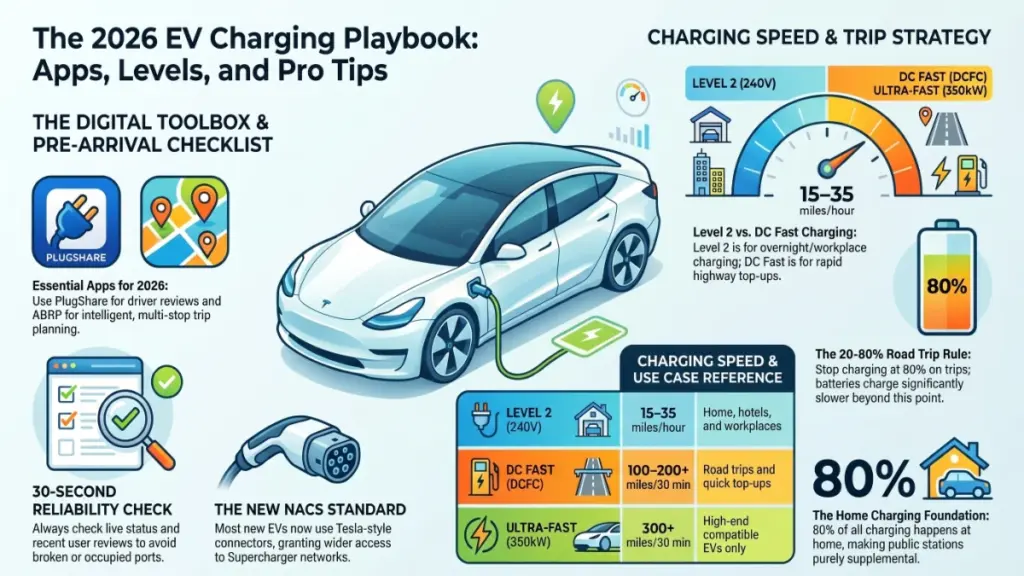
| Charging Level | Power Output | Typical Speed | Best For | Speed |
|---|---|---|---|---|
| Level 1 (120V) | ~1.4 kW | 3–5 miles/hour | Overnight home charging, emergencies | Slow |
| Level 2 (240V) | 7–19 kW | 15–35 miles/hour | Home, workplaces, hotels, destination charging | Medium |
| DC Fast Charge (DCFC) | 50–150 kW | 100–200+ miles/30 min | Road trips, quick top-ups on the go | Fast |
| Ultra-Fast (350 kW) | Up to 350 kW | Up to 300+ miles/30 min | Compatible vehicles only (Hyundai, Kia, BMW, Mercedes) | Ultra |
Think of Level 1 like charging your phone with a basic USB-A cable — technically works, but you’d never rely on it if you needed a full charge by morning. Level 2 is your home wall charger or the station at your workplace — steady, reliable, does the job overnight. DC Fast Charging is the equivalent of fast-charging your phone at 65W: meaningful progress in a short window.
Does Your Car Accept DC Fast Charging?
Not every EV accepts fast charging at the same speed — or at all. Some entry-level EVs (like the base Nissan Leaf and certain older Chevy Bolts) cap out at 50 kW regardless of how powerful the charger is. Meanwhile, vehicles like the Hyundai IONIQ 6 and Tesla Model 3 Long Range can accept well over 200 kW, cutting a 20–80% charge down to roughly 18–22 minutes. Always know your car’s maximum accepted charge rate before planning around a fast charger.
Navigating the Major Charging Networks in 2026
The U.S. charging landscape has evolved significantly. As of early 2026, the United States has over 192,000 public EV charging ports — a number that’s been growing steadily thanks to the NEVI program and private investment. But not all networks are created equal in terms of reliability, pricing, or coverage.
| Network | Type | Connector | Reliability (2026) | Pricing Model |
|---|---|---|---|---|
| Tesla Supercharger | DC Fast | NACS / CCS (adapter) | ⭐⭐⭐⭐⭐ Excellent | Per kWh or per minute |
| ChargePoint | L2 + DCFC | J1772 / CCS | ⭐⭐⭐⭐ Good | Per kWh or flat fee |
| Electrify America | DC Fast / Ultra | CCS / CHAdeMO | ⭐⭐⭐ Improving | Per kWh (membership discounts) |
| EVgo | DC Fast | CCS / CHAdeMO | ⭐⭐⭐⭐ Good | Per minute or per kWh |
| Blink | L2 + DCFC | J1772 / CCS | ⭐⭐⭐ Mixed | Per hour or per kWh |
One major shift in 2026: the North American Charging Standard (NACS) — originally Tesla’s connector — has become the dominant standard across nearly all new EVs sold in the U.S. Ford, GM, Rivian, Honda, Toyota, Nissan, and others have all adopted NACS. If you’re buying a new EV today, you’ll likely have direct access to the Tesla Supercharger network without an adapter.
Connector note: If you own an older EV with a CCS or CHAdeMO port, adapters are widely available for NACS stations. Tesla offers an official CCS-to-NACS adapter, and third-party options exist for other combinations. Don’t let the connector type alone stop you from using a particular network.
What to Check Before You Pull Up to a Charger
This is the practical stuff that saves you time and frustration. A station listed on a map doesn’t automatically mean it’s working, available, or priced the way you expect. Here’s my pre-arrival checklist after years of trial and error.
Roy’s Pre-Arrival Checklist
- Check live status: Use PlugShare or the network’s app to confirm ports are actually available and operational.
- Read recent check-ins: Reviews from the last 24–48 hours tell you far more than the station’s listing.
- Confirm the connector type: Match your car’s port to the station’s available plugs (especially important on older EVs).
- Know the pricing: Some stations charge per kWh, others per minute. Per-minute billing can get expensive if your car charges slowly.
- Check the location context: Is there somewhere worth going while you charge? A grocery store, café, or park nearby makes the wait genuinely pleasant.
- Have a backup: Identify the nearest alternative station before you arrive — just in case a port is broken or occupied.
I know that sounds like a lot, but after a few months it becomes second nature — maybe 30 seconds of habit before you route. The PlugShare app makes most of this trivially fast.
Making the Most of Your Charging Time
Here’s a mindset shift that changed how I think about public charging: it’s not wasted time, it’s scheduled downtime. On a road trip, you were going to stop anyway — for coffee, food, a bathroom break. The key is aligning charging stops with things you’d want to do regardless.
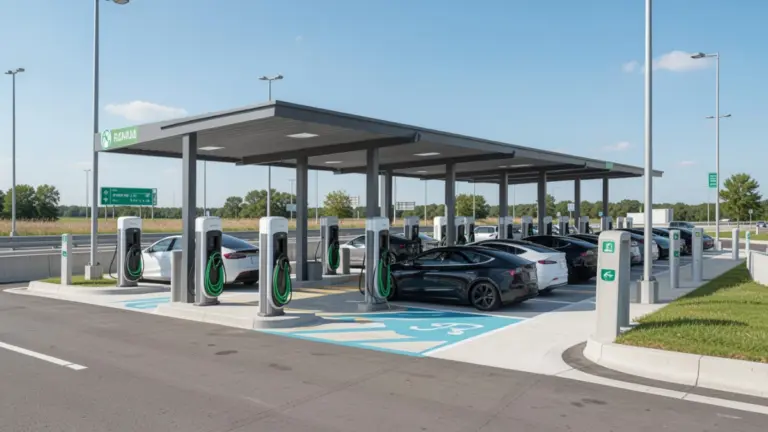
Fast chargers are increasingly placed near useful amenities. Electrify America has stations at Walmart, Target, and IKEA locations nationwide. EVgo often anchors in grocery-anchored shopping centers. Tesla Superchargers have been showing up at highway travel plazas, Starbucks drive-throughs, and hotel properties. The overlap between “places I’d stop anyway” and “EV charging available” keeps getting better.
For a typical DC fast charge session — say, adding 150 miles to your range — you’re looking at roughly 20–35 minutes at a well-functioning station. That’s a proper sit-down coffee and a snack, or a grocery run, or a leisurely walk. It’s honestly not far off from a gas stop once you factor in fueling, paying, and stretching your legs anyway.
Planning EV Road Trips Around Charging Infrastructure
Long-distance EV travel has a completely different rhythm than gas-car road trips. The planning is front-loaded — you spend five minutes plotting charge stops before you leave, and then the drive itself is largely carefree. Here’s how to approach it.
Use ABRP or Your Car’s Built-In Navigation
A Better Route Planner (ABRP) is, in my opinion, the single best tool for EV road trips. It pulls in real-time data on your car’s efficiency, your current battery state, the elevation profile of the route, ambient temperature, and typical highway speed. It then plots optimal charging stops with target arrival percentages at each station. If you’re driving a Tesla, the onboard trip planner does something nearly as good automatically.
The 20–80% Rule on Road Trips
For road trips involving multiple DC fast charging stops, most experienced EV drivers follow the 20–80% rule: charge from roughly 20% up to 80%, then continue driving. Why? Lithium-ion batteries charge exponentially slower above 80% — the last 20% takes nearly as long as the first 60%. Keeping charge sessions in the sweet spot maximizes your miles-per-minute-spent-charging. You’ll arrive at your destination faster with more, shorter stops than fewer, longer ones.
Have a Backup Plan for Remote Stretches
For particularly rural routes — say, a cross-country stretch through the Great Plains — charge a bit higher than normal (to 90%) before entering low-density areas. ABRP will flag these stretches and suggest conservative buffer charges. Trust it. One buffer charge is worth far more than the mild anxiety of watching your estimated range drop below the distance to the next station.
2026 network update: The NEVI (National Electric Vehicle Infrastructure) program — part of the 2021 infrastructure law — has been actively funding fast chargers along U.S. highway corridors. As of early 2026, every state has received NEVI funding, and stations are appearing along previously underserved Interstate corridors. Check the AFDC (Alternative Fuels Station Locator) at afdc.energy.gov for the most up-to-date government data on corridor charging coverage.
Don’t Overlook Home Charging — It Changes Everything
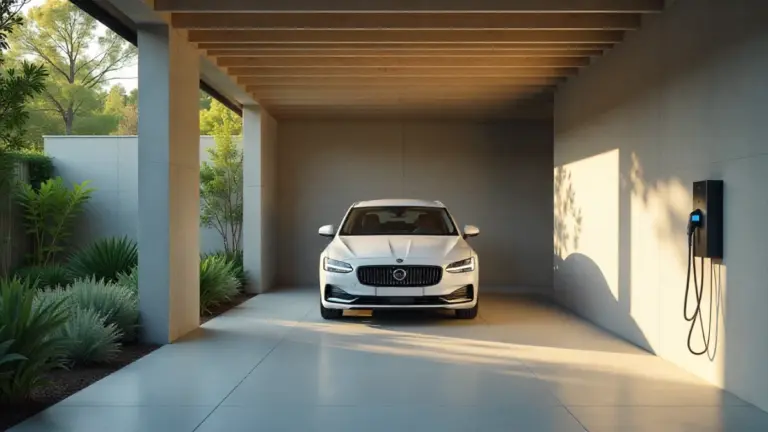
Here’s something that surprises most people who haven’t owned an EV: the vast majority of EV charging happens at home. Industry data consistently shows that around 80% of all EV charging sessions take place in a residential setting. You plug in when you get home, wake up to a full battery, and public charging becomes purely supplemental.
If you own your home or have a landlord willing to cooperate, installing a Level 2 home charger (EVSE) is the single biggest quality-of-life upgrade for EV ownership. A typical Level 2 charger adds 25–30 miles of range per hour — so a 4-hour overnight charge covers a full day’s driving for most people, and an 8-hour sleep charges virtually any EV from nearly empty to full.
No garage? Check whether your apartment building, HOA, or employer has a charging program, or explore workplace charging options. Destination chargers at hotels, long-term parking lots, and transit hubs are also underrated options for people without home access.
The Bottom Line
Finding EV charging stations near you is genuinely simple in 2026 — provided you know the right tools and build a few good habits. Here are the key takeaways:
- Use PlugShare for reliability data and real driver reviews before committing to a station.
- Understand charging levels — Level 2 is your everyday workhorse; DC fast is for road trips and quick top-ups.
- Know your network: Tesla Supercharger, ChargePoint, and EVgo lead on reliability. Check your car’s connector compatibility.
- Apply the 20–80% rule on road trips to minimize time spent at chargers.
- Prioritize home charging — it covers 80% of your needs and costs far less than public charging per kWh.
- Plan with ABRP for any drive over 150 miles.
The EV charging landscape is improving faster than many people realize. The infrastructure that felt thin in 2021 is now genuinely solid in most metro areas — and getting better along highway corridors every month. The best time to start driving electric and learning the rhythm of charging was a few years ago. The second best time is right now. Explore More EV Guides →