Looking to reduce commuting costs and emissions without changing your entire lifestyle? This guide breaks down practical eco-friendly commuting tips—from switching to EVs and e-bikes to smarter driving habits, carpooling, and hybrid work schedules. Small daily changes can lower your carbon footprint, save money on fuel, and make your commute less stressful and more enjoyable.
Your daily commute might be the single biggest environmental decision you make — and you probably don’t even think about it. The average American spends roughly 27 minutes each way commuting to work, according to U.S. Census data. Multiply that by 250 workdays a year, across millions of drivers, and you start to understand why transportation accounts for the largest share of U.S. greenhouse gas emissions — around 28%, per the EPA.
The good news? You have real options. Whether you drive a gas-powered car, are considering an EV, or are simply looking to squeeze more green into your routine, this guide gives you practical, road-tested strategies that can make a measurable difference — starting this week.
Here’s what you’ll learn: the smartest ways to reduce your commute’s carbon footprint, how to evaluate an EV switch, why carpooling has gotten a serious upgrade, and how small habits behind the wheel can save you hundreds of dollars a year.
Why Your Commute Matters More Than You Think
Before we get into the tips, let’s put some numbers on the table.
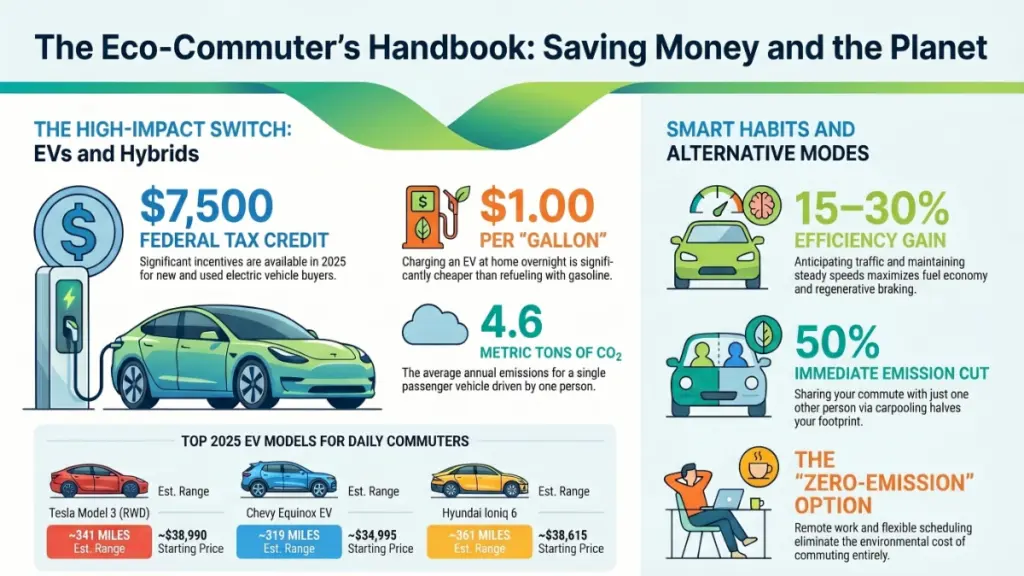
The average passenger vehicle emits about 4.6 metric tons of CO₂ per year, according to the EPA. That’s one car, one driver. If your commute is 30 miles round-trip — fairly typical in Ohio and across the Midwest — you’re burning roughly 600 gallons of gas annually at average fuel economy. That’s real money and real emissions.
Here’s the thing: commuting is also the easiest place to make change. Unlike home energy or supply chains, your commute is something you control directly, every single day. Small adjustments compound fast.
1. Make the Switch to an Electric Vehicle (Or a Hybrid)
If you’re serious about cutting emissions, nothing moves the needle faster than switching your daily driver to an EV or plug-in hybrid. I get it — it’s a significant investment. But the math has shifted dramatically over the past few years, and the 2025 EV market is genuinely the best it’s ever been for everyday buyers.
What the Numbers Look Like in 2025
The federal EV tax credit of up to $7,500 (for new vehicles) and $4,000 (for used) under the Inflation Reduction Act remains available for many buyers, subject to income and vehicle price caps. States like Colorado, California, and New York add their own incentives on top.
Charging at home overnight costs the equivalent of roughly $1.00–$1.50 per gallon in most U.S. markets. If you’re spending $60–$80 filling up a conventional sedan every week, that math adds up fast.
Top EVs Worth Considering for Commuters (2025)
| Model | Est. Range | Starting Price | Charging Speed |
|---|---|---|---|
| Tesla Model 3 (RWD) | ~341 miles | ~$38,990 | Up to 250 kW DC |
| Chevy Equinox EV | ~319 miles | ~$34,995 | Up to 150 kW DC |
| Hyundai Ioniq 6 (RWD) | ~361 miles | ~$38,615 | Up to 350 kW DC |
| Ford Mustang Mach-E | ~312 miles | ~$36,495 | Up to 150 kW DC |
| Toyota Prius Prime (PHEV) | ~44 miles EV / 640 total | ~$32,350 | Level 2 AC |
Source: EPA fueleconomy.gov, manufacturer websites (2025)
For most commuters averaging under 50 miles per day, a plug-in hybrid is a compelling middle ground — you run on electricity for the vast majority of daily driving, but the gas engine is there when you need it. The Toyota Prius Prime and Hyundai Tucson PHEV are particularly strong choices for commuters in areas with limited charging infrastructure.
The Home Charging Piece
One thing I always tell people: home charging is what makes EV ownership practical. A standard Level 2 charger (240V) costs around $500–$800 to install and adds roughly 25–30 miles of range per hour. You plug in at night, wake up to a full “tank” every morning. It genuinely changes how you think about fueling up.
2. Optimize How You Drive — Efficiency Habits That Actually Work
Whether you’re in an EV, a hybrid, or a conventional car, how you drive is just as important as what you drive. Aggressive driving — rapid acceleration, hard braking, high speeds — can reduce fuel efficiency by 15–30% on the highway, according to the U.S. Department of Energy.
Here are the habits that make the biggest practical difference:
- Anticipate traffic flow. Look ahead and coast to decelerate rather than braking hard. In an EV or hybrid, this maximizes regenerative braking. In any car, it reduces wear and saves fuel.
- Keep your speed steady. Every 5 mph you drive over 50 mph costs you roughly 7–14% more in fuel economy (DOE). If your commute includes highway miles, cruise control is your friend.
- Eliminate cold starts when possible. Short trips from a cold engine are disproportionately polluting. If you can combine errands into one trip rather than several, do it.
- Keep tires properly inflated. Under-inflated tires increase rolling resistance. The DOE estimates you can improve fuel economy by 0.5–3% just by keeping tires at the recommended PSI — simple and free.
- Turn off the engine when idling. Modern engines don’t need warm-up idling. If you’re waiting more than 60 seconds, turning off the engine saves more fuel than restarting uses.
None of these require a new car. They just require attention.
3. Explore Public Transit, Biking, and the Real Cost of Driving
Here’s a question worth asking yourself honestly: does your commute actually require a personal vehicle?
For many people — especially those in mid-sized cities or suburbs with decent transit connections — the answer is “not always.” And the financial case for alternatives is stronger than most people realize.
The True Cost of Your Commute
AAA estimates the average total cost of owning and operating a new vehicle in 2024 at around $12,182 per year — that includes depreciation, insurance, maintenance, fuel, and financing. That’s over $1,000 per month. Even eliminating car use two or three days per week has meaningful financial and environmental impact.
Transit: Underrated and Improving
If you live within reasonable distance of a bus or rail line, a transit pass typically costs $50–$150/month — a fraction of car operating costs. Many cities have dramatically upgraded apps, real-time tracking, and frequency over the past five years.
Yes, transit isn’t perfect everywhere. But if it’s feasible even a few days per week, it’s worth the experiment.
Cycling: Farther Than You Think
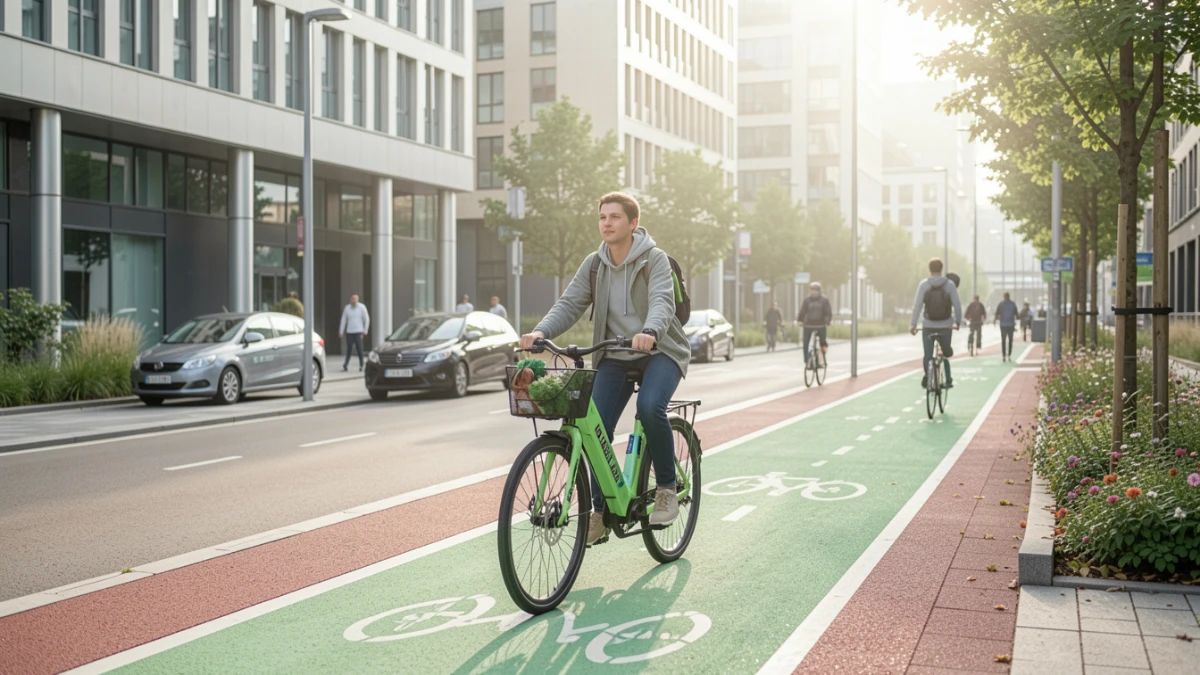
E-bikes have genuinely transformed cycling as a commute option. A quality commuter e-bike ($1,200–$3,000) can comfortably cover 15–20 miles each way, handles hills without arriving at work sweaty, and costs almost nothing to charge. Several employers now offer bike commuter benefits (up to $30/month pre-tax), and cities across the country are adding protected infrastructure rapidly.
Even a conventional bike works beautifully for commutes under 5–7 miles. The health benefits are substantial, the cost is near zero, and your carbon footprint for those trips drops to essentially nothing.
Walking: The Forgotten Option
If you’re within 1.5–2 miles of work, walking deserves genuine consideration. Thirty minutes of brisk walking produces zero emissions, costs nothing, counts as your daily exercise, and — depending on your traffic situation — may not take much longer than driving. It’s one of those options that people dismiss until they try it.
4. Carpooling and Ride-Sharing: The Underused Game-Changer
Carpooling has a reputation as a relic from the 1970s. In 2025, it’s actually one of the most effective and frictionless eco-commuting strategies available — and apps have made coordination dramatically easier.
The Emission Math on Carpooling
If two people share a commute in one car instead of driving separately, you’ve immediately cut transportation emissions for those trips in half. Add a third person and you’re at a third. It’s that simple — and no new technology required.
Modern Carpooling Tools Worth Knowing
- Waze Carpool — Integrates with your existing Waze navigation, matches you with commuters on similar routes, and handles payment automatically.
- Scoop — Popular in major metro areas, focuses specifically on workplace commutes with employer partnerships.
- Vanpooling programs — Many large employers and regional transit authorities subsidize vanpools. Check with your HR department; it’s a benefit that often goes unclaimed.
- Employer rideshare matching — Companies like Microsoft, Amazon, and many large hospital systems run internal carpool matching programs.
The social dimension is real, too. Several studies have linked regular carpooling with reduced commute stress and stronger workplace relationships. You might find you actually enjoy the ride more.
5. Work-From-Home and Flexible Schedules: The Zero-Emission Option
The most sustainable commute trip is the one you don’t take.
Since 2020, remote and hybrid work has become normalized across a huge range of industries. If your role allows any degree of remote work and you haven’t had a direct conversation with your employer about a permanent hybrid arrangement, it’s worth initiating that discussion. Even one or two days at home per week significantly reduces your annual commuting emissions.
Beyond fully remote days, flexible scheduling helps in two specific ways. First, shifting your commute hours by even 30–60 minutes often means dramatically lighter traffic — shorter trips, less idling, better fuel economy. Second, four-day workweeks (10-hour days instead of five 8-hour days) reduce commuting frequency by 20% with no change in total hours worked. Several large employers have adopted these schedules specifically citing both employee wellbeing and sustainability goals.
A Practical Approach to Combining Strategies
The most effective eco-commuters don’t rely on a single strategy — they layer them. Here’s an example of what a realistic, lower-emission commute week might look like:
- Monday: Drive EV to work (charged overnight with home solar or off-peak electricity)
- Tuesday: Work from home
- Wednesday: Carpool with a neighbor who works nearby
- Thursday: Take transit, walk the last half-mile
- Friday: Bike (e-bike in summer, carpool or transit in winter)
That’s not a radical lifestyle overhaul. It’s a realistic rotation that cuts commute emissions by 60–70% compared to five solo drives — while also saving money.
Putting It All Together: Your Eco-Commuting Action Plan
Changing your commute doesn’t require doing everything at once. Here’s how to start:
This week:
- Check your tire pressure and set a reminder to do it monthly.
- Download a transit app and look up your nearest bus or rail route — just out of curiosity.
- Calculate your current commute cost using the AAA driving cost calculator (aaa.com/autorepair).
This month:
- Have a conversation with your employer about any remote or flexible scheduling options.
- Research the federal and state EV incentives available in your area at fueleconomy.gov.
- Talk to one or two coworkers about potentially carpooling, even once a week.
This year:
- If you’re in the market for a new vehicle, take at least two EVs or PHEVs for test drives before deciding.
- Try commuting by bike or transit at least five times — give it enough chances to become familiar.
- Track your fuel spending for three months; the data is often motivating on its own.
Final Thoughts
The commute is one of the most habitual parts of daily life — which is exactly why it’s worth examining. Habits are powerful in both directions. The same routine that locks in years of unnecessary emissions can be reshaped, gradually, into something you’re genuinely proud of.
You don’t need to overhaul your life overnight. Start with one change. Add another when that one feels normal. The cumulative effect — on your wallet, your carbon footprint, and frankly your daily stress level — is more significant than most people expect.
The road is changing fast. EVs are better and more affordable than ever. Charging infrastructure is expanding. Remote work is normalized. Bike lanes are multiplying. There has never been a better time to commute smarter.
The question isn’t whether eco-friendly commuting is possible. It’s which step you’ll take first.
Sources & Further Reading:
- U.S. EPA: Greenhouse Gas Emissions from Transportation — epa.gov
- U.S. DOE: Fuel Economy Tips — fueleconomy.gov
- AAA: Your Driving Costs (2024) — aaa.com
- IRS: Clean Vehicle Tax Credits — irs.gov
- U.S. Census Bureau: Commuting in America — census.gov