Eco-friendly transportation in 2025 offers more practical choices than ever. Electric vehicles, hybrids, e-bikes, public transit, car-sharing, walking, and cycling all help reduce emissions and lower travel costs. EVs continue improving in range and affordability, while e-bikes and transit remain some of the most cost-effective green commuting options. Choosing the right mix depends on your budget, daily distance, and access to charging or public transportation.
If you’ve been thinking about cutting your carbon footprint but aren’t sure where to start, you’re not alone — and the good news is you have more choices than ever before. Whether you’re ready to go fully electric or just want to swap a few car trips for something greener, the landscape of eco-friendly transportation in 2025 is richer, more practical, and more affordable than at any point in history.
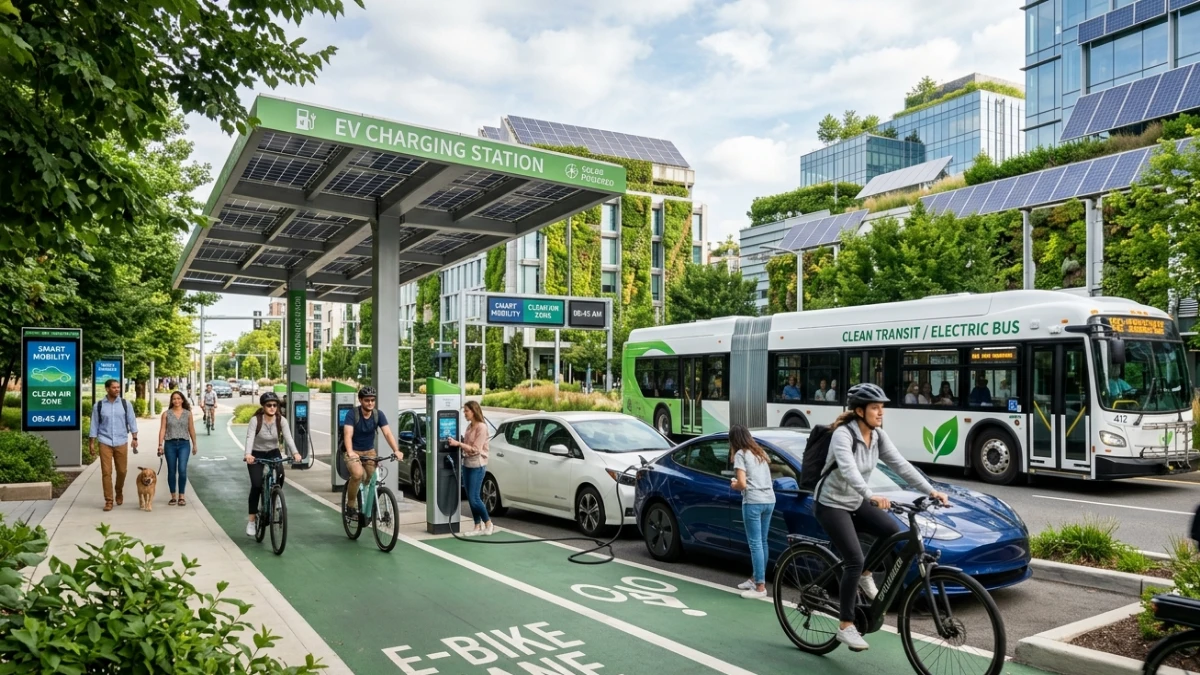
In this guide, I’ll walk you through every major sustainable transportation option available today — from electric vehicles and e-bikes to public transit and ride-sharing — covering the real-world costs, benefits, and trade-offs for each. By the end, you’ll know exactly which option (or combination) makes the most sense for your lifestyle.
Why Eco-Friendly Transportation Matters More Than Ever
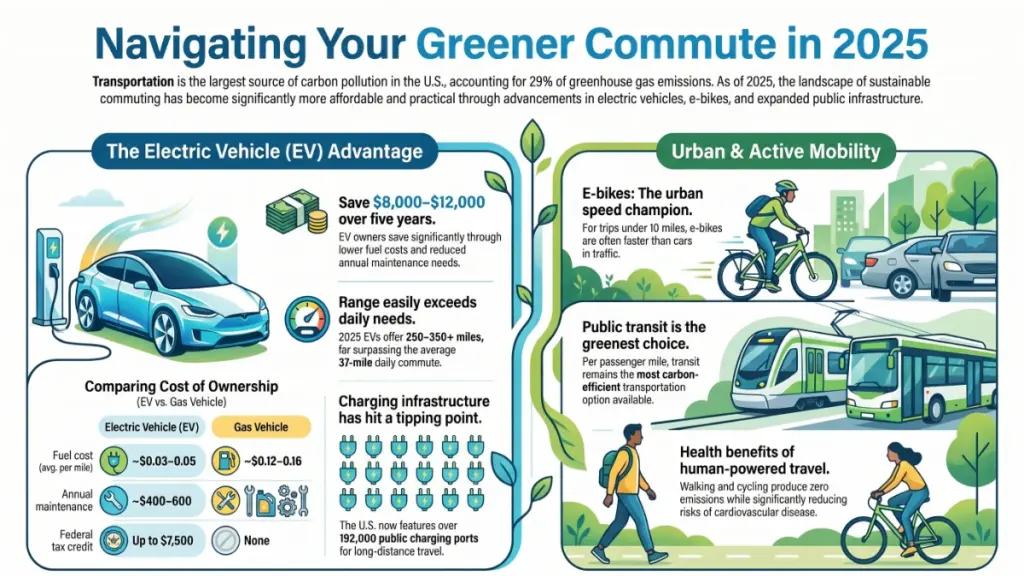
Transportation is one of the single largest contributors to greenhouse gas emissions globally. According to the U.S. Environmental Protection Agency (EPA), the transportation sector accounts for roughly 29% of total U.S. greenhouse gas emissions — making it the largest source of carbon pollution in the country.
That’s a sobering number. But here’s the flip side: it means the choices we make about how we get around carry enormous weight. Shifting even a portion of your daily travel to a lower-emission option adds up faster than most people expect.
And this isn’t just about the environment. Eco-friendly transportation often translates to real savings in your wallet, less time stuck in traffic, and — in the case of cycling or walking — a genuine boost to your physical health. The incentives are stacking up.
Electric Vehicles: The Most Practical Green Upgrade for Most Drivers
If you drive regularly and want to make the single biggest reduction in your personal transportation emissions, switching to a battery electric vehicle (BEV) is still the most impactful move you can make. I’ve tested and reviewed dozens of EVs over the years, and the improvement in range, charging speed, and overall value since even five years ago is remarkable.
What’s Available in 2025
The EV market has matured significantly. You’re no longer choosing from a handful of niche models — you’re picking from a robust lineup that covers every major category:
- Sedans & Compacts: Chevrolet Equinox EV (starting ~$35,000), Tesla Model 3, Hyundai Ioniq 6
- SUVs & Crossovers: Ford Mustang Mach-E, Kia EV6, Rivian R2 (new for 2025)
- Trucks: Ford F-150 Lightning, Rivian R1T, Chevy Silverado EV
- Budget-Friendly: Nissan Leaf, Chevrolet Bolt EUV
Most 2025 EVs offer 250–350+ miles of real-world range, which comfortably handles the vast majority of daily driving for most Americans. The average U.S. driver covers about 37 miles per day — a figure that even modest EVs handle with ease.
Charging: Easier Than You Think
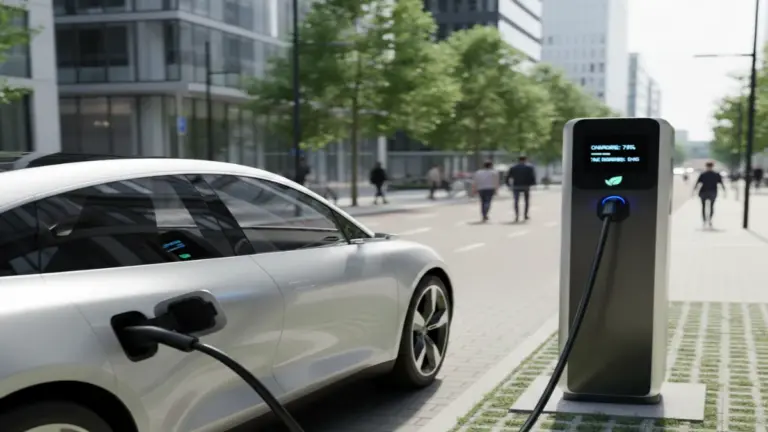
One of the biggest myths I hear is that charging is a hassle. For most EV owners, it’s actually simpler than fueling a gas car. You plug in at home overnight — just like your phone — and wake up with a full “tank” every morning. Level 2 home chargers (240V) typically add 25–30 miles of range per hour, meaning an overnight charge covers the average driver’s weekly needs.
For longer trips, DC fast chargers on networks like Tesla Supercharger (now open to most EVs), Electrify America, and EVgo can replenish 150–200 miles in around 20–30 minutes. The network has expanded dramatically: the U.S. hit over 192,000 public charging ports by early 2025, with more coming online every month.
Cost to Own
Here’s where it gets compelling. Yes, EVs often carry a higher sticker price — though the gap is narrowing fast. But the lifetime cost picture shifts considerably:
| Cost Factor | EV | Gas Vehicle |
|---|---|---|
| Fuel cost (per mile, avg.) | ~$0.03–0.05 | ~$0.12–0.16 |
| Annual maintenance | ~$400–600 | ~$900–1,200 |
| Federal tax credit (2025) | Up to $7,500 | None |
| State incentives | Varies ($500–$5,000) | Rare |
Over five years of ownership, many EV drivers save $8,000–$12,000 compared to equivalent gas vehicles, even accounting for the higher purchase price.
Hybrid and Plug-In Hybrid Vehicles: The Best of Both Worlds
Not ready to commit fully to electric? Hybrids offer a smart middle ground — and they’ve gotten genuinely excellent.
Standard hybrids (like the Toyota Camry Hybrid or Honda CR-V Hybrid) combine a gas engine with an electric motor to dramatically improve fuel efficiency. You never plug them in — the battery charges through regenerative braking and the gas engine. Expect 45–55 mpg in real-world driving, compared to 28–35 mpg for a typical gas equivalent.
Plug-in hybrids (PHEVs) take it a step further. Models like the Toyota RAV4 Prime or Hyundai Tucson PHEV offer 30–50 miles of pure electric range, meaning many drivers can handle their entire daily commute on electricity alone — then tap the gas engine for longer trips without any range anxiety.
PHEVs are particularly compelling if you live in an apartment or somewhere without easy home charging access. You get meaningful emission reductions without fully depending on public charging infrastructure.
E-Bikes: The Underrated Game-Changer
I’ll be honest — when e-bikes first started gaining traction, I was skeptical. Now, after spending considerable time on them, I think they’re one of the most underappreciated green transportation solutions available, especially for urban and suburban riders.
An electric bicycle uses a battery-powered motor to assist your pedaling, letting you cruise at 15–28 mph without breaking a sweat. Modern e-bikes have a range of 30–80 miles per charge, cost just a few cents to recharge, and often allow you to bypass traffic entirely.
Why E-Bikes Work So Well
For trips under 10 miles — which represents a huge percentage of urban car trips — an e-bike can often be faster than a car once you factor in parking. They require no registration, minimal maintenance, and produce zero direct emissions.
The upfront cost has also dropped significantly. Quality commuter e-bikes now start around $800–$1,500, with premium models from brands like Trek, Specialized, and Rad Power Bikes ranging up to $3,000–$5,000. Many cities and states offer rebates of $200–$1,000 to offset the purchase price.
If you’re commuting 5–15 miles each way in a city or suburb, an e-bike might honestly save you more money and time than any other option on this list.
Public Transit: The Greenest Option Per Passenger
Here’s a fact that often surprises people: public transit — buses, trains, and subways — remains the most carbon-efficient transportation option per passenger mile, even when compared to electric vehicles.
A fully occupied commuter rail line can move people at a fraction of the emissions of any individual vehicle, electric or otherwise. If you have good transit access, using it consistently is one of the most impactful transportation choices you can make.
Making Transit Work for You
The challenge, of course, is that transit quality varies enormously depending on where you live. If you’re in a city like New York, Chicago, Boston, or the Bay Area, you likely have robust options. In suburban and rural areas, it’s a different story.
Some practical ways to maximize transit:
- Combine modes: Take transit for the long haul, then walk, bike, or e-scooter the last mile
- Use commuter rail tax benefits: Many employers offer pre-tax transit benefits (up to $315/month in 2025)
- Track schedules with apps: Google Maps, Transit App, and Moovit make real-time tracking easy
- Consider a monthly pass: Usually 20–40% cheaper than daily fares
Transit agencies across the U.S. are also aggressively electrifying their fleets. As of 2025, cities like Los Angeles, Seattle, and New York have committed to 100% zero-emission bus fleets by 2040, making public transit even cleaner over time.
Car-Sharing, Carpooling, and Ride-Sharing
Sometimes you need a car but don’t need to own one — and that’s perfectly okay.
Car-sharing services like Zipcar and GIG Car Share let you rent vehicles by the hour or day. Studies have consistently shown that each shared car replaces 9–13 privately owned vehicles, dramatically reducing the total number of cars on the road. If you’re a low-mileage driver, this can be cheaper than ownership while still giving you access to a vehicle when you need one.
Carpooling is simple but effective. Sharing a ride with even one other person cuts your per-person emissions in half. Apps like Waze Carpool, Scoop, and employer-run rideshare programs make matching easy. Some cities and states also offer HOV lane access and parking discounts to incentivize carpooling.
Ride-hailing services (Uber, Lyft) are a mixed bag environmentally — they work best when pooling multiple riders and worst when driving empty between trips. Both companies have pledged electric vehicle transitions by 2030, which will improve their emissions profile significantly.
Walking and Cycling: Zero Emissions, Maximum Health Benefits
It almost goes without saying, but walking and traditional cycling produce zero emissions, cost almost nothing to operate, and offer substantial health benefits. The American Heart Association notes that regular moderate exercise — like a 20-minute bike commute — meaningfully reduces the risk of cardiovascular disease, diabetes, and depression.
If your home, workplace, and errands are within a reasonable distance, human-powered transportation deserves serious consideration. Many people find that replacing just two or three car trips per week with walking or cycling makes a noticeable difference in both their carbon footprint and their mood.
Urban infrastructure is improving, too. U.S. cities added over 1,500 miles of protected bike lanes between 2022 and 2024, with more planned under federal infrastructure funding. Bikeshare programs like Citi Bike (New York), Divvy (Chicago), and Capital Bikeshare (D.C.) offer convenient access without the need to own or store your own bike.
How to Choose the Right Eco-Friendly Option for You
Every person’s situation is different, and the “best” green transportation choice depends on your specific circumstances. Here’s a simple framework to help:
Ask yourself:
- How far do you travel daily? Under 10 miles → e-bike or walking may be ideal. 10–40 miles → EV or PHEV shines. Longer → consider EV + fast charging or transit for portions.
- Do you have home charging access? Yes → BEV makes strong sense. No reliable home charging → PHEV or hybrid is a smarter bet.
- Do you live in a dense urban area? Transit, cycling, and car-sharing often outperform ownership in cities.
- What’s your budget? E-bikes and transit passes offer dramatic emission reductions at the lowest upfront cost. EVs require more investment but pay back over time.
You don’t have to pick just one option, either. A combination — like commuting by e-bike on good weather days, taking transit on bad weather days, and owning an EV for longer trips — often produces the best environmental and financial outcome.
The Road Ahead: What’s Coming in Eco-Friendly Transportation
The next five years look genuinely exciting. Battery costs continue to fall — analysts at BloombergNEF project that EVs will reach price parity with gas vehicles (before incentives) sometime between 2026 and 2028. Solid-state batteries, which promise higher energy density and faster charging, are entering initial production at Toyota and several other manufacturers.
Electric aviation is making early strides for short-haul routes. Electric ferries are already operating in Scandinavia and beginning to appear in U.S. coastal cities. And hydrogen fuel cell vehicles, while still niche, continue developing for long-haul trucking applications.
The trajectory is clear: cleaner, cheaper, and more convenient transportation options are on the way. The question is which ones you want to take advantage of now.
Key Takeaways
- Transportation accounts for ~29% of U.S. greenhouse gas emissions — your choices here matter enormously
- Battery EVs offer the biggest emission reduction for regular drivers, with improving range, charging speed, and falling costs
- PHEVs and hybrids are an excellent middle ground, especially without reliable home charging
- E-bikes are one of the most cost-effective and practical options for urban and suburban commuters
- Public transit remains the most efficient per-passenger option — use it when accessible
- Walking and cycling produce zero emissions and offer significant health co-benefits
- The best strategy is often a combination of modes, matched to your specific daily needs
The transition to greener transportation doesn’t have to happen all at once. Start with one change — swap a few car trips for an e-bike ride, look into a transit pass, or start researching EVs in earnest. Each step adds up, and the options available in 2025 make that first step easier than it’s ever been.