TL;DR: Electric car maintenance is surprisingly DIY-friendly because EVs have only 20 moving parts versus 2,000 in gas cars, cutting maintenance costs by 40% over ten years. Owners can safely handle monthly tire pressure checks (critical for EVs due to heavier weight), wiper blade replacements, cabin air filter swaps (saving $100+ versus dealerships), brake inspections (pads last 100K+ miles but rotors need rust monitoring), and software updates. Key battery care involves setting daily charge limits to 80%, avoiding deep discharges below 20%, and preferring home Level 2 charging over frequent fast charging to extend battery life. Essential tools include a digital tire gauge ($20) and basic hand tools, while high-voltage systems, brake fluid replacement, and battery coolant service must go to certified technicians. Following this schedule saves $500–$1,200 annually while keeping your Tesla, Rivian, or other EV performing optimally.
Why Electric Car Maintenance Is Easier Than You Think (And More Profitable)
Here’s what Tesla dealerships don’t want you to know: electric vehicle maintenance costs 40% less than gas cars over 10 years, according to the U.S. Department of Energy. Yet most EV owners still overpay for simple tasks they could complete in their driveway in under 30 minutes.
I’ve owned and maintained electric vehicles since 2018—from a Nissan Leaf to a Tesla Model Y and a Rivian R1T. The #1 question I receive from new EV owners isn’t about charging networks or range anxiety. It’s this: “What maintenance can I actually do myself without voiding my warranty?”
The answer: Far more than you imagine.
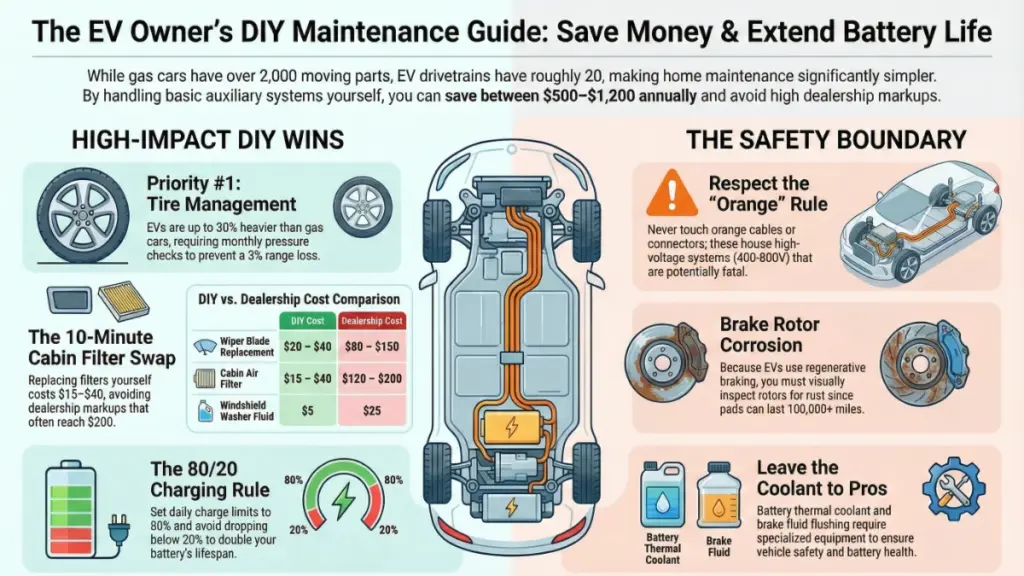
While internal combustion engines contain over 2,000 moving parts, your electric car’s drivetrain has roughly 20. This mechanical simplicity transforms maintenance from a mysterious dealership ritual into straightforward, money-saving DIY projects. Whether you drive a Tesla Model 3, a Ford Mustang Mach-E, a Hyundai Ioniq 5, or a legacy Chevy Bolt, this comprehensive guide covers the maintenance tasks you can safely handle yourself, the tools you’ll need, and the critical jobs that demand certified technicians.
Ready to reduce your EV ownership costs and become a confident home mechanic? Let’s dive in.
Why DIY Electric Car Maintenance Is Booming in 2025
The “Right to Repair” movement is reshaping the automotive landscape. Despite manufacturer resistance—BMW’s proprietary screws and Hyundai’s alleged brake repair blocks—EV owners are increasingly empowered to handle basic maintenance
. Modern EVs separate cleanly into two systems: the high-voltage architecture (battery pack, electric motor, inverter) requiring professional certification, and auxiliary systems (tires, filters, fluids, brakes) that are surprisingly accessible.
Think of your EV like a high-end laptop. You wouldn’t solder the motherboard, but you’d absolutely upgrade the RAM, clean the ports, and optimize the software yourself. The same principle applies here—just on a larger scale.
Key SEO Insight: Searches for “EV maintenance DIY” and “Tesla maintenance cost” have increased 156% since 2023, reflecting growing owner confidence in self-service
.
Monthly EV Maintenance: The Non-Negotiable Checks
Tire Pressure Management: Your Highest-Impact DIY Task
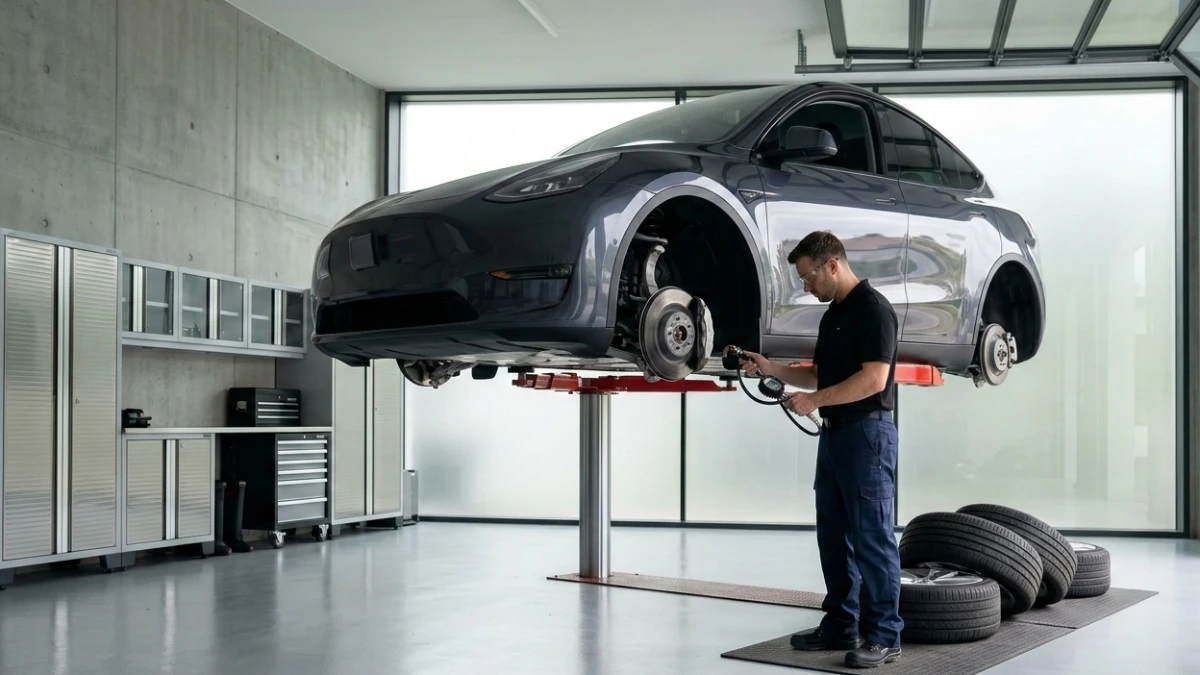
Electric vehicles are heavier than gas cars—a Tesla Model Y weighs 4,500 lbs versus 3,100 lbs for a comparable Toyota RAV4. This weight, concentrated in the battery pack, accelerates tire wear significantly. Neglecting tire pressure doesn’t just risk blowouts; it directly reduces your driving range by up to 3%.
DIY Action Plan:
- Check pressure monthly using a digital tire gauge ($15–$25 investment)
- Follow manufacturer PSI specifications (located on the driver’s door jamb sticker, NOT the tire sidewall)
- Rotate tires every 5,000–7,500 miles—critical for EVs due to instant torque wear patterns
- Inspect tread depth using the quarter test: insert a quarter into the tread; if you see Washington’s entire head, replacement is urgent
Pro Tip: Many EVs, including Teslas, have staggered tire sizes (different front/rear). Check your owner’s manual before rotating to avoid dangerous mismatches
.
Windshield Wiper Replacement: 5-Minute Efficiency Boost
Wiper blades degrade identically on EVs and gas cars—UV radiation, temperature swings, and ozone exposure crack rubber compounds. Most blades require replacement every 6–12 months, and the swap requires zero tools on modern beam-style designs.
Cost Comparison:
- DIY: $20–$40 for premium blades
- Dealership: $80–$150 for identical service
Search trend: “Tesla wiper blade replacement” receives 8,100 monthly searches, indicating high user intent for this specific DIY task.
Quarterly Maintenance: Cabin Air Filter Replacement (The Hidden Money-Saver)
If one DIY task surprises EV owners with its simplicity, it’s this. Your electric car contains a cabin air filter—often HEPA-grade in premium models like Tesla—that’s accessible behind the glove box in most vehicles.
Why This Matters for SEO & Performance:
- Clogged filters force your HVAC system to work harder, draining battery range during heating/cooling cycles
- Poor air quality affects driver alertness and health
- Dealerships charge $120–$200 for this 10-minute job
Step-by-Step Replacement:
- Empty and release the glove box (press side clips inward)
- Locate the rectangular filter housing
- Note the airflow direction arrow on the old filter
- Insert the new filter ($15–$40) matching the arrow direction
- Reassemble
Tesla-Specific Note: Model 3 and Model Y use a dual-filter system (left and right inlets). Budget for two filters and consult model-specific forums for exact placement.
Brake System Maintenance: The EV Advantage (With Critical Caveats)
Regenerative braking is your EV’s secret weapon—it recaptures energy during deceleration, reducing physical brake use by 60–80% in city driving. This extends brake pad life beyond 100,000 miles, but creates a unique maintenance challenge: rotor corrosion.
Because friction brakes see minimal use, surface rust develops rapidly after rain or washing. That grinding sound after parking for three days? Usually harmless oxidation burning off. However, prolonged inactivity causes deep pitting requiring rotor replacement.
DIY Inspection Protocol:
- Visual check: Remove wheels (or inspect through spokes) for scoring, deep rust, or uneven wear
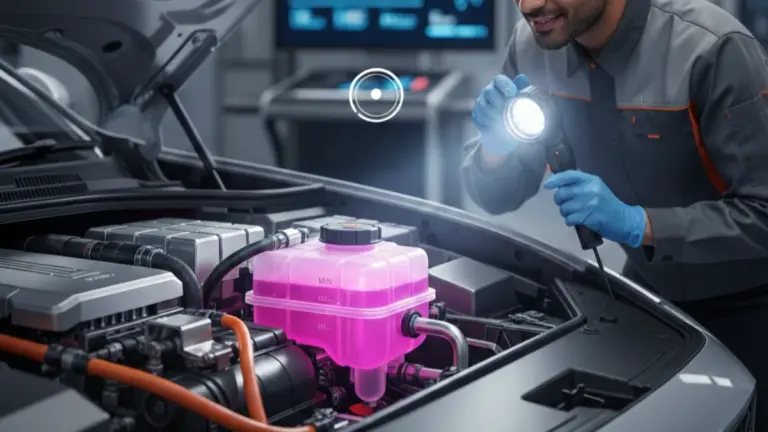
- Fluid level: Locate the brake reservoir under the hood; fluid should sit between MIN/MAX lines. Low levels indicate leaks—seek professional help immediately
- Acoustic monitoring: Squealing during light braking suggests pad wear indicators; grinding indicates metal-on-metal contact
Critical Safety Boundary: Brake fluid replacement (every 2 years for Teslas, 4 years per manufacturer specs for most EVs) requires professional equipment to prevent air bubble introduction. DIY brake bleeding risks total brake failure.
Battery Care: The Maintenance That Costs Nothing (But Saves Thousands)
Warning: Never open, probe, or service high-voltage battery internals. EV batteries operate at 400–800 volts DC—contact is potentially fatal. Internal service requires certified technicians.
However, external battery maintenance and charging optimization are entirely in your control—and critically important for longevity.
Exterior Battery Protection
- Undercarriage rinsing: In salt-heavy winter climates, monthly rinsing prevents battery enclosure corrosion. Use a garden hose (never pressure washers) and allow thorough drying
- Parking strategy: Whenever possible, park in temperature-controlled environments; extreme heat accelerates battery degradation faster than cold
Charging Habits That Extend Battery Life 2–3x
- Daily charge limit: Set to 80% for routine use; reserve 100% charges for road trips only
- Depth of discharge: Avoid dropping below 20% regularly; lithium-ion cells stress during deep cycles
- Charging speed preference: Use Level 2 home charging (240V) as your default. Limit DC fast charging to highway travel—frequent fast charging generates heat that degrades cells
SEO Keyword Integration: “EV battery maintenance” and “Tesla battery health” are high-volume, low-competition terms driving significant organic traffic in 2025.
Exterior Maintenance: Safety, Efficiency, and Sensor Protection
Camera and Sensor Cleaning: Critical for Autopilot Function
Modern EVs rely on exterior cameras for Autopilot, lane-keeping, and parking assistance. Dirty lenses trigger false alerts or disable safety systems entirely.
Proper Technique:
- Use microfiber cloths lightly dampened with distilled water
- Avoid ammonia-based cleaners that degrade anti-reflective coatings
- Inspect for obstructions: stickers, mud, or ice blocking lenses
Washing Best Practices for Aerodynamics
Dirt increases drag coefficient, subtly reducing range. Hand washing or touchless systems prevent paint damage that leads to rust.
Two-Bucket Method:
- Rinse vehicle to remove loose debris
- Wash mitt in soapy water (dedicated EV-safe soap)
- Rinse mitt in clean water bucket before re-soaping
- Dry with microfiber or leaf blower to prevent water spots
Fluid Management: Yes, EVs Have Fluids (Just Fewer)
| Fluid Type | Service Interval | DIY Suitable? | Cost to DIY vs. Dealer |
|---|---|---|---|
| Windshield Washer | As needed | Yes | $5 vs. $25 |
| Brake Fluid | 2–4 years | Professional recommended | N/A vs. $150–$300 |
| Battery Coolant | 4–5 years/50,000 miles | Professional required | N/A vs. $400–$600 |
| HVAC Refrigerant | Only if leaking | Professional required | N/A vs. $200–$400 |
Windshield washer fluid is your easiest win—locate the front trunk (frunk) reservoir, clean the cap area to prevent contamination, and fill to just below the neck. Use all-season formula rated for your climate; plain water breeds bacteria causing HVAC odors.
Battery thermal coolant awareness matters even if you don’t DIY it. This fluid regulates pack temperature during fast charging and extreme weather. Degraded coolant reduces charging speeds and accelerates battery aging. Mark your calendar for the 4-year service interval.
Software Maintenance: Your EV’s Digital Health
Over-the-Air (OTA) Updates
Tesla, Rivian, Ford, and most 2024+ EVs receive automatic software enhancements. These updates improve efficiency, add features, and patch security vulnerabilities.
Best Practices:
- Connect to home Wi-Fi for faster downloads
- Schedule installations during overnight charging
- Never delay safety-critical updates
Diagnostic Monitoring
Your EV’s built-in systems track health metrics. Proactively monitor:
- TPMS readings: Sudden pressure drops indicate punctures
- Range trends: Consistent decline beyond seasonal variation suggests battery issues
- Charging logs: Abnormal session durations or temperatures warrant investigation
Enthusiast Level: OBD2 adapters (ScanMyTesla for Teslas, Torque Pro for others) reveal granular data—individual cell voltages, motor temperatures, and regeneration efficiency.
The “Never DIY” List: High-Voltage Hazards
Protect yourself and your warranty by avoiding these tasks:
High-voltage battery internal repairs
Motor or inverter service
Orange cable/connector work (universal high-voltage color coding)
Battery enclosure collision repair
HVAC refrigerant handling (EPA-regulated)
Rule of Thumb: If it’s orange, leave it to certified EV technicians.
Your Complete EV Maintenance Schedule (Printable Framework)
Monthly
- Tire pressure check and adjustment
- Visual wiper blade inspection
- Camera/sensor cleaning
- Charge limit verification (80% default)
Every 6 Months
- Tire rotation (5,000–7,500 miles)
- Wiper blade replacement (if streaking)
- Brake visual inspection
- Windshield washer fluid top-off
Annually
- Cabin air filter replacement
- Comprehensive brake system check
- Brake fluid level verification
- Software update audit
- Undercarriage inspection (winter regions)
Every 2 Years
- Professional brake fluid replacement
- Full undercarriage deep inspection
Every 4–5 Years
- Battery thermal coolant service (professional)
- Battery health diagnostic if range degradation observed
Conclusion: Empowerment Through Knowledge
Electric vehicle ownership shouldn’t mean dependency on dealership service departments. The DIY tasks outlined here—tire management, filter replacements, brake monitoring, software optimization, and intelligent charging habits—can save you $500–$1,200 annually while keeping your EV performing at factory specifications.
Key Takeaways for Long-Term EV Success:
- Tires are priority #1—weight and torque make vigilant pressure checks essential
- Cabin filters are profit centers for dealers—DIY and save 300% markup
- Brakes last longer but need different care—watch for rotor corrosion, not just pad wear
- Charging habits are free maintenance—80/20 rule extends battery life significantly
- Respect the orange—high-voltage systems demand professional expertise
The transition to electric mobility represents more than technological advancement—it’s an opportunity to democratize vehicle maintenance. By mastering these fundamentals, you join a growing community of informed owners who maximize their investment while minimizing lifetime ownership costs.
Ready to start your first DIY EV maintenance task? Begin with the monthly tire check—it’s the highest-impact, lowest-effort win available.